Verdict
Peec is the middle ground: more diagnostic than Otterly.AI, more accessible than Profound, and best for ecommerce teams that already have a content or SEO owner. Shortlist it if you track real competitors and recurring AI-search prompts. Skip it if you only need a one-time ChatGPT check or no one owns the follow-up work.
The buying reason is not just another visibility score. It is Peec’s source and citation workflow. For ecommerce, the useful question is rarely “what is our AI visibility percentage?” in isolation. The better question is: which sites, product pages, Reddit threads, reviews, comparison pages, and competitor assets are AI engines using as evidence instead of us? Peec is built around that question more clearly than most entry-level tools.
This is still a researched review, not a live-account test. Based on Peec’s public pages and docs, the product looks strongest for monitoring, competitor benchmarking, source diagnostics, and prompt organization.
What Peec AI Does
Peec AI is an AI search analytics platform for tracking how your brand appears across answer engines. The public product and pricing pages position it around visibility, position, sentiment, prompts, competitors, sources, and actions.
For an ecommerce team, that translates into five jobs:
- Track a defined set of buyer prompts over time.
- See whether your brand, products, and competitors are mentioned.
- Compare visibility, rank, and sentiment across AI engines.
- Inspect which domains and URLs AI answers use as evidence.
- Turn source gaps into owned-content and earned-media priorities.
The core self-serve model is prompt-based. Peec’s current public pricing page lists Starter at 50 prompts, Pro at 150 prompts, and Advanced at 350 prompts, with three selected models included on those tiers. The available self-serve model set shown publicly includes ChatGPT, AI Mode, AI Overviews, Microsoft Copilot, Perplexity, and Gemini, while Enterprise expands to all models and adds API access and SSO.
The important mental model is simple: Peec is not measuring all possible AI discovery. It is measuring the prompts, markets, models, and competitors you configure. That makes prompt design the real input quality problem.
For ecommerce, the useful mapping is:
| Peec AI workflow | What it maps to in a Shopify or DTC team | Output to assign |
|---|---|---|
| Prompt tracking | Category, comparison, attribute, and branded-trust buyer questions | A recurring prompt set for one product category or buying journey |
| Source analysis | Product pages, category pages, reviews, Reddit, YouTube, publishers, and competitor pages | A list of cited domains and URLs that explain why AI engines recommend one brand over another |
| Competitor benchmarking | Real buyer alternatives, not just SEO keyword competitors | Prompts where a competitor wins and the evidence source that helped it win |
| Actions | Owned-content fixes, technical cleanup, review collection, and third-party outreach | Tasks for content, merchandising, SEO, PR, or review-generation owners |
| Reports and exports | Weekly AI visibility review for founders, growth leads, or agency clients | A decision log showing which gaps were acted on and what changed after reruns |
Prompt Tracking
Peec treats prompts like conversational AI-search questions, not traditional keywords. That matters because a shopper does not ask an assistant “litter box keywords.” They ask:
- “best automatic litter box for a small apartment”
- “quiet litter box for two cats under $500”
- “Litter-Robot vs Whisker & Co. for odor control”
- “what do reviews say about Whisker & Co.?”
Those are the units Peec is designed to run repeatedly across AI engines. Public docs also show support for prompt suggestions, tags, topics, prompt archiving, and prompt organization. That is the workflow upgrade over a spreadsheet: the same question can be monitored consistently instead of retyped manually whenever someone remembers.
For ecommerce, I would not let Peec generate the whole measurement plan. I would start from the 50 AI search prompts for ecommerce and cut them down to the questions a real buyer would ask before choosing a product this month:
| Prompt bucket | What to track first | Why it matters |
|---|---|---|
| Category discovery | ”best [product category] for [use case]“ | Tests whether AI engines know you as a category option. |
| Attribute prompts | ”quiet”, “durable”, “for small apartments”, “for sensitive skin” | Matches how shoppers describe needs, not how brands describe SKUs. |
| Comparison prompts | ”[your brand] vs [competitor]“ | Reveals which third-party sources frame the buying decision. |
| Branded trust prompts | ”is [your brand] legit?” | Finds reputation, review, and entity-consistency problems. |
| Post-purchase prompts | ”replacement parts”, “returns”, “warranty” | Catches support and policy facts AI engines may summarize badly. |
The trap is overloading the first project. If you have 50 prompts and three models, every prompt costs attention. A cleaner first setup is 20 to 30 prompts around one product category, three to five competitors, and the engines your buyers are most likely to use. For a seller, that means one buying journey you can actually improve, not a vanity map of every possible prompt.
Peec’s visible pricing structure also makes prompt limits a buying constraint. Starter’s public page currently lists 50 prompts, which is enough for one serious category baseline. It is not enough for every product line, every country, and every funnel stage at once.
Source & Citation Analysis
This is the main reason Peec belongs in the conversation.
AI visibility is not only about whether a model names your brand. It is also about where the model learned the answer. For ecommerce, those sources can be your own product pages, category pages, reviews, Reddit threads, YouTube videos, G2-style listings, affiliate roundups, publisher reviews, comparison pages, or competitor pages.
Peec’s docs and public materials frame source analysis as a core workflow: domains, URLs, source reports, citation visibility, domain classification, URL classification, and gap analysis. The practical question is: which sources are shaping AI answers, and are we present in them?
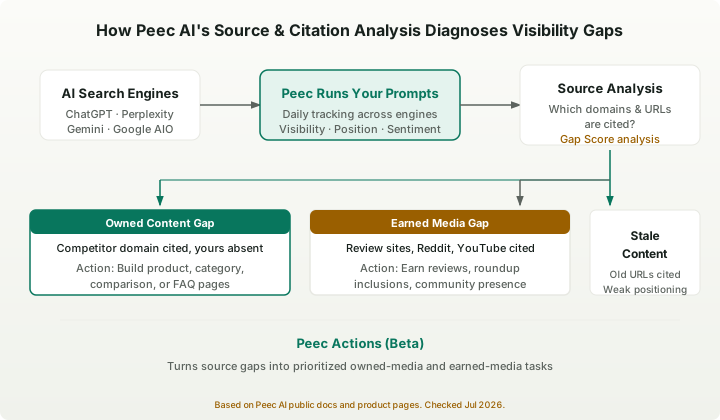
That distinction matters because a store can lose AI visibility in several different ways:
- AI engines cite your own site, but the answer still recommends a competitor.
- AI engines mention your brand, but cite a third-party page with old pricing or weak positioning.
- AI engines cite Reddit, YouTube, or review sites where your brand has no meaningful presence.
- A competitor is mentioned because a comparison article or category roundup includes them and excludes you.
- Your product page is crawlable, but it lacks the attributes the answer needs: size, materials, warranty, stock, use case, or review evidence.
Peec’s source view is useful because it can turn “we are invisible” into a more specific diagnosis:
| Source pattern | Ecommerce interpretation | Likely next action |
|---|---|---|
| Competitor domain cited, your domain absent | Their owned pages answer the prompt better. | Build or improve product, category, comparison, or FAQ content. |
| Review sites cited, your brand absent | AI trusts third-party evidence in the category. | Earn inclusion in credible reviews, roundups, and buyer guides. |
| Reddit/UGC cited heavily | Community language is shaping the answer. | Study objections, collect real reviews, and participate without astroturfing. |
| Your page cited with weak sentiment | The source exists, but the framing is not helping. | Clarify positioning, specs, reviews, and trade-offs on the cited page. |
| Old or irrelevant URLs cited | AI has a stale or confused mental model. | Refresh pages, consolidate duplicates, and strengthen internal/entity signals. |
This is where Peec can justify costing more than a basic tracker. A visibility score tells you the scoreboard. Source analysis tells you where the game is being played.
Competitor Benchmarking
Peec also supports competitor tracking and benchmarking. Public docs mention competitor identification, brand suggestions, manual brand creation, and reports for brands. The content brief also notes Peec-style classification into Leaders, Niche Players, and Laggards.
For an ecommerce operator, I would use those labels carefully. They are useful as a map, not a final verdict; the point is to see which competitor is winning the shopper’s question and which source helped them win it.
| Segment | What it usually means | What to do next |
|---|---|---|
| Leaders | A brand is repeatedly named and cited across the prompt set. | Inspect the prompts and sources where it wins; do not copy the brand blindly. |
| Niche Players | A brand wins narrow prompts, attributes, or use cases. | Decide whether that niche is strategically worth pursuing. |
| Laggards | A brand rarely appears or appears with weak positioning. | Fix entity basics, owned content, product data, and third-party proof before buying more tracking. |
The ecommerce-specific move is to define competitors by buyer reality, not just SEO keyword overlap. A DTC pet brand may compete with another DTC brand, Amazon listings, Wirecutter-style roundups, Reddit consensus, a category marketplace, and a legacy retailer at the same time. I would review the benchmark as a merchandising and content input: where are buyers being sent, what evidence is missing from our pages, and which third-party sources deserve outreach?
Actions
Peec’s Actions feature is described as a way to translate source-level data into opportunities to improve AI visibility. I would treat it as a useful prioritization layer, not as an autopilot.
Based on the public docs and research brief, the promise is sensible: if a competitor is cited from a source where your brand is absent, Peec can turn that into an action. Some actions are owned-media work, such as creating a better comparison page or improving category content. Others are earned-media work, such as getting mentioned on a review site, community thread, or publisher page that AI engines already use.
That is exactly the right direction for ecommerce GEO. But the beta label matters. A recommendation is only as good as the prompt set, competitor set, and source classification underneath it. Peec may surface the gap; it will not negotiate a publisher mention, rewrite your PDP, fix your schema, or collect better customer reviews.
I would use Actions like this:
- Sort by the highest-impact prompts first.
- Separate owned fixes from earned-media gaps.
- Check the actual source page before assigning work.
- Convert each finding into a content, technical, review, or outreach task.
- Rerun the same prompts over several weeks before judging impact.
That turns Peec from a dashboard into a weekly operating rhythm.
Pricing and Value
Peec pricing needs a careful read because public sources vary.
Peec’s current public pricing page clearly shows plan structure and quotas, but exact visible prices can vary by source, timing, region, and signup flow. On the public page checked for this review, the useful facts are the plan limits:
| Plan | Publicly visible quota | Practical read |
|---|---|---|
| Starter | 50 prompts, 3 selected models, 1 project, daily tracking | One serious ecommerce category baseline. |
| Pro | 150 prompts, 3 selected models, 2 projects, daily tracking | Better for a team tracking several prompt groups. |
| Advanced | 350 prompts, 3 selected models, 5 projects, multi-country, Looker Studio | More realistic for agencies or larger content teams. |
| Enterprise | Custom, all models, unlimited projects, API, SSO | For organizations that need integrations, governance, and broader coverage. |
Third-party pricing references are inconsistent. The research brief found public sources citing roughly $49/month for a Lite-style plan, around $100/month for Starter, and higher tiers around the low-to-mid hundreds per month. Peec’s pricing page also notes a 15% annual billing discount and says pricing is based on prompts and analyzed models.
The buyer takeaway: do not budget from a single screenshot or old review. Treat Starter as roughly the $49-$100/month zone until checkout or sales confirms the current number. Then check three things before paying:
- How many prompts are active on your chosen plan?
- Which three models can you select?
- What happens if you need another model, country, project, export, or API access?
For a small DTC store, Peec is not a casual impulse buy if Otterly.AI or a spreadsheet would answer the immediate question. For a content-led brand already investing in GEO work, the value is plausible because one good source-gap finding can change a content roadmap.
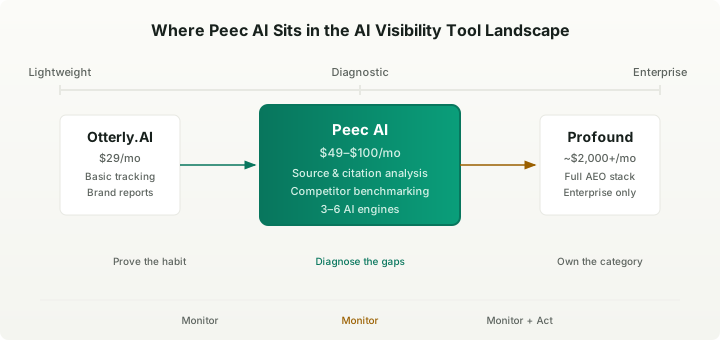
Peec AI vs Otterly.AI
Otterly.AI is the easier first paid step. Peec AI looks like the more serious middle step when source analysis and competitor diagnostics matter more than a low entry price.
| Decision point | Otterly.AI | Peec AI |
|---|---|---|
| Best first buyer | Solo seller or small team trying paid monitoring for the first time | Mid-market brand, content team, or agency with a defined prompt strategy |
| Entry cost | Lower public entry point | Higher and less transparent public pricing signals |
| Prompt workflow | Friendly report workflow; prompt quality still needs human editing | More structured prompt/project/model workflow, with higher Starter quota visible publicly |
| Source/citation depth | Useful citations for GEO planning | Stronger emphasis on source domains, URLs, classifications, and citation gaps |
| Competitor work | Good for basic brand reports and comparisons | Better fit for ongoing share-of-voice and source-gap benchmarking |
| Ecommerce execution | Monitoring and recommendations, not store-native execution | Monitoring plus richer diagnostics, still not store-native execution |
| Integrations | More accessible lower-tier reporting in public pricing | Looker Studio on Advanced, API/SSO at Enterprise based on public pricing |
| Best use | Prove the habit and learn your prompt set | Operationalize AI visibility once the prompt set matters every week |
So what does the extra money buy? Mostly diagnosis quality.
With Otterly.AI, I would expect a small seller to learn: “Are we named, are competitors named, and which prompts create the gap?” With Peec, I would expect a more mature team to ask: “Which cited sources make competitors win, what type of pages do AI engines trust, and which owned or earned assets should we prioritize next?”
If you cannot act on that second question, save the money. If you can, Peec is the more interesting tool.
Peec AI vs Profound
Profound is the enterprise comparison point. Peec is not trying to be the full AEO operating system Profound sells to large brands, but that is exactly why it can be a better fit for ecommerce teams that need diagnosis before enterprise governance.
| Decision point | Peec AI | Profound |
|---|---|---|
| Best buyer | DTC teams, content leads, SEO owners, and agencies that need recurring source diagnostics | Enterprise brands and agencies with budget for a broader AEO platform |
| Buying motion | Public self-serve tiers plus enterprise options, with pricing details that still need checkout confirmation | Sales-led enterprise contracts with opaque pricing |
| Core strength | Prompt monitoring, source/citation analysis, competitor benchmarking, and action prioritization | Deeper platform architecture, Prompt Volumes, server-log crawler analytics, and creation workflows |
| Ecommerce fit | Practical middle option when a Shopify or DTC team can act on source gaps | Better for large retail programs that need board-level reporting and broader governance |
| Main risk | You still need humans to fix content, schema, reviews, and outreach | Overkill for smaller stores and teams that have not proved the AI visibility workflow yet |
The simplest split: use Peec when you want to know which prompts and cited sources deserve work next. Consider Profound when AI visibility is already a funded enterprise program and you need deeper data, integrations, governance, and executive reporting.
Ecommerce Use Cases
The best Peec setup is not “track everything.” It is a controlled monitoring system around a real buying journey.
Imagine a fictional DTC brand, Whisker & Co., selling premium litter boxes and accessories. A good first Peec project would not include every possible pet-care prompt. It would focus on one commercial cluster:
| Setup item | Whisker & Co. example |
|---|---|
| Project | US market, English, independent-site DTC brand |
| Models | ChatGPT, Perplexity, Google AI Overviews or AI Mode |
| Competitors | Litter-Robot, PetSafe, Amazon Basics, a top publisher/review site if relevant |
| Prompt count | 25 to 50 prompts, grouped by category, attribute, comparison, and branded trust |
| Source focus | Product pages, comparison articles, Reddit threads, YouTube reviews, pet publisher roundups |
From the 50-prompt ecommerce guide, I would start with a trimmed set like:
- “best automatic litter box for two cats”
- “quiet litter box for a small apartment”
- “self-cleaning litter box that controls odor well”
- “Litter-Robot vs Whisker & Co.”
- “what do reviews say about Whisker & Co.?”
- “is Whisker & Co. worth it compared with cheaper litter boxes?”
- “best litter box for a nervous cat”
- “which automatic litter boxes have the best warranty?”
Then I would read Peec in three layers:
- Brand layer: Does Whisker & Co. appear, and where does it rank?
- Source layer: Which pages or domains are cited when Whisker & Co. loses?
- Action layer: Which gaps are fixable by owned content, product data, review collection, or third-party coverage?
For an ecommerce team, this becomes a weekly meeting agenda:
- Which prompts did we lose this week?
- Which source types are driving those losses?
- Are we absent from review sites or community sources AI engines already trust?
- Are our own pages missing attributes, comparisons, warranty details, price clarity, or schema?
- Which fixes are worth putting into the next sprint?
That is where Peec makes sense: a diagnostic layer for teams already doing the work.
For a broader shortlist, compare Peec against the best AI visibility tools for ecommerce.
Limitations and Gaps
Peec’s biggest limitation is not that it lacks data. It is that data is not execution.
Here are the eight constraints I would check before buying:
| Limitation | Why it matters |
|---|---|
| Monitoring-first workflow | Peec can show what is happening, but your team still has to fix pages, earn mentions, and improve product evidence. |
| No proven AI traffic attribution in this review | Public materials do not prove that a Peec visibility gain maps cleanly to ecommerce revenue. |
| Prompt volume is still a hard constraint | Starter-level tracking can cover one category well, not a whole catalog across every market and model. |
| Public pricing signals vary | Third-party price references differ from each other, so confirm current checkout pricing before budgeting. |
| Extra models and advanced access can change the real cost | The useful engine mix may require plan decisions or add-ons. |
| API and SSO are Enterprise-level | Teams wanting automated workflows or governance may hit an enterprise wall. |
| Ecommerce-native depth is still unproven | Product catalog and AI Shopping docs exist, but this review does not verify live SKU workflows. |
| Actions are prioritization, not fulfillment | Recommendations still need human judgment, content production, technical fixes, and outreach. |
There is also a softer risk: Peec can make weak strategy look organized. If the prompt set is too broad, competitors are poorly chosen, or the team has no execution owner, the dashboard will produce charts without changing outcomes.
Who Should Use Peec AI?
Use Peec AI if AI visibility is now a real workstream, not a side curiosity.
It is especially sensible for:
- A DTC brand with an SEO or content lead responsible for AI visibility.
- A Shopify team tracking category, comparison, and branded trust prompts monthly.
- A brand that has outgrown manual prompt spreadsheets.
- An ecommerce agency managing visibility across several client projects.
- A team that needs to understand sources and citations, not just brand mentions.
- A mid-market company that cannot justify Profound but needs more depth than a starter tracker.
The best buyer already has the basics in motion: crawlability, product schema, category content, review collection, comparison pages, and a content calendar. Peec then tells that team where the gaps are.
Who Should Skip Peec AI?
Skip Peec AI for now if you have not done the free work.
If your product pages lack clean schema, prices, stock status, review markup, comparison language, return policy detail, or category context, a visibility tracker will mostly document predictable problems. Start with the GEO checklist for ecommerce first.
Also skip it if:
- You only need a one-time AI visibility check.
- You track fewer than 10 prompts.
- You do not know which competitors matter.
- You need Amazon Rufus, Walmart, or marketplace-native proof.
- You need direct revenue attribution from AI search.
- You expect the tool to write content, fix schema, or do outreach automatically.
- Pricing must be fully transparent before signup.
In those cases, a spreadsheet or cheaper starter tool is the cleaner first step.
Alternatives
- Otterly.AI - Better first paid step for solo sellers and small teams that want a lower-cost, self-serve AI visibility monitor.
- Alhena AI - Better if your team wants product-level AI visibility connected to an onsite shopping assistant and support automation.
- Profound - Better for enterprise brands and agencies that need the deepest AEO platform, broader engine coverage, Prompt Volumes, server-log crawler analytics, and enterprise governance.
- Triple Whale - Better if you want a free Shopify-native baseline before paying for source diagnostics.
- Manual prompt spreadsheet - Better when you have fewer than 10 to 15 prompts and have not yet proved the workflow is worth paying for.
- Traditional SEO tools - Still needed for technical SEO, keyword research, backlinks, site audits, and organic search diagnostics. Peec does not replace them.
Peec’s lane is the middle: more diagnostic depth than the starter tools and much more accessible than enterprise AEO.
Bottom Line
Peec AI is a strong shortlist candidate for ecommerce teams that have moved from “are AI engines mentioning us?” to “which sources make competitors win, and what should we fix next?”
That is a meaningful step up. Source and citation analysis is where AI visibility becomes operational, because it points beyond your own site into the messy evidence layer that assistants actually use: review sites, forums, YouTube, comparison pages, product data, and competitor content.
But do not buy Peec as a shortcut around strategy. Buy it when you have prompts worth tracking, competitors worth comparing, and someone accountable for turning gaps into work. For a solo seller, start cheaper. For an enterprise retail program, look at Profound. For the middle, Peec is one of the more practical options.
Sources Checked
This is a researched review based on public evidence checked through July 1, 2026. We did not test a live Peec AI account or verify a billing screen. Source references below are grouped by what they supported in the review, so readers can separate Peec’s own claims from third-party and Ecom AI Reviews analysis.
- Product positioning and feature surface: Peec AI official site.
- Plan limits, model selection, projects, Looker Studio, API, SSO, and annual-discount notes: Peec AI pricing page.
- Prompt setup, source analysis, actions, model channels, reports, API, shopping, and project workflows: Peec AI docs index and the public docs pages listed from that index.
- Pricing caveats and third-party signal checks: internal Ecom AI Reviews Peec evidence log and content brief, based on public pages, docs, third-party comparisons, and user-review research.
- Category comparisons and editorial benchmarks: Otterly.AI review, Profound review, 50 ecommerce AI search prompts, and best AI visibility tools.
Comments