EAR Ecom AI Reviews Independent · Rigorous · Ecommerce-first

Peec AI vs Triple Whale AI Visibility: Free Shopify Baseline or Paid Source Diagnostics?

Peec AI

8.1 /10

A clean monitoring-first option when you want share-of-voice data and will handle the strategy yourself.

Researched Jun 23, 2026
Pricing checked
Jun 23, 2026
Pricing transparency
partial
Store fit
Independent site
AI coverage
chatgpt, perplexity, google-aio, gemini

Prompt tracking · Citation tracking · Competitor tracking

Triple Whale

9.1 /10

The best first stop for ecommerce sellers because it starts free and speaks in products, citations, and revenue context.

Researched Jun 23, 2026
Pricing checked
Jun 23, 2026
Pricing transparency
partial
Store fit
Independent site
AI coverage
chatgpt, perplexity, google-aio

Prompt tracking · Citation tracking

Winner for...

Free first AI visibility check for a Shopify brand Triple Whale
Source and citation gap diagnostics Peec AI
DTC brand with a content or SEO owner who can act on findings Peec AI
Shopify brand that wants a no-cost baseline before committing Triple Whale
Team that needs competitor benchmarking and multi-engine monitoring Peec AI

Feature comparison

Feature Peec AI Triple Whale
Starting price $49–$100/mo (Starter, public sources vary) Free (Founders Dash)
AI engines ChatGPT, AI Mode, AI Overviews, Copilot, Perplexity, Gemini (3 selected on self-serve) ChatGPT confirmed; broader engine coverage not independently verified
Source analysis Domain + URL classification, Gap Score, citation visibility Owned-vs-earned citation split, source-type patterns
Competitor tracking Leaders / Niche / Laggards classification with source-gap benchmarking Weaker public signal; not a primary emphasis
Product shape Standalone AI search analytics platform Module inside an ecommerce analytics platform
Ecommerce-native No — general AI visibility tool Yes — built for Shopify and DTC teams
Prompt limits (entry) 50 prompts (Starter) Not publicly specified as a hard limit in the free tier
Best for Teams that need to diagnose which sources make competitors win Shopify brands that want a free first AI visibility read
Main risk Costs more and still requires human execution Narrow engine coverage and weaker diagnostics
In this comparison
  1. How to choose
  2. What the price gap actually buys
  3. Bottom line

How to choose

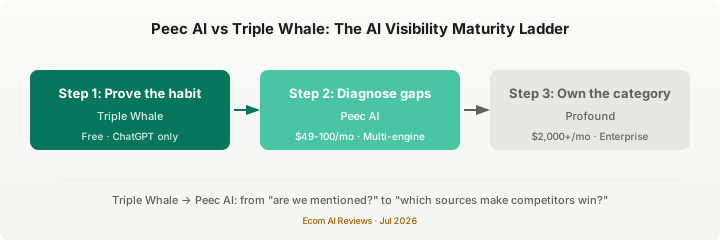
AI visibility maturity ladder showing Triple Whale as the free first step, Peec AI as the source diagnostics layer, and Profound as the enterprise category-ownership platform.
Figure 1. Triple Whale proves the habit; Peec AI turns the habit into diagnosis. Source: Ecom AI Reviews.

Peec AI and Triple Whale AI Visibility solve different versions of the same problem. Triple Whale answers “is ChatGPT mentioning us?” for free. Peec answers “which sources make competitors win, and what should we fix next?” for $49–$100/month.

Choose Triple Whale if you are a Shopify brand taking your first step into AI visibility. The free tier gives you a ChatGPT baseline without asking for budget approval. If the answer is “no, AI search does not mention us yet,” you have lost nothing. If the answer is “yes, and competitors are winning,” you have a reason to upgrade.

Choose Peec AI if you already know AI visibility matters and need to understand why — which domains, URLs, and content types AI engines cite, and which gaps explain why competitors keep showing up instead of you. Peec’s source analysis, Gap Score, and competitor benchmarking turn a visibility report into a content and outreach plan.

The maturity ladder is clean: Triple Whale proves the habit for free, Peec operationalizes it with diagnostics.

What the price gap actually buys
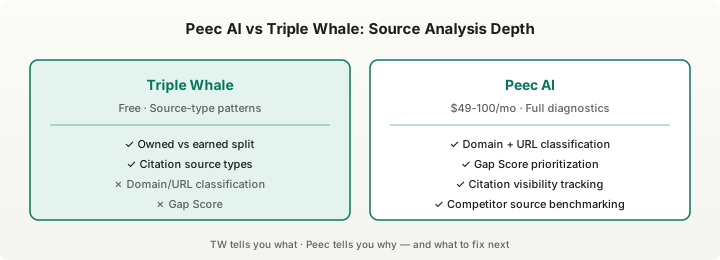
Source diagnostic depth comparison showing Triple Whale's free owned-versus-earned citation split and Peec AI's deeper domain, URL, source type, and competitor gap analysis.
Figure 2. The price jump buys source-level diagnosis, not just a different visibility score. Source: Ecom AI Reviews.

The difference between free and $49–$100/month is mostly diagnostic depth.

Triple Whale’s free tier gives you a yes/no on ChatGPT visibility, a rough owned-vs-earned citation split, and source-type patterns. That is enough to answer “should I care about this?”

Peec adds three things that justify the cost for a team ready to act:

  1. Source-level diagnosis. Peec tells you which specific domains and URLs AI engines cite, classifies them by type, and produces a Gap Score that ranks which missing citations hurt most. Triple Whale shows you the pattern; Peec shows you the list.

  2. Competitor benchmarking. Peec classifies competitors into Leaders, Niche Players, and Laggards based on citation data, and ties each competitor’s wins to the specific sources that helped them. Triple Whale’s competitor tracking is weaker — it is not a primary emphasis in the AI Visibility module.

  3. Multi-engine coverage. Peec tracks ChatGPT, Perplexity, Google AI Overviews, Copilot, and Gemini on self-serve plans. Triple Whale’s confirmed public coverage is ChatGPT. If your buyers use multiple AI engines, the gap matters.

If your team has not yet proved that AI visibility deserves a recurring workflow, save the money and start with Triple Whale. If you have a content or SEO owner who will turn source gaps into tasks every week, Peec’s extra depth pays for itself.
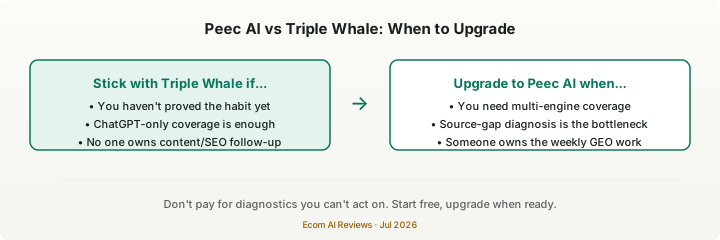
Upgrade decision map showing when to stay with Triple Whale for a free ChatGPT baseline and when to upgrade to Peec AI for source gaps, competitor benchmarking, and multi-engine monitoring.
Figure 3. Upgrade only when the team can turn source gaps into weekly content, SEO, review, or outreach work. Source: Ecom AI Reviews.

Bottom line

Triple Whale is the free baseline. Peec AI is the paid diagnostic layer. Start free, learn what you need, and upgrade when source and citation data becomes the bottleneck — not before.

Read our full reviews of Peec AI and Triple Whale, or see all four tools side by side in our best AI visibility tools for ecommerce.

Disclosure

Some tool links are affiliate links. We may earn a commission if you buy, at no extra cost to you.

Affiliate relationships never determine rankings, scores, inclusion, or whether we tell you to skip a tool. Buyer fit, evidence quality, pricing, and ecommerce usefulness come first.

FAQ

Which tool should a Shopify brand with a content team pick?+

Peec AI, if the team has someone who can turn source and citation gaps into content, review, PR, or technical work. Triple Whale's free tier is better as a first baseline, but Peec's diagnostics become more valuable once someone owns the follow-up.

Does Triple Whale's free tier do source analysis?+

Triple Whale shows owned-vs-earned citation splits and source-type patterns, which is useful for a free tool. Peec goes further with domain and URL classification, citation gap scoring, and competitor source benchmarking. If source diagnosis is your main workflow, Peec is the stronger tool.

Can a small DTC store justify Peec's price over a free tool?+

Only if the store has a team member who can act on source diagnostics. A solo seller who cannot turn gap findings into content or outreach work should start with Triple Whale's free tier and only upgrade when someone owns the execution.

Do both tools track the same AI engines?+

No. Peec covers ChatGPT, Perplexity, Google AI Overviews, Copilot, and Gemini with model selection on self-serve plans. Triple Whale's confirmed public coverage is centered on ChatGPT. Broader engine coverage for Triple Whale should be verified before relying on it.

Comments