Verdict
Triple Whale AI Visibility is the best free first stop for Shopify and DTC brands that want to know whether ChatGPT mentions them, cites them, and describes them accurately.
That does not make it the most complete AI visibility platform. It makes it the easiest serious on-ramp for ecommerce teams. If you run on Shopify and you have not measured AI visibility before, the free Founders Dash path is hard to argue with. You can learn whether this workflow matters before paying for a standalone GEO tool.
The catch is scope. Triple Whale’s confirmed public AI Visibility story is centered on ChatGPT: mentions, citations, sentiment, and source patterns. That is useful because ChatGPT is one of the highest-priority AI discovery surfaces for shoppers. It is also narrower than a full monitoring stack that tracks ChatGPT, Perplexity, Google AI Overviews, Gemini, Claude, Copilot, and other engines across many prompt groups.
The second catch is product shape. AI Visibility is a module inside Triple Whale, not a standalone AI search platform. That is a strength if you also need ecommerce analytics, attribution, Moby AI, dashboards, or later automation. It is a weakness if your only buying question is “which AI engines mention us and which competitors win?”
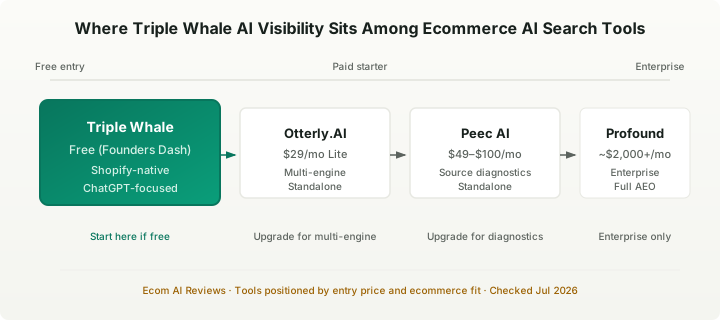
For a Shopify seller, the decision is simple: start with Triple Whale if free, ecommerce-native visibility is the priority. Compare Otterly.AI if you want a dedicated low-cost monitor, and compare Peec AI if source and citation diagnosis matter more than a free entry point.
What Triple Whale AI Visibility Does
Triple Whale AI Visibility is a free module inside Triple Whale’s ecommerce analytics platform. It is designed for Shopify and DTC teams that want to understand how their brand appears in AI-generated shopping and recommendation answers.
The practical workflow is:
- Track whether ChatGPT mentions your brand.
- See which sources ChatGPT cites when it talks about your category.
- Monitor sentiment and positioning around your brand.
- Separate owned sources from earned or third-party citations.
- Use those patterns to decide what content, reviews, product pages, or third-party mentions need work.
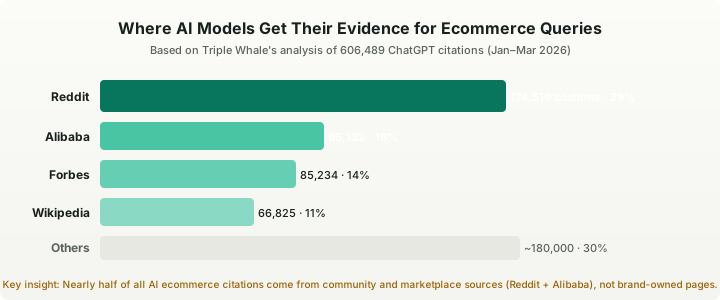
The strongest public evidence behind the module is Triple Whale’s own AI visibility research. The company says it tracked 606,489 ChatGPT citations from January through March 2026 and published a source breakdown showing Reddit at 29%, Alibaba at 16%, and Forbes at 14%. For ecommerce teams, that is the important clue: AI visibility is not only about your website. It is about the evidence layer AI assistants trust across communities, marketplaces, publishers, and product pages.
This is why Triple Whale is interesting for ecommerce specifically. A generic AI visibility dashboard can show a brand mention. Triple Whale’s pitch is closer to the store operator’s question: which sources shape AI recommendations, and how does that connect to my ecommerce growth stack?
This review remains researched, not hands-on tested. We have not verified a live Triple Whale AI Visibility dashboard, prompt setup flow, exports, alerting, or attribution connection. We are evaluating public product facts, pricing structure, and fit for ecommerce buyers.
What You Get at Each Tier
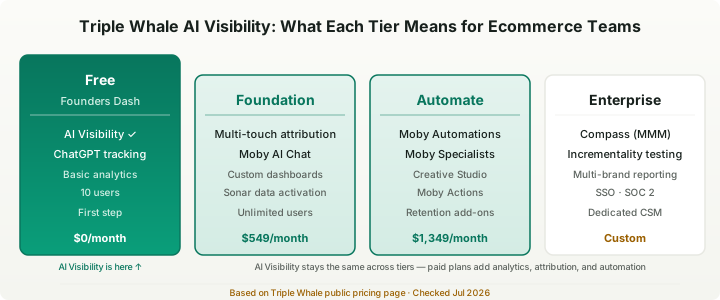
Triple Whale’s pricing structure matters because AI Visibility starts free, but the broader platform scales into paid ecommerce analytics and automation.
| Tier | Public price signal | What it means for AI visibility buyers |
|---|---|---|
| Free / Founders Dash | Free | Includes AI Visibility, basic analytics, and up to 10 users. Best first step for a Shopify brand that wants a no-cost baseline. |
| Foundation | $549/month | Adds deeper ecommerce analytics such as multi-touch attribution, Moby AI, and custom reporting. Relevant if AI visibility needs to sit beside performance reporting. |
| Automate | $1,349/month | Adds stronger automation and creative workflows, including Moby automation and Creative Studio. Better for teams already using Triple Whale as an operating layer. |
| Enterprise | Custom | Adds custom commercial terms and advanced capabilities such as Compass for marketing mix modeling and incrementality testing. Relevant for larger brands, not first-time GEO users. |
The free tier is the buying story. Most AI visibility tools ask for a paid subscription before you know whether the workflow matters. Triple Whale lets Shopify brands start with a free module, then only consider paid plans if the broader analytics platform is useful.
That can be a real advantage. A small brand may not need another $50 to $500 monthly software line item just to learn whether ChatGPT knows it exists. A free baseline can answer the first question:
| First question | What Triple Whale can help reveal |
|---|---|
| Does ChatGPT mention our brand? | Whether the brand appears in relevant AI answers. |
| What sources shape the answer? | Which cited domains or source types seem to influence the result. |
| Is sentiment favorable? | Whether AI answers frame the brand positively, neutrally, or negatively. |
| Are owned sources enough? | Whether your site contributes evidence or third-party sources dominate. |
| Is this worth operationalizing? | Whether AI visibility deserves a recurring workflow, paid tooling, or team ownership. |
The paid tiers are a different question. You should not buy Foundation or Automate only for AI Visibility unless Triple Whale’s broader analytics platform is also valuable to your team. At $549/month and above, the decision becomes ecommerce analytics and attribution first, AI visibility second.
How Triple Whale Compares
Triple Whale, Otterly.AI, and Peec AI all help teams move beyond manual ChatGPT checks, but they are built from different starting points.
| Decision point | Triple Whale AI Visibility | Otterly.AI | Peec AI |
|---|---|---|---|
| Best buyer | Shopify and DTC brands that want a free ecommerce-native baseline | Solo sellers and small teams that want a dedicated low-cost monitor | Mid-market teams and agencies that need deeper source and citation diagnostics |
| Entry cost | Free via Founders Dash | Paid starter path, with a low public entry point | Paid starter path with higher quota and deeper diagnostic positioning |
| Product shape | Module inside an ecommerce analytics platform | Standalone AI search visibility tool | Standalone AI search analytics platform |
| Confirmed public engine emphasis | ChatGPT mentions, citations, and sentiment | Multiple AI-search surfaces depending on plan and add-ons | Configured prompts and selected models across public plan tiers |
| Ecommerce fit | Strongest Shopify-native fit | Useful for ecommerce, but not store-native | Strong for ecommerce source analysis, but not store-native execution |
| Competitor tracking | Weaker public signal | Useful basic competitor reporting | Stronger competitor and source-gap workflow |
| Main advantage | Free, ecommerce-native, tied to store analytics context | Easy dedicated monitor for a small team | Better source/citation diagnosis for recurring GEO work |
| Main risk | Too narrow if you need multi-engine GEO coverage | Prompt quality and limits can constrain the value | Costs more and still requires human execution |
The cleanest split is this:
- Choose Triple Whale first if you are a Shopify brand and want a free AI visibility baseline.
- Choose Otterly.AI if you want a dedicated monitor and can pay for a small prompt set.
- Choose Peec AI if source-level diagnosis and competitor analysis are the real work.
For enterprise teams that need the deepest possible AEO platform, Profound is the heavier comparison point. For most DTC stores, it is too expensive and too sales-led as a first step.
Ecommerce Fit
Triple Whale is more ecommerce-native than most AI visibility tools because it comes from an ecommerce analytics platform rather than a general SEO or brand-monitoring workflow.
That matters for three reasons.
First, Shopify brands do not only care whether a model mentions them. They care whether the answer reflects products, pricing, reviews, positioning, and revenue context. Triple Whale already speaks the language of DTC operators: attribution, analytics, creative performance, customer acquisition, and store growth.
Second, the free tier lowers the adoption barrier. A founder can check AI visibility without turning it into a procurement decision. That is especially useful when GEO is still early and many teams have not proved that AI visibility deserves a recurring budget.
Third, the citation research is ecommerce-relevant. If ChatGPT relies heavily on Reddit, Alibaba, Forbes, publishers, and other third-party sources, the work is not just “write another blog post.” It may include review generation, Reddit visibility, marketplace data quality, PR, comparison pages, product schema, and category authority.
The best-fit user is a Shopify or DTC team asking:
- Are we visible in ChatGPT when shoppers ask category questions?
- What sources does ChatGPT trust in our category?
- Are third-party discussions helping or hurting our brand?
- Does AI visibility deserve a recurring workstream?
- Should we eventually connect AI visibility to broader ecommerce analytics?
The weaker fit is just as important:
- A non-Shopify business that does not need Triple Whale’s ecommerce platform.
- A team that needs Perplexity, Google AI Overviews, Gemini, Claude, and Copilot tracking as a confirmed requirement.
- An agency managing many client brands with detailed competitor reports.
- A content team that needs source-gap workflow, exports, and multi-project reporting more than free access.
- A large enterprise retail team that needs governance, SSO, broad engine coverage, and executive reporting.
If your team has not done the free GEO basics yet, start with the GEO checklist for ecommerce and the 50 ecommerce AI search prompts. Triple Whale can help measure the baseline, but it will not replace the work of making your store understandable and cite-worthy.
Limitations and Gaps
Triple Whale’s biggest strength is also the source of most limitations: AI Visibility is a focused ecommerce module, not a full standalone GEO suite.
| Limitation | Why it matters |
|---|---|
| ChatGPT-centered public positioning | ChatGPT is important, but many ecommerce discovery journeys also touch Perplexity, Google AI Overviews, Gemini, Claude, and Copilot. Verify broader coverage before treating it as a full AI visibility stack. |
| AI Visibility is a module, not the whole product | This is useful if you want Triple Whale analytics, but less ideal if your only need is AI search monitoring. |
| Competitor tracking appears weaker than dedicated tools | If your main workflow is competitor share of voice and source-gap reporting, Peec AI or another dedicated platform may fit better. |
| No hands-on verification in this review | We have not tested setup, dashboards, exports, alerting, prompt controls, or accuracy in a live account. |
| Attribution connection is not proven here | Triple Whale is an analytics platform, but this review does not verify that AI visibility changes can be tied cleanly to ecommerce revenue. |
| Shopify-native fit can be a constraint | The closer a product is to Shopify/DTC workflows, the less universal it may be for marketplaces, B2B SaaS, publishers, or non-Shopify stores. |
The operational risk is dashboard comfort. A free visibility module can make a brand feel more informed without changing the underlying evidence. If ChatGPT cites Reddit, review sites, or product pages that frame your category poorly, the work still has to happen outside the dashboard.
Use Triple Whale AI Visibility as a signal layer:
- Identify whether the brand appears.
- Inspect which sources shape the answer.
- Separate owned-page gaps from earned-source gaps.
- Assign work to content, SEO, merchandising, PR, or review collection.
- Rerun the same prompt set over time.
That is the workflow that turns a free tool into a business process.
Who Should Use Triple Whale AI Visibility?
Use Triple Whale AI Visibility if you run a Shopify or DTC brand and want the lowest-friction way to start measuring AI visibility.
It is especially sensible for:
- Shopify founders who want to know whether ChatGPT mentions their brand.
- DTC marketers who need a free first AI visibility baseline.
- Ecommerce teams already considering Triple Whale for analytics or attribution.
- Brands that care about cited-source patterns, not just visibility scores.
- Operators who want to test the GEO workflow before paying for Otterly.AI, Peec AI, or a larger platform.
- Teams that suspect Reddit, publishers, marketplaces, or review sites influence how AI describes their category.
The best buyer is not trying to buy a full AI search command center on day one. They are trying to answer the first practical question: is AI visibility worth real attention for our store?
Who Should Skip Triple Whale AI Visibility?
Skip Triple Whale AI Visibility as your primary tool if your requirements are already more advanced than a free ChatGPT-oriented baseline.
You should compare other tools first if:
- You need confirmed multi-engine monitoring across ChatGPT, Perplexity, Google AI Overviews, Gemini, Claude, and Copilot.
- You need detailed competitor tracking across many brands, markets, and prompt groups.
- You are not a Shopify or DTC operator.
- You do not want Triple Whale’s broader analytics platform.
- You need agency reporting, exports, API workflows, or multi-client governance.
- You expect the tool to create content, fix schema, earn reviews, or do outreach automatically.
Also skip paid Triple Whale tiers if AI Visibility is your only reason to upgrade. Foundation and Automate pricing should be justified by attribution, analytics, reporting, Moby AI, automation, or creative workflows, not by the AI Visibility module alone.
Alternatives
- Otterly.AI - Better if you want a dedicated, self-serve AI visibility monitor with a low paid entry point and do not need a Shopify-native analytics platform.
- Peec AI - Better if source and citation diagnostics, competitor benchmarking, model selection, and recurring GEO operations matter more than a free first step.
- Alhena AI - Better if you want AI visibility bundled with product discovery and support automation rather than a free baseline module.
- Profound - Better for enterprise brands and agencies that need a broad AEO platform, Prompt Volumes, server-log crawler analytics, governance, and executive reporting.
- Manual prompt spreadsheet - Better if you have fewer than 10 prompts and have not yet proved that AI visibility monitoring will change your work.
- Traditional SEO and analytics tools - Still necessary for technical SEO, product schema, organic search, revenue attribution, and merchandising diagnostics.
For the broader shortlist, see our best AI visibility tools for ecommerce.
Bottom Line
Triple Whale AI Visibility is not the deepest AI visibility product in the category. It is the most obvious free starting point for Shopify brands.
That distinction matters. If you are early in GEO, your first job is not to buy the most complex dashboard. It is to learn whether AI assistants mention your brand, which sources they trust, and whether the findings are important enough to assign work against.
Triple Whale fits that first job well. It is free, ecommerce-native, and anchored in the reality that AI answers pull from third-party evidence, not only your own website. The limitation is that it should be treated as a ChatGPT-focused baseline unless Triple Whale confirms the broader engine coverage your team needs.
Start here if you are a Shopify brand that wants a no-cost AI visibility read. Move to Otterly.AI or Peec AI when you need a dedicated monitor or deeper source diagnostics. Move to Profound only when AI visibility has become an enterprise program with budget and team ownership.
Sources Checked
This is a researched review based on public evidence and PM-provided research notes checked through July 2, 2026. We did not test a live Triple Whale account or verify dashboard output.
- Product positioning, AI Visibility module framing, and ecommerce-native claims: Triple Whale AI Visibility official page.
- Tool metadata, score, category fit, pricing transparency, and affiliate record: Ecom AI Reviews tool record for Triple Whale.
- Pricing structure and plan interpretation: PM-verified research notes for Free Founders Dash, Foundation, Automate, and Enterprise tiers.
- Citation research: PM-verified Triple Whale public citation analysis covering 606,489 ChatGPT citations from January through March 2026, including Reddit, Alibaba, and Forbes source-share examples.
- Third-party fit signal: ATTN Agency March 2026 commentary summarized in PM research notes, especially the distinction between brands that need attribution analytics and brands that only want another dashboard.
- Editorial comparisons: Otterly.AI review, Peec AI review, Profound review, 50 ecommerce AI search prompts, and best AI visibility tools.
Comments