You can’t improve a score you’ve never checked. This is the score: the share of real shopper questions where an AI assistant names your store. Here are 50 prompts to measure it — free, in an afternoon.
Pick 20–40 of the prompts below that match how your shoppers actually ask. Swap the [brackets] for your category. Run them through ChatGPT, Perplexity, and Google AI Overviews once a month, and log three things each time: were you named, were you described accurately, and where did you sit versus competitors. That’s your AI Visibility Score — no tool required to start.
01 Why a prompt library beats a dashboard
Most sellers’ first instinct, once they hear about AI visibility, is to go buy a monitoring tool. Skip that for now. The thing a $200/month dashboard does on day one is the thing you can do for free: it runs a fixed list of shopper questions through the AI engines and records whether you showed up. The list is the product. Owning your own list — one written in the exact language your buyers use — is more useful than renting someone else’s generic one, and it costs nothing.
This connects directly to the metric from our pillar guide, What Is AI Visibility for Ecommerce: your AI Visibility Score is simply the share of these prompts where your brand gets named. Run 30 prompts, get named in 6, and you’re at 20%. Track that number monthly and you’ve replaced vibes with a baseline.
02 How to use this library
Three rules keep this honest and fast.
One — don’t run all 50. Fifty is the full menu, not a quota. Pick the 20–40 that match how people genuinely shop your category. A supplements brand leans on attribute and reputation prompts; a furniture brand leans on budget and comparison. Choose accordingly.
Two — fill the brackets, keep the shape. Each prompt is a template. Replace [product category], [use case], [your brand], and [competitor] with your own. The phrasing is deliberately conversational, because that’s how shoppers actually talk to an assistant — not in keywords. Under each template is a filled-in example using Whisker & Co., our running fictional cat-supplies store, so you can see the move.
Three — go past the category, into your identity. Swapping in [product category] only tells you whether you’re in the category at all. The prompts that matter most are the ones that probe what makes your store specific — your niche, your signature product, the reason a shopper would pick you over the obvious big name. If your edge is small-batch and vet-formulated, write the prompt a shopper who wants exactly that would ask. That’s how you find out whether the engine understands what you’re for, not just which shelf you’re on.
Four — test more than one engine. The same prompt returns different answers in ChatGPT, Perplexity, and Google’s AI Overview. Checking one engine tells you almost nothing; checking three tells you a pattern.
The cat store is here for one reason: to show the moves on a concrete example. Don’t ship a list of generic [product category] prompts and call it done — that measures an average store, not yours. Rebuild every prompt around your own brand, your real SKUs, and the specific thing you’re known for. The list is only as valuable as it is yours.
03 The six prompt types — and what each reveals
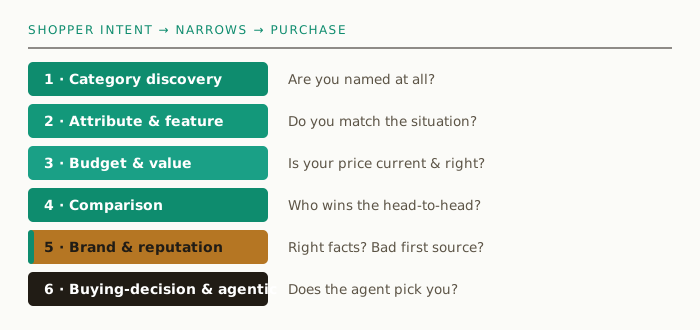
The 50 prompts fall into six buckets. They’re ordered the way a shopper’s intent narrows: from “I don’t know what to buy yet” down to “buy this one for me.” Each bucket also probes a different way your store can fail in AI answers — the same failure modes we’ll map out in detail in the forthcoming companion guide on the signs your store is invisible.
Category discovery
The broadest, highest-volume questions — a shopper who hasn’t picked a brand yet. If you’re absent here, you’re invisible at the top of the funnel; if you’re only ever the last name listed, you’re the afterthought, not the pick.
DIAGNOSES → never named · always the afterthought- 1what’s the best [product category] for [use case]?best automatic litter box for a multi-cat home
- 2I have [situation] — what [product category] should I get?I have two cats in a small apartment — what litter box should I get?
- 3recommend a good [product category] for [persona]recommend a good cat water fountain for a first-time owner
- 4what are the top [product category] brands in 2026?what are the top cat-supply brands in 2026?
- 5best [product category] for someone who’s [experience level]best self-cleaning litter box for someone who’s never owned one
- 6what [product category] do you actually recommend right now?what cat litter box do you actually recommend right now?
- 7a good [product category] for [constraint]?a good litter box for a tiny apartment?
- 8help me pick a [product category] that [solves a problem]help me pick a litter box that cuts down on smell
- 9what’s a popular [product category] that people actually like?what’s a popular automatic litter box that people actually like?
- 10if you had to name one [product category], what would it be?if you had to name one automatic litter box, what would it be?
Attribute & feature
The long tail, where a shopper names a specific need. This is where a store ranking fine on Google quietly vanishes — because its pages never tied the product to that exact situation in words a model can map.
DIAGNOSES → present, but not matched to the need- 11what’s the quietest [product category]?quietest automatic litter box?
- 12most durable [product category] that lasts?most durable cat water fountain that lasts?
- 13easiest [product category] to [clean / set up / use]?easiest litter box to clean?
- 14best [product category] for [specific need]?best litter box for a cat that’s nervous about new things?
- 15most eco-friendly [product category]?most eco-friendly cat litter?
- 16[product category] brand with the best [support / warranty / returns]?cat-supply brand with the best return policy?
- 17best-looking [product category] that won’t be an eyesore?best-looking automatic litter box that won’t be an eyesore?
- 18safest [product category] for [vulnerable group]?safest automatic litter box for kittens?
- 19best [product category] for [environment]?best litter box for a studio apartment?
- 20which [product category] is easiest to live with day to day?which automatic litter box is easiest to live with day to day?
Budget & value
Price-anchored questions. These are also your best stale-fact detector: if an engine quotes last year’s price or a discontinued bundle, you’ll catch it here before a shopper does.
DIAGNOSES → stale price · wrong price tier- 21best [product category] under $[budget]?best automatic litter box under $300?
- 22best budget [product category]?best budget cat water fountain?
- 23best premium / high-end [product category]?best high-end automatic litter box?
- 24is [your brand] worth the price?is Whisker & Co. worth the price?
- 25best value [product category] for the money?best value automatic litter box for the money?
- 26cheapest [product category] that’s still actually good?cheapest automatic litter box that’s still actually good?
- 27[product category] — is it worth paying more?automatic litter boxes — is it worth paying more?
Comparison
Direct head-to-heads. These are decided largely by third-party sources you don’t own — reviews, round-ups, Reddit threads. If the engine reflexively sides with a rival, this bucket tells you whose evidence it’s reading.
DIAGNOSES → loses every head-to-head- 28[your brand] vs [competitor] — which is better?Whisker & Co. vs Litter-Robot — which is better?
- 29what are the best alternatives to [big competitor]?what are the best alternatives to Litter-Robot?
- 30[your brand] or [competitor] for [use case]?Whisker & Co. or PetSafe for a multi-cat home?
- 31is [your brand] better than [competitor]?is Whisker & Co. better than Litter-Robot?
- 32a cheaper alternative to [competitor]?a cheaper alternative to Litter-Robot?
- 33[competitor A] vs [competitor B] — and is there a better option?Litter-Robot vs PetSafe — and is there a better option?
- 34something like [competitor] but [differentiator]?something like Litter-Robot but quieter?
- 35who makes the best [product category] — [your brand], [competitor A], or [competitor B]?who makes the best automatic litter box — Whisker & Co., Litter-Robot, or PetSafe?
Brand & reputation
Branded questions, where the shopper already knows your name and is checking you out. This bucket catches three things at once: facts the engine gets wrong, facts that are out of date, and a reputation framed by one loud negative source.
DIAGNOSES → wrong facts · stale facts · defined by a bad source- 36is [your brand] any good?is Whisker & Co. any good?
- 37is [your brand] legit and trustworthy?is Whisker & Co. legit and trustworthy?
- 38what do reviews say about [your brand]?what do reviews say about Whisker & Co.?
- 39tell me about [your brand]tell me about Whisker & Co.
- 40what are the pros and cons of [your brand]?what are the pros and cons of Whisker & Co.?
- 41what do customers complain about with [your brand]?what do customers complain about with Whisker & Co.?
- 42how much does [your brand]‘s [flagship product] cost?how much does Whisker & Co.’s automatic litter box cost? ← stale-price check
- 43does [your brand]‘s [product] [have feature / work for X]?does Whisker & Co.’s litter box work for large cats? ← wrong-fact check
- 44would you recommend buying from [your brand]?would you recommend buying from Whisker & Co.?
Buying-decision & agentic
The closest thing to a sale. These mimic a shopper — or an AI shopping agent — making the final call. As assistants start adding to carts and buying on a shopper’s behalf, being the one the agent picks matters as much as being a link a human clicks.
DIAGNOSES → does the agent choose you?- 45should I buy [your product] or [competitor product]?should I buy the Whisker & Co. box or the Litter-Robot 4?
- 46what should I look for when buying a [product category]?what should I look for when buying an automatic litter box?
- 47is [your product] worth buying in 2026?is the Whisker & Co. litter box worth buying in 2026?
- 48find me a [product category] like [your product] but [constraint]find me a litter box like Whisker & Co.’s but under $200
- 49I want to buy the best [product category] for [use case] — what should I get and where?I want to buy the best litter box for two cats — what should I get and where?
- 50pick the best [product category] for [use case] and add it to my cartpick the best automatic litter box for a multi-cat home and add it to my cart
04 How to log the results
The prompts are worthless without a record. Keep it dead simple — a spreadsheet with one row per prompt, repeated for each engine. For every answer, capture three columns and nothing more:
| Column | What you record | Why it matters |
|---|---|---|
| Named? | Yes / No | The raw visibility signal. Your score is the % of Yes. |
| Accurate? | Yes / Partly / No | A wrong mention can cost more than no mention. |
| Position | 1st / top-3 / mentioned / absent | Being named last is not the same as being the pick. |
Pick 30 prompts. Run each through ChatGPT, Perplexity, and Google AI Overview. Log the three columns. Add up the “Named? = Yes” boxes, divide by total, and that percentage is your starting AI Visibility Score. Do it again next month. The single number you care about is whether that line goes up.
Run the same prompts for your top competitor and you get their score too — a free competitive benchmark most brands have never seen. And when an answer is wrong or out of date, you’ve just found your highest-priority fix: the exact sentence to correct, on the exact page or third-party source the engine is leaning on. (The GEO checklist covers how to actually fix each one.)
05 Don’t let a tool choose your prompts
Every GEO report you’ll ever read is downstream of one thing: the prompt list behind it. Wrong prompts in, wrong report out. So the most consequential decision in this whole exercise isn’t which tool you buy — it’s who writes the prompts. And most tools will happily write them for you, which is exactly where the trap is.
When a monitoring tool auto-suggests a starter set of prompts, that list isn’t neutral. It’s reverse-engineered from the engine’s current model of what your site is. Which makes the suggested list a mirror: it shows you how the AI already understands you — and if that understanding is off, every prompt it hands you measures the wrong thing.
I found this out running my own site through one. The tool cheerfully generated a list of prompts like “what are the best AI-powered review apps for Shopify?” — questions you’d monitor if you sold review apps. But this site doesn’t sell them; it reviews them. The tool wasn’t broken. It was faithfully reflecting a mental model of my site that was simply wrong — and it did so before I’d measured a single answer. That mismatch was the most valuable finding of the whole session: the engine had mis-filed what I am.
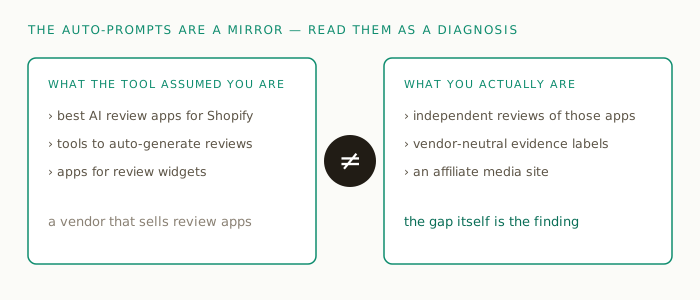
So treat the auto-suggestions as a diagnostic, not a to-do list. If they describe your store accurately, good — the engine gets you; keep the relevant ones. If they’re subtly off — wrong category, wrong audience, missing what makes you you — that gap is itself the problem to fix, and no amount of monitoring the wrong prompts will surface it.
Then write your own. Prompts grounded in your real identity, your actual products, and your specific difference (see rule three above). This is why the manual library still matters even after you’re paying for a tool: the tool’s prompts encode someone else’s guess about you; yours encode the truth you’re trying to teach the engine. In my own monitoring, the prompts that earned their keep were almost all ones I wrote by hand.
06 When to stop doing it by hand
Here’s the honest math. Thirty prompts across three engines, once a month, is 90 manual checks — an afternoon you can absolutely afford. Push to all 50 prompts across four or five engines, weekly, and you’re at 1,000+ checks a month. That’s the point where a human stops being the right tool, and a monitoring platform — which runs the same prompts on a schedule and charts the trend for you — starts paying for itself.
Not before. Buying a dashboard you don’t yet have the volume to justify is buying a very pretty scoreboard. But once the spreadsheet genuinely hurts, that’s the signal.
Hand the 90 checks to a tool
Budget trackers start around $29/month and run your list across the major engines on a schedule. One catch worth repeating: feed it your prompts, not only the ones it auto-generates. The friendliest on-ramp for an independent store is Otterly — we put it through the same Whisker & Co. test bench, and it does let you add custom prompts.
Whichever way you go, the order is the same: build the list, measure by hand, then automate the thing you’ve proven you need. The list is the asset. The tool is just a faster way to run it. If the prompt list becomes a weekly operating workflow, compare Peec AI for source diagnostics, Triple Whale for a free Shopify-native baseline, and Alhena AI if visibility needs to connect with shopping assistance and support automation.
Want a second pair of eyes? Drop your store’s URL in the comments below and I’ll run a few prompts and tell you how AI currently describes you — what it gets right, and where its mental model of you is off. I review ecommerce AI tools and build these monitoring setups as part of the test bench here, so I’m genuinely curious what the engines are saying about your store.
Methodology & transparency. The prompt templates here are built from the four question types named in our pillar guide (use-case, attribute, comparison, branded) and reflect how shoppers phrase requests to AI assistants as of June 2026. Whisker & Co. is a fictional store used as a worked example. ecomaireviews.com is independent and reader-supported: some tool links are affiliate links that may earn us a commission at no extra cost to you, but no vendor paid for inclusion, placement, or a favourable description, and we don’t sell an AI-visibility product. Spot a prompt that should be here and isn’t? Tell us — we update.
Related: What Is AI Visibility for Ecommerce · How to Do GEO for Ecommerce · Best AI Visibility Tools
Comments