Verdict
Otterly.AI is a strong first paid AI-search monitor for ecommerce sellers who have outgrown manual checks in ChatGPT, Perplexity, Google AI Overviews, and Copilot.
The setup flow is friendly, the prompt workflow is understandable, and the Brand Report format makes the main question visible fast: for this specific set of prompts, is my brand showing up, or are competitors getting the answer instead?
That phrase matters. A Brand Report is only as useful as the prompt set underneath it. Otterly.AI can generate prompts for you, but in my hands-on test the generated prompts were too noisy to treat as a serious measurement plan. The better workflow is to bring your own prompt set, organized around one buyer mindset, then create separate reports for separate angles.
For ecommerce, the catch is important. Otterly.AI is a visibility and content-intelligence tool first. It is not an ecommerce operating system. It can help you see the gap, but it will not fix product schema, rewrite category pages, improve review quality, or prove that one AI mention created revenue.
That is why I would treat Otterly.AI as the paid upgrade after a manual prompt spreadsheet, not as the first thing every store should buy. If you have not done the free groundwork yet, start with the GEO checklist for ecommerce and the manual AI search prompt library first.
What I Tested
This review is based on a hands-on setup and UI walkthrough captured on June 23, 2026, using Ecom AI Reviews as the test property, plus a pricing and feature check on Otterly.AI’s public site on June 24, 2026.
| Test area | What I checked | What stood out |
|---|---|---|
| Account setup | Email verification, profile fields, company domain, role, country, and language | The onboarding is polished and removes a lot of blank-page work. |
| Brand setup | Brand name, website, market, language, and competitor suggestions | Competitor suggestions were useful as a starting point, but the test site also produced noisy adjacent matches that needed cleanup. |
| Prompt workflow | Generated prompts, prompt selection, and setup confirmation | The tool makes prompts feel like a tracked asset, but the auto-generated set was not accurate enough to trust without editing. |
| Brand report | Demo report, brand ranking, top prompts, coverage, mentions, and citations | Each report is shaped by one prompt group, so prompt cohesion matters more than the UI makes obvious. |
| Pricing | Public monthly plans and prompt limits | The $29/month entry point is attractive, but prompt volume is the real constraint. |
I did not run a full 30-day longitudinal test. That matters. A long test would be needed to judge alert quality, trend stability, export workflows, and how well recommendations improve actual AI visibility over time.
What Otterly.AI Does
Otterly.AI describes itself as a content-intelligence platform for AI search. The public feature page frames the workflow as research, monitor, and optimize: find prompts, track brand visibility and citations, then use recommendations and audits to improve what AI engines can cite.
For an ecommerce seller, the practical version is simpler:
- Build one focused prompt set around one buyer question, product line, or use case.
- Track whether your brand, products, and competitors appear in AI answers.
- See which domains and pages are being cited.
- Watch brand coverage, position, sentiment, and competitor share over time.
- Create additional reports for other angles instead of mixing every prompt into one dashboard.
- Use the gaps in each report to decide what content, schema, reviews, or third-party mentions to improve next.
The public product copy says Otterly.AI tracks major AI-search surfaces including ChatGPT, Google AI Overviews, Perplexity, Copilot, Gemini, AI Mode, and Claude. The pricing page is more specific: the core monthly plans include tracking across four engines, with Claude, Gemini, and Google AI Mode listed as add-ons.
That distinction matters when you compare tools. “Tracks many engines” is not the same as “all engines are included in the plan you are about to buy.” For the broader shortlist, see our best AI visibility tools for ecommerce ranking.
Setup Experience
The onboarding is better than I expected for an early GEO tool category.
The first screens ask for the basics: email verification, name, company domain, role, brand name, brand website, country, and language. This is not exciting, but it is useful. AI visibility depends heavily on entity clarity. If the tool does not know your brand, market, and language, the reports will be noisy from the start.
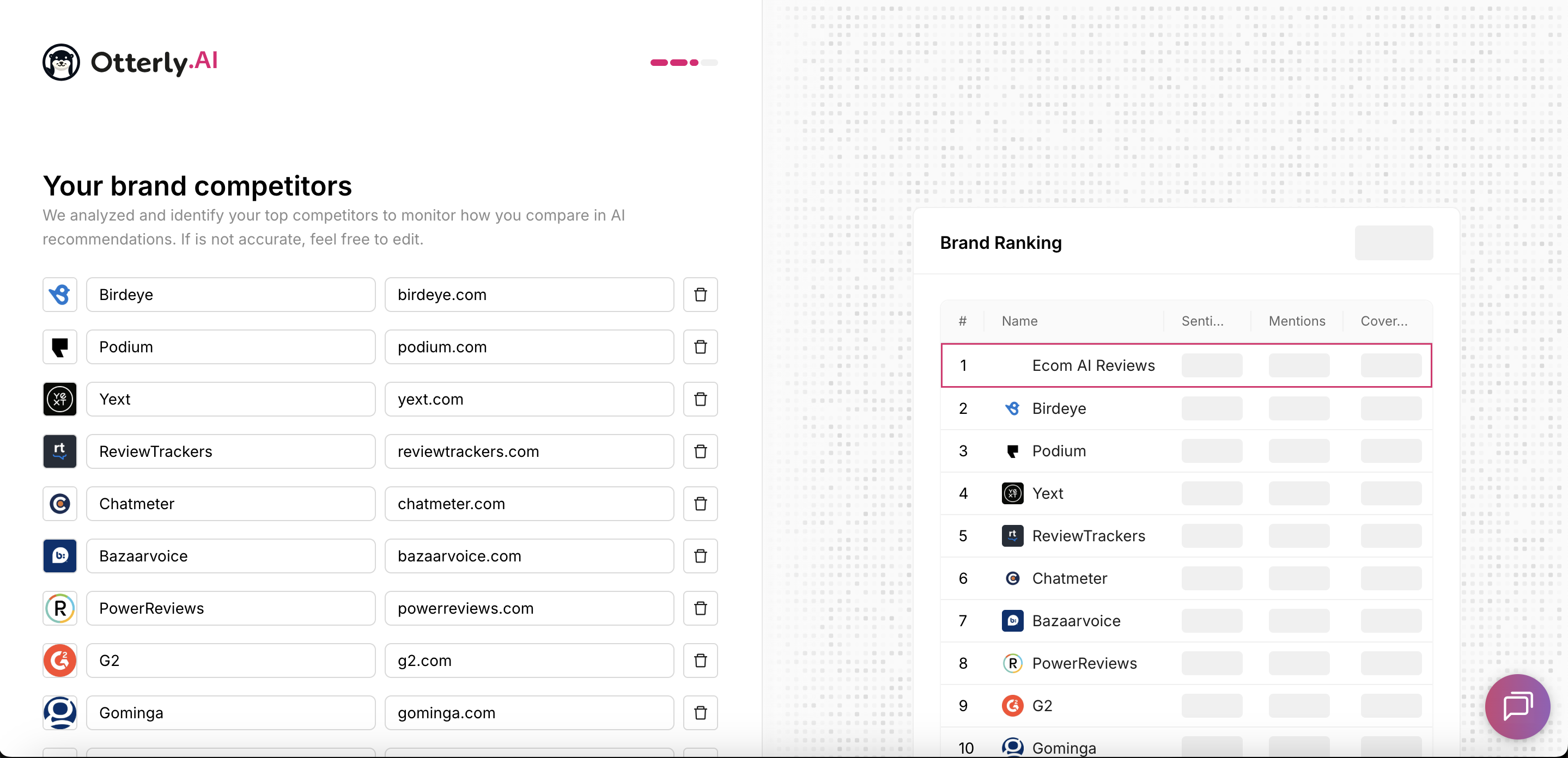
The competitor step was the most interesting part of setup. I used Ecom AI Reviews as the test property, so Otterly.AI tried to infer nearby entities from an AI-tool-review domain. The suggested list included adjacent review and reputation platforms, which was not perfect, but it was useful evidence: automatic competitor discovery should be treated as a draft, not a final source of truth.
That is still exactly the right workflow for a seller because AI answers are rarely judged in isolation. You do not only care whether your store, publication, or product appears. You care whether the assistant names you before it names the closest alternatives.
The warning is that competitor suggestions should not be accepted blindly. In my setup, the automatic list looked useful as a first pass but still needed cleanup. Ecommerce categories are just as messy: a Shopify app, a review platform, a marketplace seller, and an independent buyer’s guide can all share overlapping language while competing in very different ways. Plan to edit the list.
Prompt Workflow
Otterly.AI’s prompt setup is where the product starts to feel more valuable than a spreadsheet, and also where the main risk appears.
After brand and competitor setup, the tool generated high-impact search prompts and moved into a review-and-select screen. That is the right interface pattern. The worst way to measure AI visibility is to ask five random questions on Monday, five different questions next month, and then pretend the numbers are comparable.
But the generated prompts should not be treated as strategy.
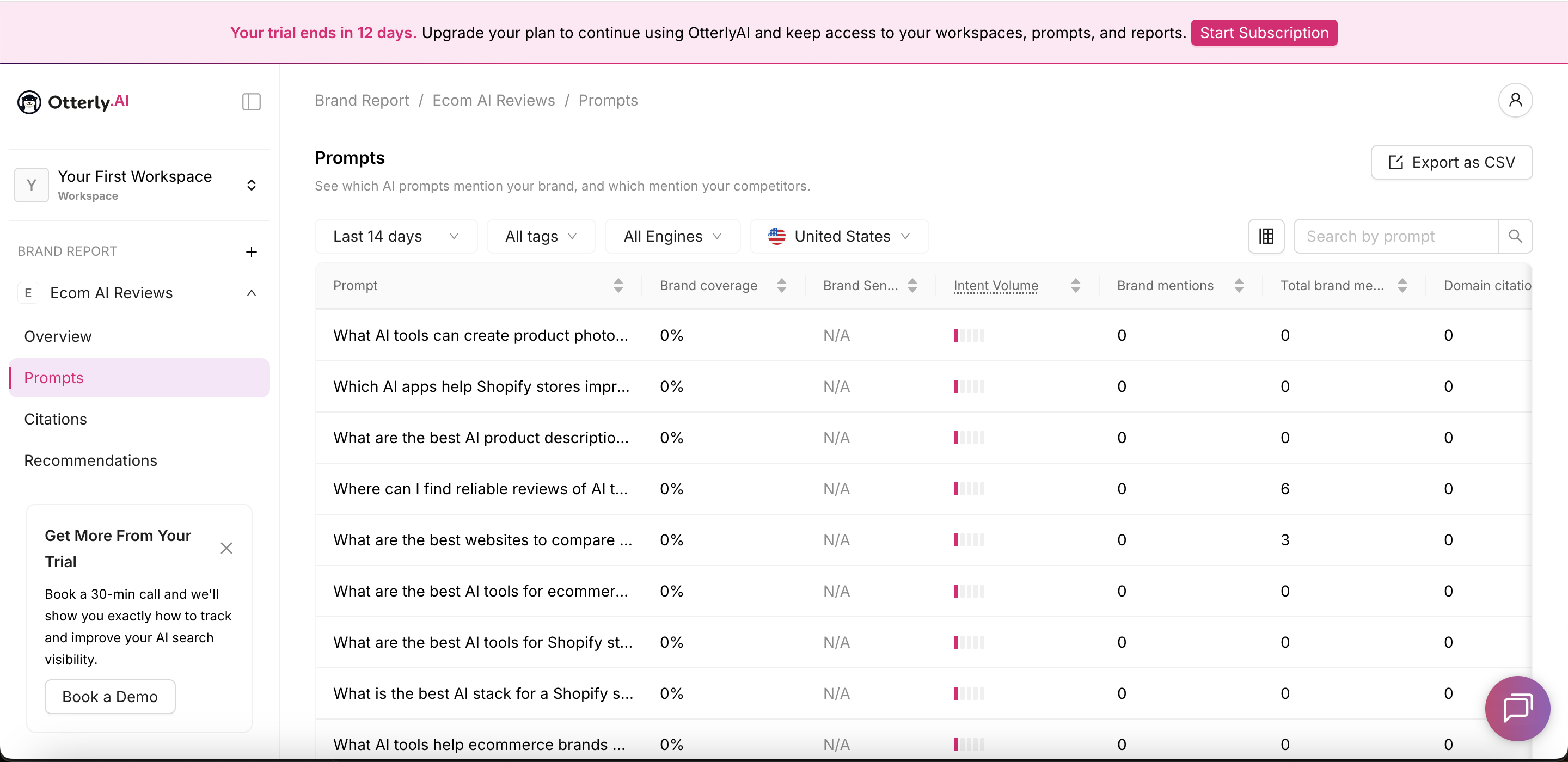
In this test, Otterly.AI’s auto-generated prompts were helpful for understanding the workflow, but not accurate enough for a serious Ecom AI Reviews report. Some prompts drifted into adjacent Shopify review-app territory. That made the UI easy to test, but it also proved the point: if the prompt set is off, the Brand Report will be off.
The better workflow is to prepare the prompt set yourself. Think of each prompt set as one coherent mental model, not a bag of loosely related keywords. A good set should answer one question:
- “How visible are we for AI visibility tools for ecommerce?”
- “How visible are we for Shopify review apps?”
- “How visible are we for ecommerce GEO monitoring?”
- “How visible are we against a named competitor set?”
Those should be separate reports, not one mixed report.
For an ecommerce AI-tool review site like Ecom AI Reviews, I would build prompts in four buckets:
- Category prompts, such as “best AI visibility tools for ecommerce”
- Use-case prompts, such as “AI tools for Shopify sellers to monitor ChatGPT visibility”
- Comparison prompts, such as “Otterly.AI vs Peec AI for ecommerce GEO”
- Branded prompts, such as “is Ecom AI Reviews trustworthy for AI tool rankings?”
Otterly.AI helps operationalize that. The more disciplined you are about prompt design, the more valuable the dashboard becomes. I would not judge the tool from its generated prompts alone; I would judge it after loading a clean prompt set that I actually want to track for a month.
The limitation is prompt volume. Otterly.AI’s Lite plan lists 15 search prompts. That is enough for a small first baseline, but it disappears quickly. In the reporting UI, the prompts become a table you can sort, export, and inspect by brand coverage, mentions, and citations. That is useful, but it also makes bad inputs painfully visible: if the prompt list drifts, the whole report drifts with it. Use the 50 ecommerce AI search prompts as a starting point, then narrow the list to your actual products and buyer questions.
Brand Reports
The Brand Report is the clearest part of the product experience, and it is also where Otterly.AI becomes more than a prompt spreadsheet.
A Brand Report is not a universal score for the whole business. It is a report generated from a group of prompts. That means the report inherits the intent, scope, and bias of that prompt group.
This is useful if you are deliberate. You can create one report for category discovery, another for comparison prompts, another for branded trust questions, and another for a specific market or language. Each report then tells you something concrete.
It is less useful if you mix every angle together. “AI visibility” becomes hard to interpret when category prompts, product prompts, branded reputation prompts, and competitor prompts all live in one unstructured bucket.
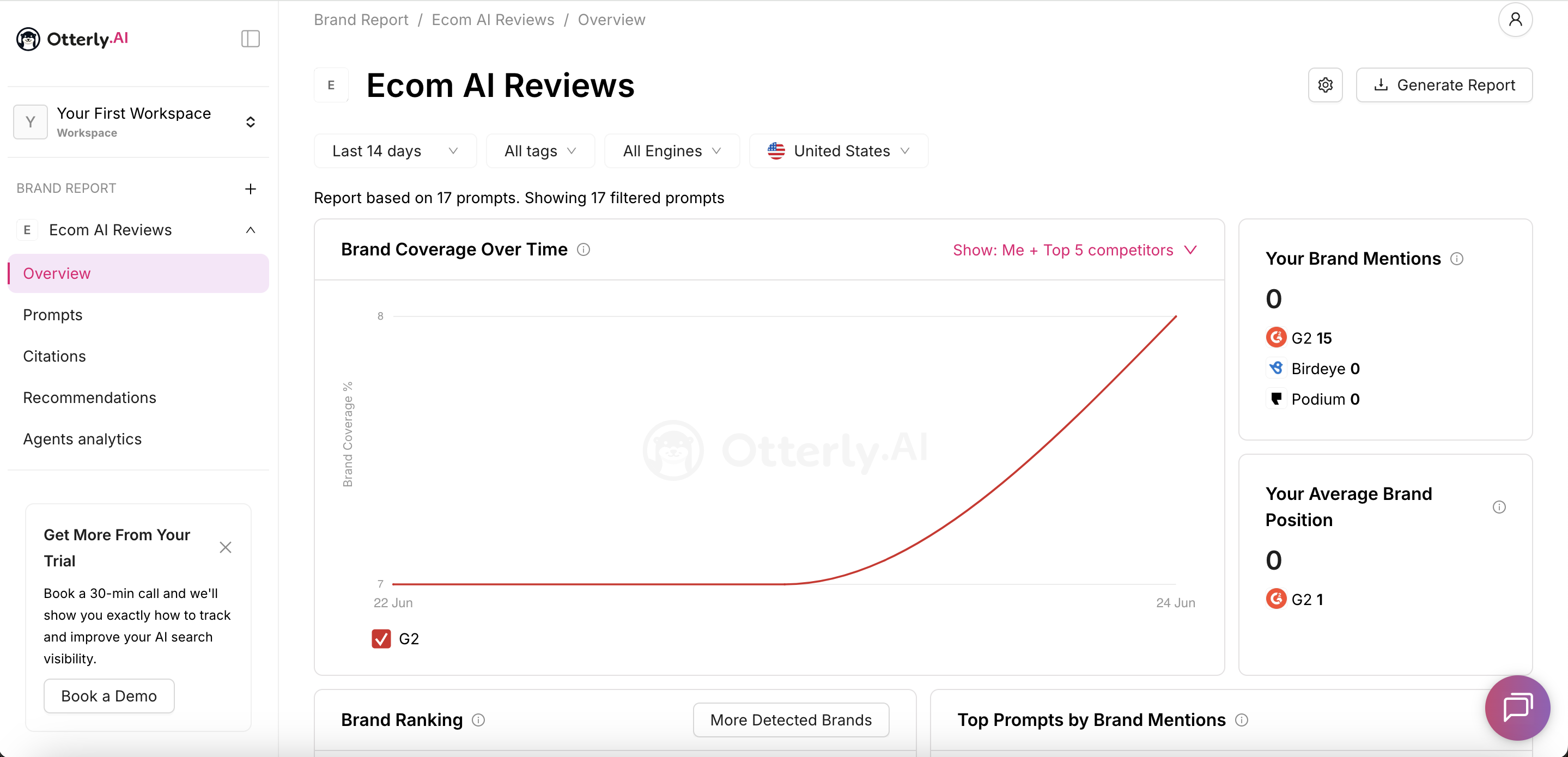
The in-app overview makes this dependency explicit. In my Ecom AI Reviews test, the overview stated that the report was based on 17 prompts, then showed brand coverage over time, brand mentions, average brand position, brand ranking, and top prompts by brand mentions.
That is the right mental model. You are not asking, “Are we visible everywhere?” You are asking, “For this exact buyer-question set, who gets named, who gets cited, and which prompts create the gap?”
Before reading the charts, keep one distinction clear: brand metrics and domain metrics are different.
Brand metrics answer: does the AI answer name or recommend this brand? Domain metrics answer: does the AI answer cite this website as evidence? A brand can be mentioned without its own domain being cited. A domain can be cited without the brand becoming the recommended choice.
Here is how I would read the main Brand Report modules:
- Brand Coverage Over Time: the percentage of prompts where a brand appears in AI answers, tracked across dates. This is the trend line for “are we getting named more often?”
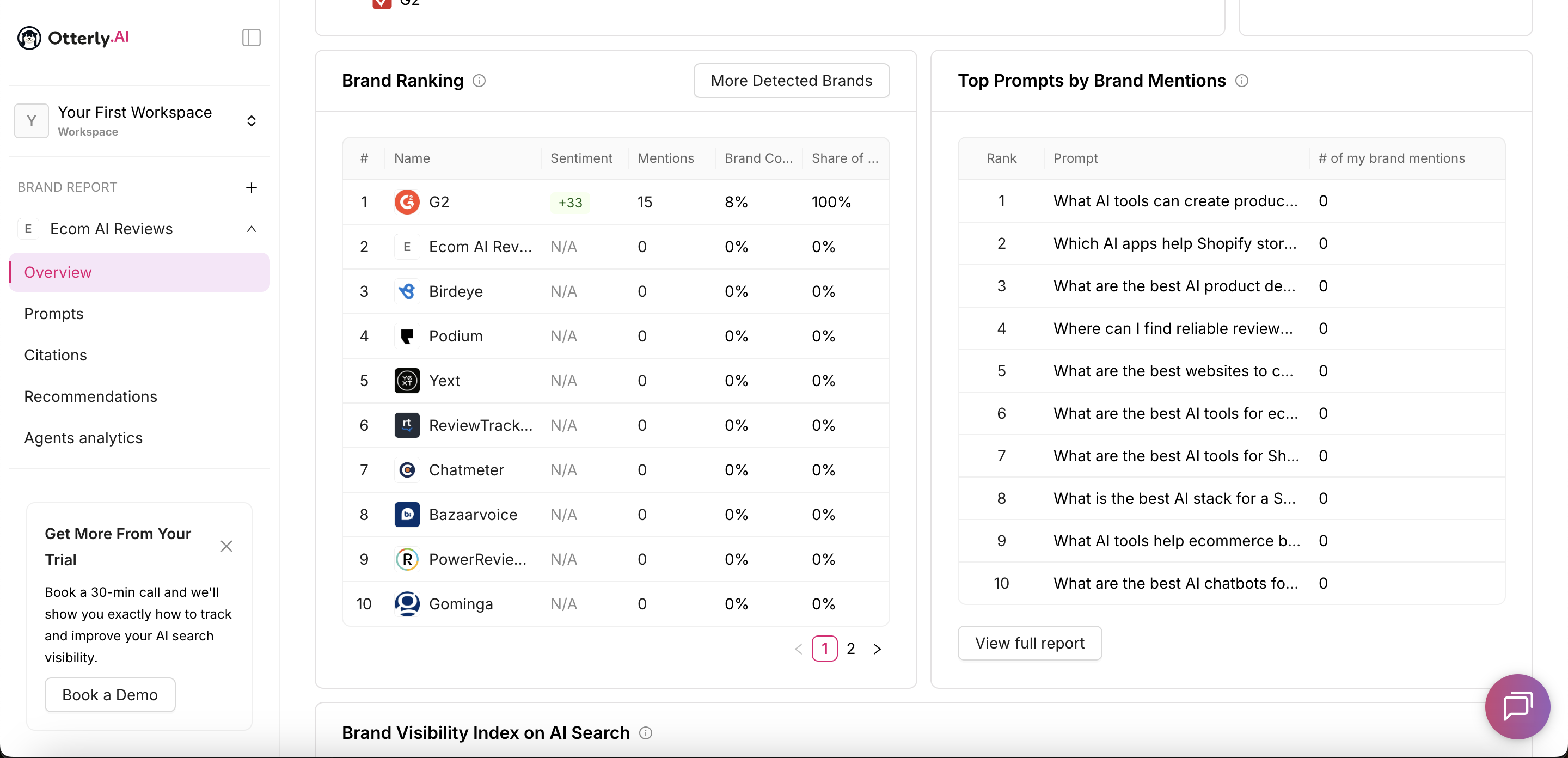
- Brand Ranking: a leaderboard of brands mentioned across the prompt set. This is the fastest way to see which competitors own the answer space.
- Top Prompts by Brand Mentions: the exact prompts that create brand mentions. This is where you find the buyer questions that need content, positioning, or comparison work.
- Brand Visibility Index on AI Search: a diagnostic map that combines coverage with buyer-choice strength. I would use it to separate “AI does not know us” from “AI knows us but does not make us sound compelling.”
- Citations: the specific URLs cited inside AI answers. This shows which pages AI engines are treating as evidence.
- Domain Coverage Over Time: the percentage of prompts where a domain gets cited over time. This is the trend line for “are our pages becoming useful evidence?”
- Domain Citations: the domains most often cited across the report. This helps identify trusted third-party sources in the category, not just your own site performance.
- Top Prompts by Website Citations: the prompts that trigger website citations. This is useful for finding prompts where your site is absent and another source is supplying the evidence.
The first layer to read is brand presence. The Brand Ranking card shows who is being mentioned across the prompt set, and the Top Prompts card shows which questions are producing those mentions. In this test, G2 dominated the set while Ecom AI Reviews had no brand mentions. That is not flattering, but it is useful. A zero-result baseline is still a baseline.
For a seller, this is where the report becomes actionable:
- If a competitor is mentioned and you are not, inspect the exact prompt.
- If the same competitor appears across many prompts, study the pages and third-party sources AI engines are using.
- If your brand appears only in branded prompts, you may have recognition but not category visibility.
- If your brand appears in category prompts but not comparison prompts, you may need clearer positioning and competitor pages.
Otterly.AI appears built around those questions.
The second layer is the Brand Visibility Index. Otterly.AI plots brands by coverage and likelihood to buy, then labels the result with categories such as Low Performance, Low Conversion, Niche, or Leaders.
I would treat this as a diagnostic map, not a revenue model. The useful part is not the label by itself. The useful part is that it separates two different problems:
- Coverage problem: AI engines rarely name you.
- Conversion-language problem: AI engines may know you, but the answer does not make you sound like the obvious buyer choice.
For ecommerce, that distinction matters. A store can be mentioned often because it has many indexed pages, but still lose if the answer favors a competitor’s reviews, shipping policy, price clarity, or category authority. The visibility index points you toward the type of work to investigate, but it does not prove which update will create sales.
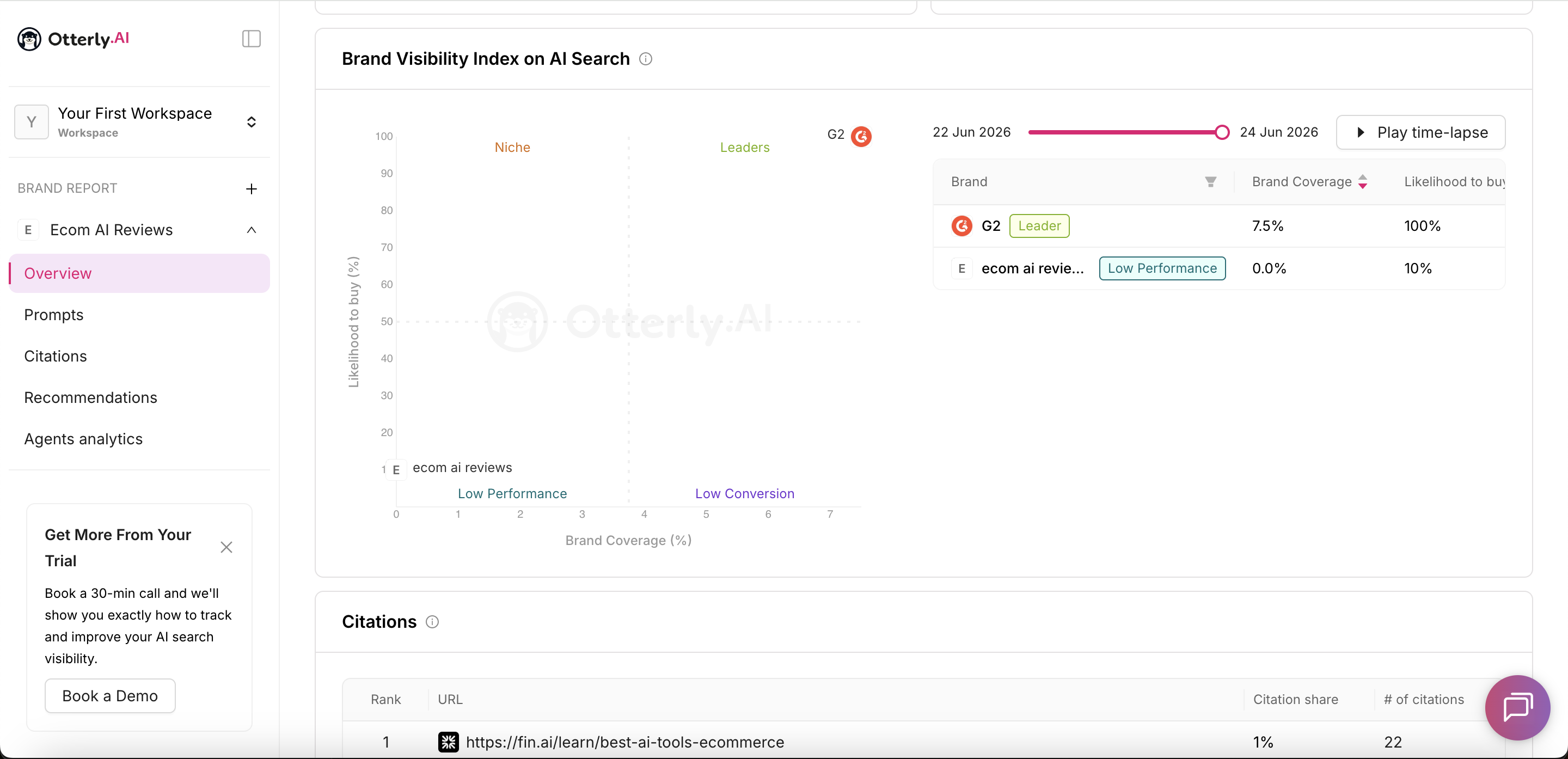
The third layer is citations. This is the part I would watch closely for GEO work.
Otterly.AI separates brand mentions from domain citations. That matters because AI engines can recommend a competitor while citing a third-party page, or mention your category without citing your site at all. In the Ecom AI Reviews test, the citation tables surfaced domains such as Shopify, Reddit, YouTube, Capterra, and other ecommerce/software sites. That is a practical clue: AI visibility is not won only on your own pages.
For an ecommerce seller, citation reports can suggest three kinds of work:
- Fix owned pages so AI engines have clean product, category, pricing, policy, and review evidence.
- Earn or improve third-party pages that AI engines already cite in the category.
- Build content that answers the exact prompts where your domain citation share is zero.
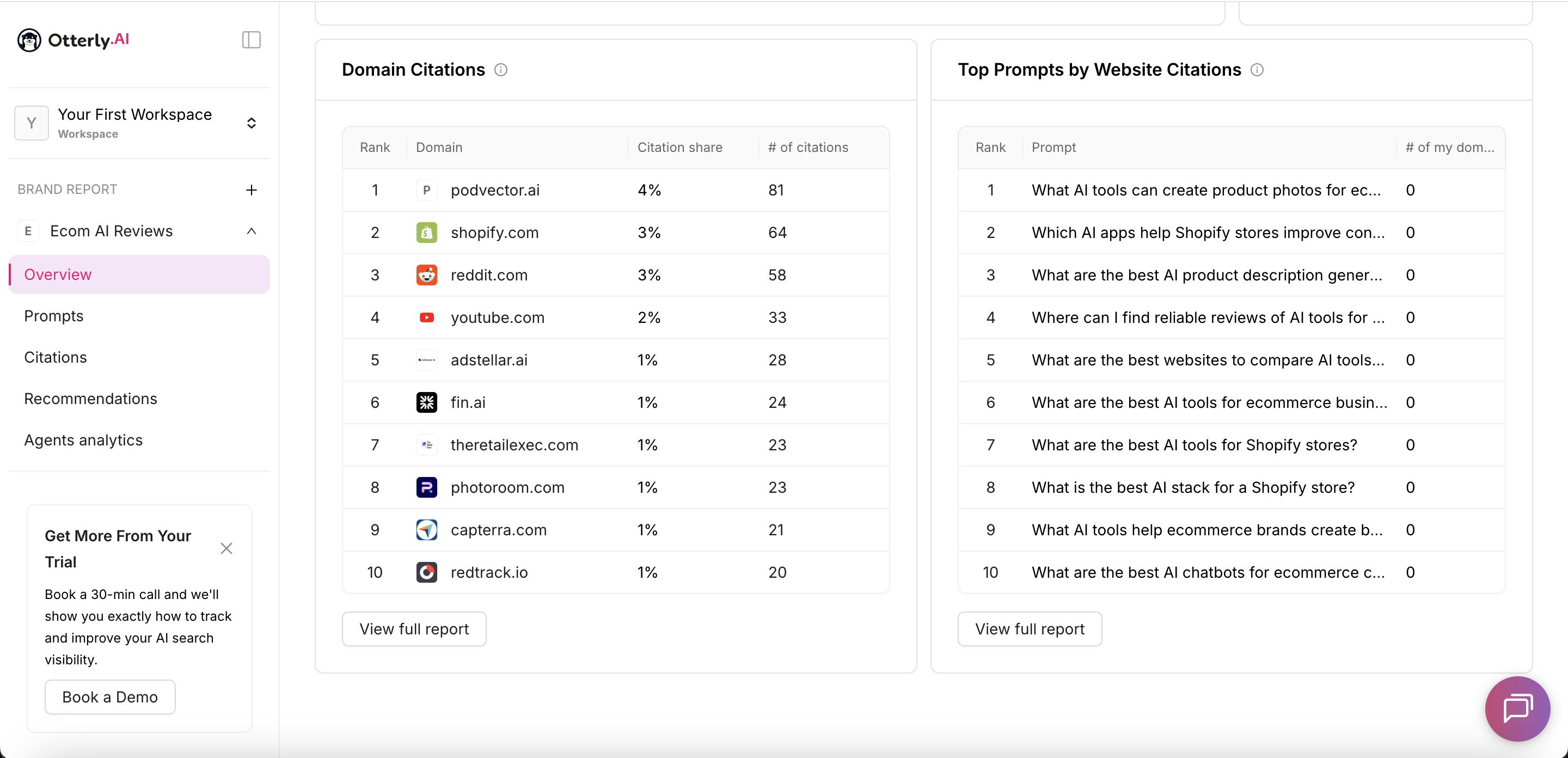
The strongest use case is monthly or weekly monitoring across multiple focused reports. If you already have a content calendar, product pages, schema cleanup, and review collection in motion, one report can track category visibility, another can track competitor comparisons, and another can track branded trust. That is more useful than one oversized report trying to explain everything.
General Tools Beyond Brand Reports
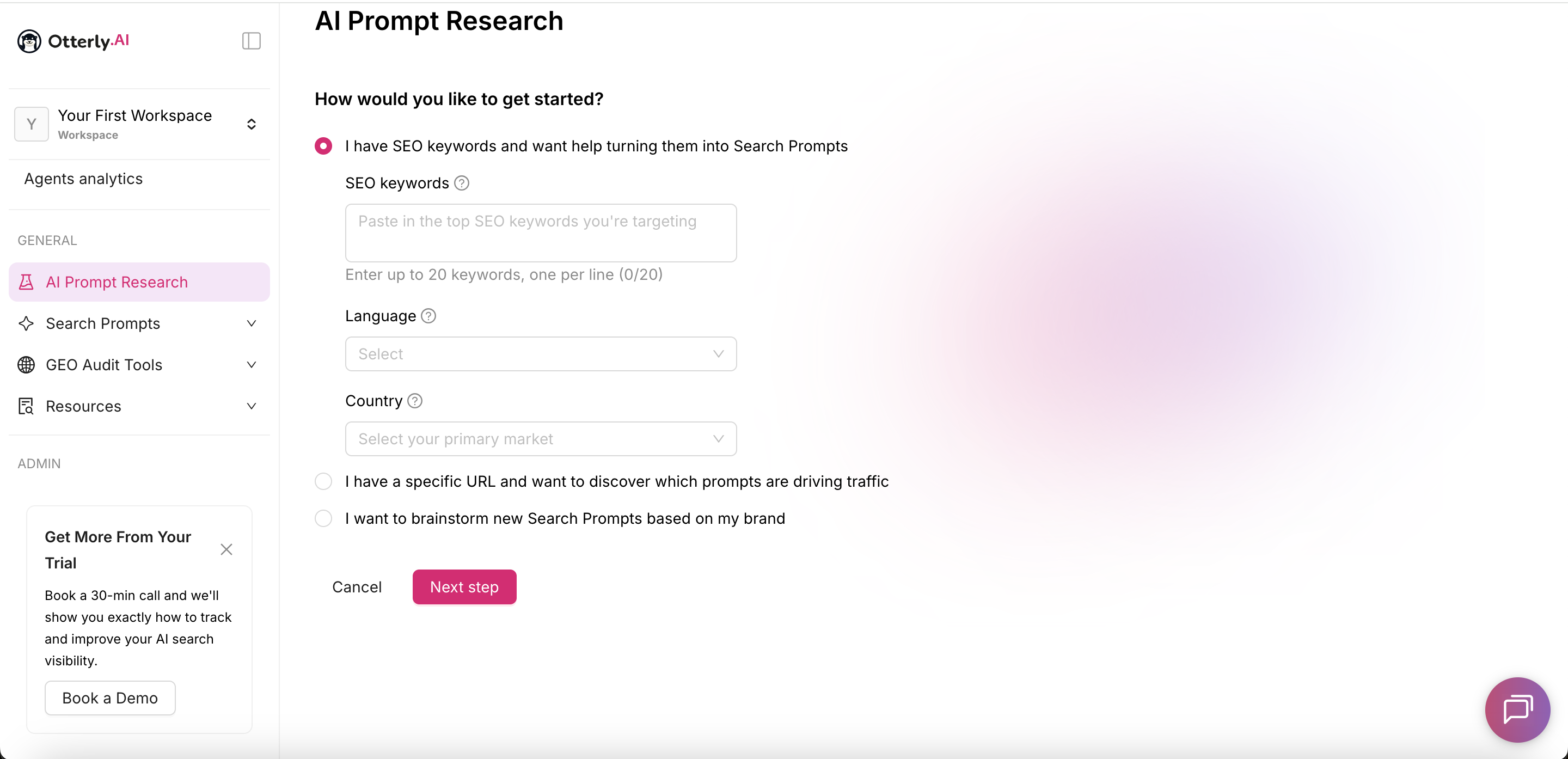
Otterly.AI is not only a Brand Report dashboard. The left navigation also exposes a broader set of general tools: AI Prompt Research, Search Prompts, GEO Audit Tools, Resources, and Agents analytics.
I would think of these as workflow helpers around the core report:
- AI Prompt Research helps generate candidate search prompts from SEO keywords, a specific URL, or a brand brainstorming brief.
- Search Prompts appears to be the prompt library layer: the place to organize, inspect, and reuse the questions that power reports.
- GEO Audit Tools suggests a more tactical audit workflow for checking whether pages are ready to be cited or understood by AI engines.
- Resources likely supports education, documentation, or templates around GEO work.
- Agents analytics looks adjacent to the reporting layer, but I would want more hands-on time before treating it as a core ecommerce buying reason.
The AI Prompt Research screen is especially relevant to this review because it explains why Otterly.AI can feel helpful and risky at the same time. It can turn SEO keywords into Search Prompts, discover prompts from a URL, or brainstorm prompts from a brand. That is useful for getting started. But based on the generated prompt quality I saw in the Ecom AI Reviews setup, I would still treat this as a draft generator, not the source of truth.
The best workflow is probably:
- Use AI Prompt Research to get unstuck.
- Manually remove off-topic or adjacent-category prompts.
- Group the remaining prompts by one buyer mindset.
- Build one Brand Report from that focused group.
- Only then use the report metrics to decide what to improve.
Ecommerce Fit
Otterly.AI is useful for ecommerce, but it is not ecommerce-native in the way a store operator might expect.
The good fit:
- A solo seller wants to stop checking prompts manually.
- A small DTC team wants a baseline before investing heavily in GEO content.
- A founder wants to see whether AI engines recommend competitors.
- An SEO or content lead wants AI visibility next to traditional search work.
- An agency wants a lightweight report for ecommerce clients.
- A team is willing to prepare its own prompt sets instead of outsourcing the strategy to generated suggestions.
The weaker fit:
- You want SKU-level tracking.
- You need product-feed diagnostics.
- You need revenue attribution from AI mentions.
- You want review-content analysis by product attribute.
- You need direct Shopify, Klaviyo, Google Merchant Center, or analytics tie-ins.
This is the central buying decision. If your current pain is “I do not know whether AI engines mention us”, Otterly.AI fits. If your current pain is “which product page update drove purchases from AI search”, the product is probably not deep enough by itself.
Pricing and Value
As of June 24-25, 2026, Otterly.AI’s public pricing page and in-app plan screen list three main monthly plans:
| Plan | Price | Prompt limit | Other practical limits |
|---|---|---|---|
| Lite | $29/month | 15 tracked prompts | 1,000 URL audits/month, 3 recommendations/week, 1 workspace, unlimited brand reports |
| Standard | $189/month | 100 tracked prompts | 5,000 URL audits/month, unlimited recommendations, unlimited workspaces, 2,000 API requests/month, 2,000 MCP requests/month, Looker Studio connector |
| Premium | $489/month | 400 tracked prompts | 10,000 URL audits/month, unlimited recommendations, unlimited workspaces, 5,000 API requests/month, 5,000 MCP requests/month, Looker Studio connector |
Standard and Premium also show an option to add 100 prompts for $99/month. All three plans list daily AI visibility tracking, an AI prompt research tool, citation and link analysis, and a Generative Engine Optimization audit. The in-app plan screen also lists add-ons, so buyers should still confirm exactly which AI engines are included in the plan they choose.
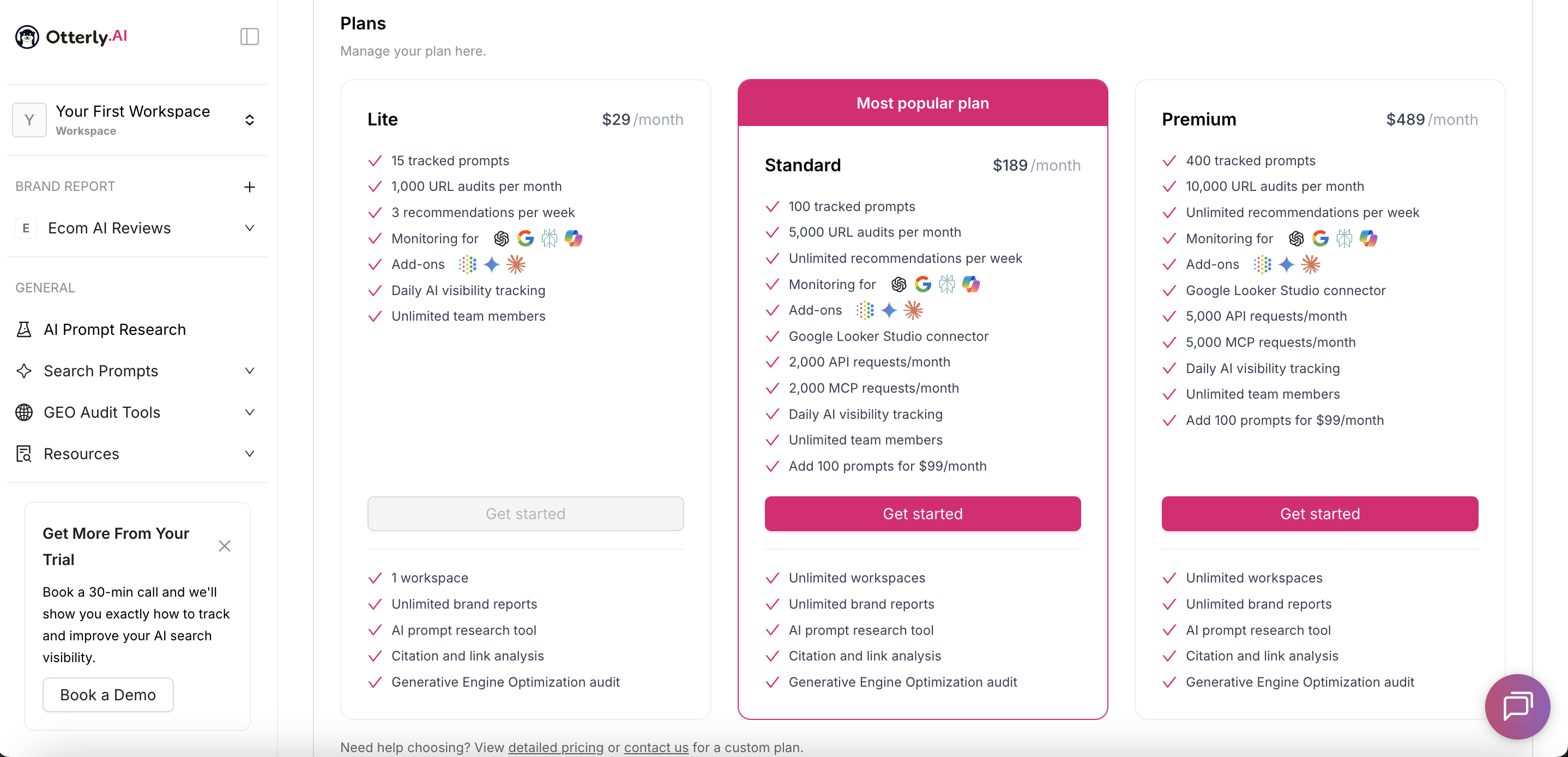
The entry price is one of Otterly.AI’s advantages. A $29/month AI-visibility monitor is easy to justify if you already know you want to track the category.
The real question is not the sticker price. It is prompt coverage and workflow depth.
A small ecommerce seller can start with Lite if the scope is narrow: one workspace, one brand, one country, one language, one product category, and a focused set of 10 to 15 buyer questions. Lite still lists unlimited brand reports, but that does not mean unlimited useful measurement. With only 15 tracked prompts, each report needs a tight angle.
Standard becomes more realistic once you want to monitor multiple prompt sets, run more URL audits, export reporting into Looker Studio, or connect the workflow to API/MCP-based processes. Premium looks like the agency or larger-team tier: more prompts, more audits, and higher integration capacity.
At that point, Otterly.AI is no longer a casual experiment. It becomes a recurring marketing tool that needs to influence actual content, schema, PR, review, or merchandising decisions.
What I Like
First, onboarding is clear. The product does not throw you into an empty dashboard and ask you to invent a measurement system. It asks for brand and market inputs, suggests competitors, generates prompts, and explains reports.
Second, the report format is readable. Brand ranking, coverage, mentions, citations, and top prompts are the right starting metrics for GEO.
Third, the report-per-prompt-set model is the right mental model. Multiple focused reports can show different sides of AI visibility without collapsing every buyer question into one score.
Fourth, the product has a practical middle ground. It is more repeatable than a spreadsheet and cheaper than an enterprise research stack.
Fifth, the workflow encourages better behavior. Prompt review, competitor cleanup, and reporting cadence are exactly the habits ecommerce sellers need before they start making big claims about AI visibility.
What Could Be Better
The biggest issue is input quality.
Otterly.AI can generate prompts automatically, but my test set was not accurate enough to use as-is. That is not a minor detail. Since every Brand Report is downstream of a prompt group, weak prompts create polished but misleading reports. The product would be stronger if it made prompt strategy more explicit: group purpose, target buyer mindset, excluded topics, market, language, and competitor set.
The second issue is ecommerce specificity.
Otterly.AI can tell you whether your brand appears in AI-search answers. It can help you see competitors and citations. But ecommerce visibility is not just brand presence. It is also product attributes, price, availability, reviews, return policy, shipping details, comparison language, and third-party trust.
For a serious ecommerce GEO workflow, I would want deeper answers to questions like:
- Which product pages are missing schema?
- Which product attributes are most often cited by AI engines?
- Which reviews supply the language AI engines quote?
- Which competitor product pages are winning and why?
- Did AI visibility correlate with revenue or assisted conversions?
Otterly.AI may support parts of this through audits, recommendations, exports, and API workflows, but the screenshots and public pages do not make it feel fully store-native yet.
The third issue is plan complexity. The public site markets broad AI-engine coverage, while pricing details split coverage by included engines and add-ons. That is not unusual, but buyers should check the exact engine mix before signing up.
Who Should Use Otterly.AI?
Use Otterly.AI if you are already doing some SEO or content work and want AI-search tracking to become a routine part of the process.
It is especially sensible for:
- A DTC founder who wants a monthly AI visibility baseline
- A small ecommerce team watching competitors in ChatGPT and AI Overviews
- A content lead deciding which buyer questions deserve new pages
- An agency that needs repeatable GEO reporting for clients
- A seller who tried manual prompt tracking and found it too inconsistent
- A team that already knows the prompt categories it wants to monitor
The best first month is simple: prepare one prompt set yourself, keep it to 10 to 15 prompts, clean up the competitor list, run the baseline, and turn the top gaps into content or technical fixes. Then create a second report for a different angle only after the first one is useful.
Who Should Skip It?
Skip Otterly.AI for now if you have not done the basics.
If your product pages lack clean titles, schema, stock status, review markup, product attributes, comparison copy, or category content, tracking will mostly tell you what you already know: AI engines do not have enough reliable evidence to cite you.
Also skip it if you only need a one-time check. You can run a manual prompt spreadsheet first. Otterly.AI becomes more valuable when you want repeatable monitoring, competitor comparison, and progress tracking over time.
Skip it if you expect the tool to invent the right prompt strategy for you. The auto-generated prompts are a starting point, not the final measurement plan. We will cover prompt design in a dedicated guide, but the short version is: bring your own coherent prompt set.
Alternatives to Consider
- Triple Whale: Better if you want ecommerce-native visibility tied more closely to revenue context.
- Peec AI: Better if you want a monitoring-first AI visibility tool and will handle strategy yourself.
- Alhena AI: Better if you want visibility bundled with an ecommerce shopping assistant and support automation.
- Profound: Better for enterprise AEO teams that need broader governance, crawler analytics, and reporting depth.
- Manual spreadsheet: Better if you have fewer than 10 prompts and have not proved the workflow is worth paying for.
Bottom Line
Otterly.AI is worth testing if AI visibility has moved from curiosity to recurring marketing work.
The product’s biggest strength is making AI-search monitoring feel operational: choose a focused prompt set, generate a Brand Report, compare competitors, watch the same report over time, and use the gaps to decide what to fix next.
For ecommerce sellers, I would start small. Use Lite only if your first report has a narrow prompt set. Do not rely on the generated prompts without editing. Upgrade only when the reports are changing what you publish, which pages you improve, which citations you pursue, or which competitors you watch.
Otterly.AI will not do GEO for you. But it can make the work visible enough to manage.
Sources Checked
- Otterly.AI feature overview
- Otterly.AI pricing
- Hands-on screenshots captured during Ecom AI Reviews test sessions on June 23 and June 25, 2026.
Comments