How to choose
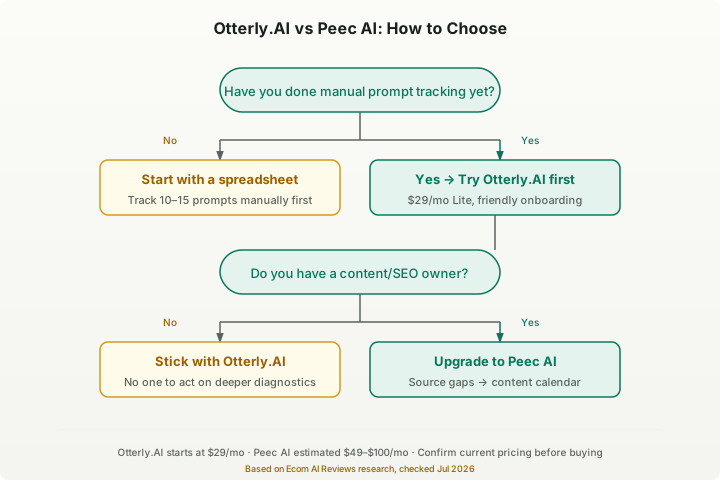
Start with the question you are actually trying to answer.
If the question is, “Are AI engines mentioning us, and which competitor shows up instead?”, Otterly.AI is the cleaner first buy. It is cheaper, easier to start, and good enough for a focused prompt set around one category, product line, or buyer question.
If the question is, “Which sources make competitors win, and what should we fix next?”, Peec AI is the better shortlist. The extra value is not a prettier visibility score. It is source and citation diagnosis: which domains, URLs, third-party mentions, and owned pages are shaping AI answers.
The practical split is this: Otterly.AI helps a seller prove the AI visibility monitoring habit. Peec AI helps a team turn that habit into a weekly operating workflow.
What the extra money buys
Otterly.AI is the better entry point because the Lite plan gives a small team a low-risk way to stop checking prompts manually. The trade-off is prompt volume. Fifteen tracked prompts can be enough for one tight Brand Report, but it gets cramped once you split by category, country, funnel stage, AI engine, and competitor set.
Peec AI costs more and public pricing signals need checking before purchase. In return, it appears to give a more structured diagnostic layer: source reports, domain and URL analysis, classifications, competitor benchmarking, and action-style follow-up around citation gaps. That matters when AI engines are citing review sites, Reddit threads, YouTube videos, comparison pages, or competitor assets instead of your own pages.
So the extra spend only makes sense if someone owns the follow-up work. Peec can point to the source gap; it will not rewrite product pages, fix schema, collect better reviews, pitch third-party guides, or prove revenue attribution from AI search.
Where Otterly.AI wins
Otterly.AI wins for the first paid step after a manual spreadsheet. It is especially sensible when the buyer is a solo founder, small DTC marketer, or agency operator who wants a simple recurring baseline without committing to a heavier AEO stack.
The strongest workflow is narrow:
- Choose 10 to 15 buyer prompts.
- Clean the competitor list manually.
- Build one Brand Report around one product category or buyer question.
- Read brand mentions, competitor presence, top prompts, and citations.
- Turn the top gaps into content, schema, review, or third-party mention work.
That is enough to learn whether AI visibility is worth managing every month. It is not enough to map an entire catalog or prove that a ChatGPT mention created sales.
Otterly.AI also wins when speed matters. If a founder asks, “Do AI engines mention us at all for these prompts?”, the setup and report workflow are more direct than Peec’s deeper diagnostic model.
Where Peec AI wins
Peec AI wins when the team already knows which prompts matter and wants to understand why it is losing them.
For ecommerce, source analysis is the key difference. A brand can be absent from AI answers because its own product pages are weak. It can also lose because a competitor is present in the third-party pages, review sites, publisher roundups, Reddit threads, or YouTube videos that AI engines cite. A plain visibility score does not separate those problems clearly enough.
Peec is the stronger choice when you want to ask:
- Which domains are cited when competitors win?
- Are our own product, category, comparison, and FAQ pages being used as evidence?
- Are third-party reviews or community sources shaping the answer?
- Which citation gaps should become content, technical, review, or outreach tasks?
- Which prompts should we keep monitoring after the fix ships?
That is why Peec fits teams with a content lead, SEO owner, ecommerce growth lead, or agency workflow. The product is more useful when findings can become assignments.
Buyer scenarios
For a small DTC store buying its first AI visibility tool, I would start with Otterly.AI. Keep the first project narrow and use the 14-day trial to test whether the reports change your work. If the report only creates curiosity, do not upgrade yet.
For a Shopify team that already has a content roadmap and recurring SEO work, Peec AI is more interesting. The source layer can show whether the next best move is a product-page update, comparison page, review collection push, third-party inclusion, or stale-source cleanup.
For an ecommerce agency, Peec AI is the stronger default if multiple client projects and recurring source-gap reporting matter. Otterly.AI can still fit as a lower-cost monitoring starter, but Peec’s project, source, and reporting depth better match an agency operating rhythm.
For a solo seller with fewer than 10 prompts, neither tool should be the automatic first step. Use the manual ecommerce AI search prompt guide and the GEO checklist for ecommerce first. Buy software after the manual checks produce repeatable questions worth tracking.
Evidence caveat
This comparison uses different evidence levels. Ecom AI Reviews tested Otterly.AI hands-on with a live setup and screenshots in June 2026. The Peec AI review is researched, based on Peec’s public pages, docs, pricing signals, and third-party research notes checked through July 1, 2026. Treat Peec product claims here as researched buying signals, not live workspace test results.
That difference does not make Peec a weaker product. It means the comparison should be read honestly: Otterly.AI has direct test evidence on this site; Peec AI has public-evidence analysis and still needs hands-on verification.
Bottom line
Choose Otterly.AI if you want a low-cost, self-serve way to make AI visibility visible for the first time. It is the better first paid tracker for a small store, especially if you can bring a clean prompt set.
Choose Peec AI if AI visibility has become a real operating workflow and the team needs source-level diagnosis. It is the better fit when the next question is not “are we mentioned?”, but “which cited evidence makes competitors win, and what work should we assign next?”
For the broader category context, see the best AI visibility tools for ecommerce, the Otterly.AI review, and the Peec AI review.
Comments