Verdict
Profound is the most serious, most complete AI-visibility platform available in 2026 — and it knows it, which is reflected in pricing that quietly excludes everyone who isn’t an enterprise. If you’re a large brand or a well-resourced agency, it belongs at the top of your shortlist. If you’re a DTC operator, this review is best read as a category map, not a buying recommendation.
What makes Profound special is real, not marketing. Prompt Volumes — its panel-based dataset of what people actually ask AI — is a moat no lightweight tool can match, and Agent Analytics reads your server logs to show how AI crawlers really hit your site. On top of monitoring, it’s the rare “read/write” platform: its Agents don’t just report, they research and publish content to win answers, with a human approving before anything goes live.
The catch is access and fit. There’s no trial and no self-serve, pricing is custom and four-figure, and the whole platform is sized for teams. For an ecommerce store whose real question is “does ChatGPT recommend me?”, that’s a Fortune 500 instrument aimed at a question lighter, self-serve tools answer for a fraction of the cost. Our score reflects that gap between product power (excellent) and DTC fit (low) — not a knock on the product itself.
Scoring note: Ecom AI Reviews is written for small-to-mid-market ecommerce, DTC, Shopify, marketplace, and independent-store teams first. If this were an enterprise analyst report, Profound’s score would likely be higher. In our rubric, accessibility, self-serve evaluation, pricing fit, and operator usability count alongside raw capability.
What Profound Does
Profound pitches itself as a full-stack marketing platform for “the marketer of the future.” Strip the slogan away and it does two distinct jobs. First, it monitors how your brand surfaces inside AI-generated answers across every major engine. Second — the part that justifies the price — it acts: it ships AI “Agents” that research and publish content designed to win those answers. Profound calls this a “read/write” platform for AI, versus the read-only monitoring tools that only tell you the score.
The customer roster tells you who it’s built for: Uber, LinkedIn, Airbnb, Walmart, Target, Expedia, Ramp. These are organizations where AI visibility is a board-level line item with a dedicated owner and budget. That positioning is deliberate — Profound has openly avoided the SMB market — and it shapes every decision from feature depth to pricing. If you need the operator-level playbook before choosing software, start with our GEO checklist for ecommerce.
The category it created: AEO (Answer Engine Optimization) and GEO (Generative Engine Optimization) are to AI answers what SEO was to blue links. The premise: consumers increasingly ask an AI assistant what to buy instead of Googling it, so the new battleground is whether the AI recommends and cites you. Profound’s whole platform is organized around measuring and winning that.
The Platform Architecture: Monitor + Create
Before the feature walk-through, it helps to see how Profound organizes itself, because it splits cleanly into two halves. Monitor is everything that measures and analyzes (four modules). Create is the half that takes action (one module, Agents). Every feature below lives in one of these two blocks, and the pitch is that Monitor feeds Create: you find the gaps, then an Agent fills them.
Monitor — measure & analyze
- Answer Engine Insights — how AI mentions, ranks, and cites your brand
- Prompt Volumes — what people actually ask AI (search volume for prompts)
- Shopping — your product placement inside ChatGPT Shopping
- Agent Analytics — how AI crawlers hit your site, from server logs
Create — take action
- Agents — no-code AI workflows that research, draft, and publish AEO content, with a human approving before anything goes live
Answer Engine Insights
Monitor · “Understand how AI is talking about your brand”
This is the flagship dashboard. It runs a set of structured prompts across the AI platforms every day — on the logic that AI never returns the same answer twice, so a visibility score is only meaningful as a running average — and analyzes where and how your brand appears.
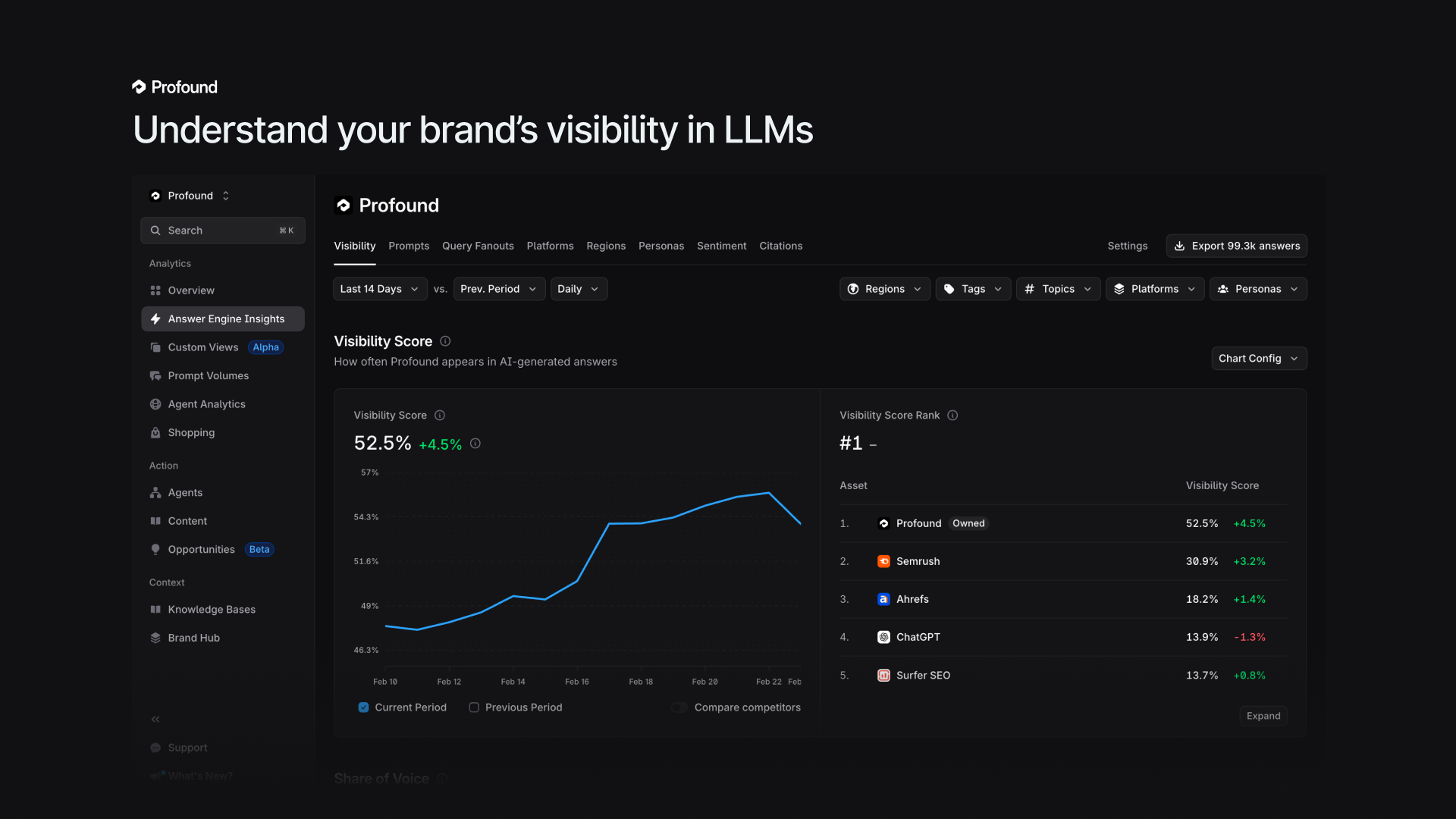
It breaks into a stack of sub-dashboards:
- Visibility & Share of Voice — how often you appear and your average position, filterable by topic, platform, region, and persona, so you see where you win and where you’re invisible.
- Citations — which domains and pages AI engines pull from, with Citation Share and Rank — effectively a roadmap of where to get mentioned.
- Sentiment & keyword themes — how AI describes your brand, for catching outdated messaging or competitor-framed comparisons.
- Query Fanouts, Platforms, Regions, Personas, Prompts — slice every metric by the dimension that matters, with a proprietary Profound Index score and CSV export.
One technical detail is a genuine differentiator: Profound captures responses from the browser — the real front-end a user sees — not from an API. Many cheaper tools query the API, which can return different answers than a consumer gets. Coverage spans the front-ends of ChatGPT, Perplexity, Claude, Copilot, Google AI Overviews and AI Mode, Gemini, Grok, Amazon Rufus, Meta AI, and DeepSeek, across 30+ languages and 150+ regions.
What we can’t verify: whether this returns clean, accurate data for your specific category is exactly what a demo would confirm, and exactly what we couldn’t test. We also can’t independently confirm the “browser, not API” claim from the outside — it’s Profound’s stated method, and a credible one, but we’re reporting it, not verifying it.
Prompt Volumes
Monitor · “The keyword data your SEO tools don’t have”
If one feature explains Profound’s price and its lead, it’s this. Instead of only tracking the prompts you configure, Prompt Volumes reveals what people are actually asking AI — billed as the world’s first tool to estimate AI search volume. Think of it as keyword research rebuilt for the AI era, where queries are longer, conversational, and full of follow-ups no Google keyword tool captures.
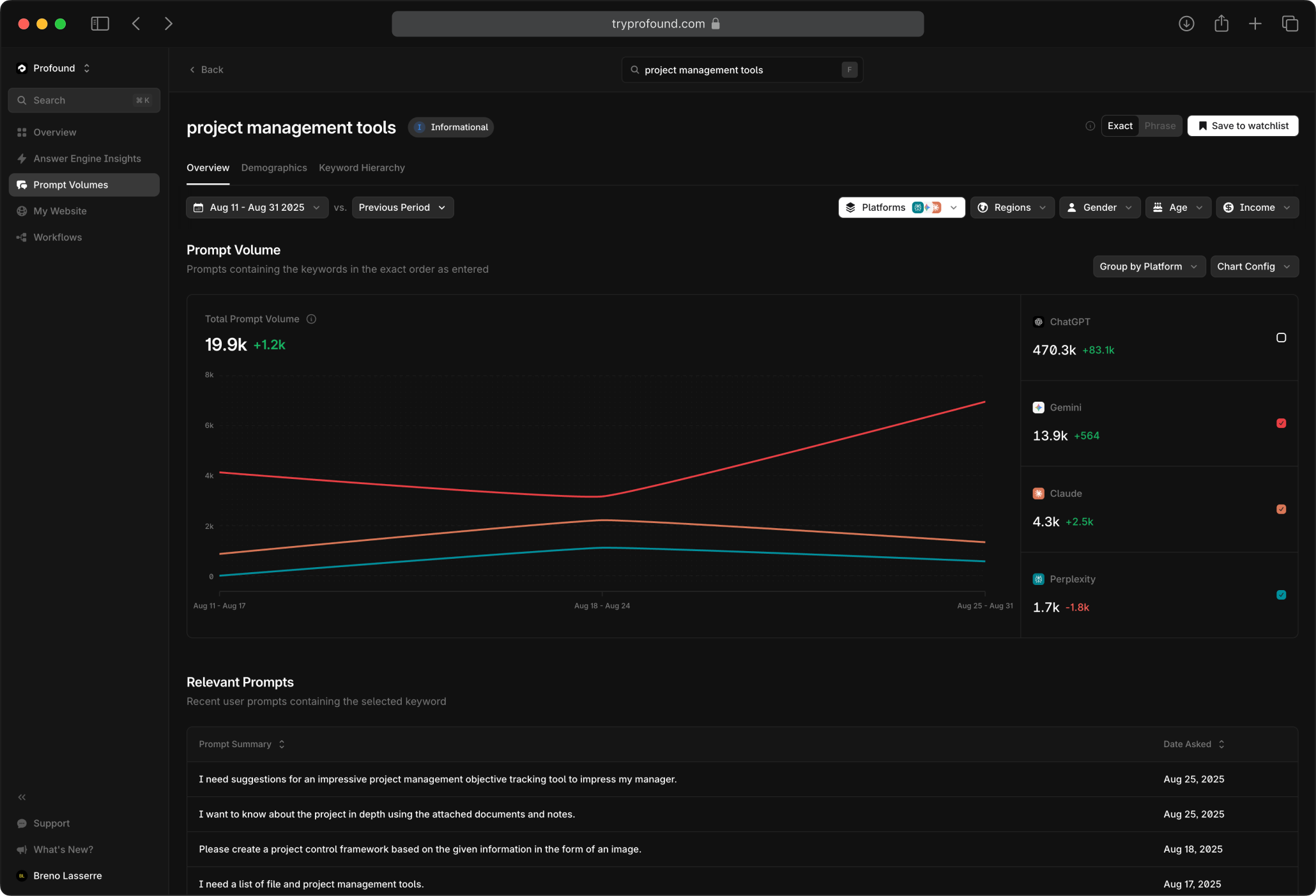
The strategic shift it enables is the whole point: instead of “which keyword should we target,” you ask “which AI conversations are happening without us in them?” It’s built across several layers:
- Keyword hierarchy & intent — visualize how a seed term fans into sub-topics and long-tail variations, with automated intent classification (informational, commercial, conversational, generative) and a sunburst of sub-intents.
- Demographic breakdown — filter prompt demand by platform, age, and income to see how it varies by segment.
- Competitive & co-citation mapping — see which competitors appear alongside you in the same answers, and detect “uncited prompts” where a rival is cited and you aren’t.
- URL-level prompt lookup — search any page slug and see the exact prompts that cause AI engines to cite that page, by platform and volume.
Where the data comes from (and the caveat): This is panel data — hundreds of millions of prompts a month — licensed from double opt-in consumer panels of real AI users, then anonymized, PII-scrubbed, and modeled to correct for demographic and geographic bias (GDPR/CCPA compliant). A real, defensible moat. The caveat: it’s modeled demand, not a census, strongest in major markets (US, UK, Canada, Germany, France, and a handful more) on ChatGPT, Gemini, Claude, and Perplexity — data from January 2025, refreshed weekly.
Shopping
Monitor · The module DTC sellers will care about most
This is the part aimed squarely at ecommerce, and it’s narrower than the name suggests: today it’s built specifically around ChatGPT Shopping. It tracks how your products are surfaced, described, and placed when a shopping query triggers ChatGPT’s in-chat product tiles instead of a plain text answer.
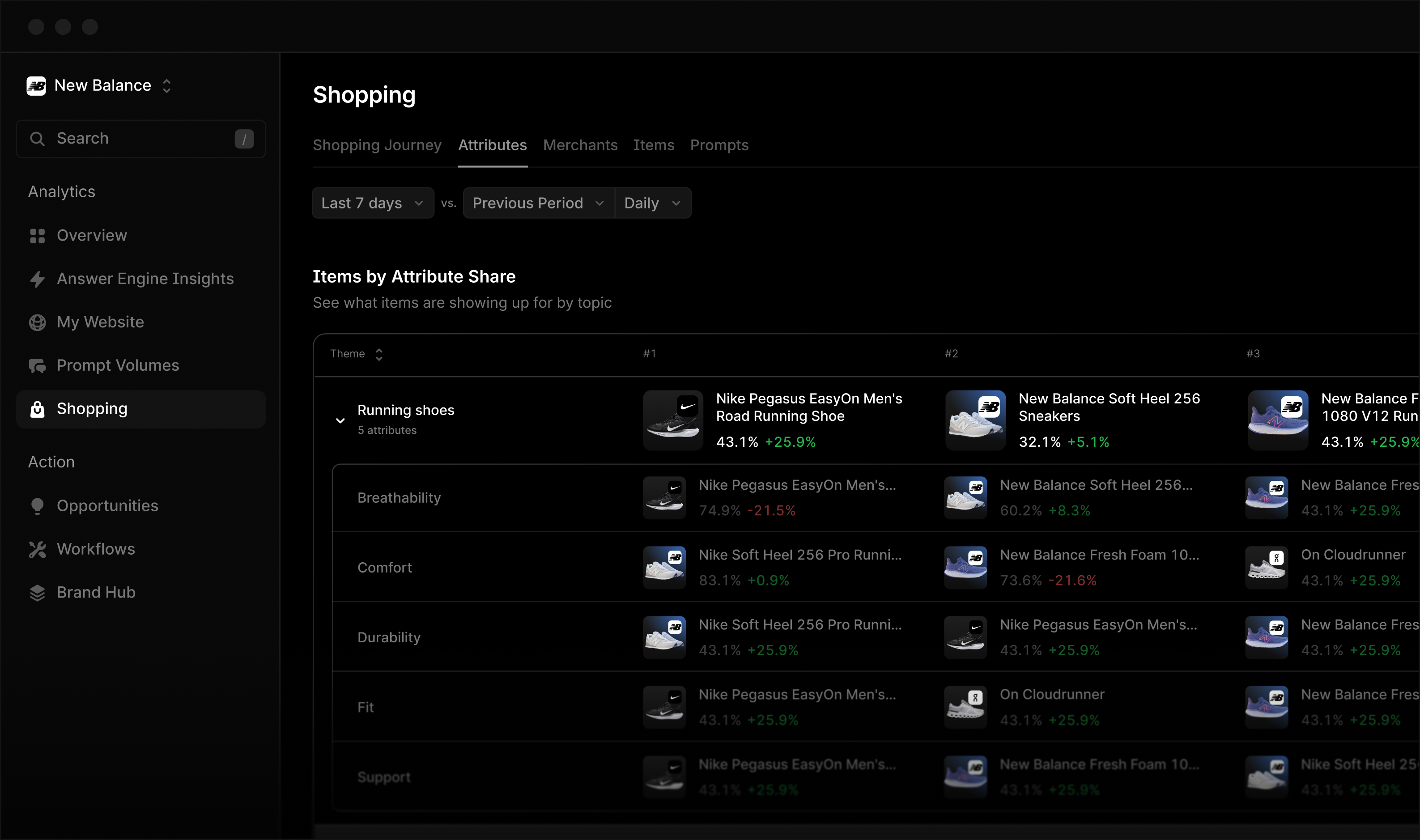
- Shopping Mode Rate — how often queries in your category actually trigger ChatGPT’s shopping interface versus a text response.
- SKU-level analysis — track individual products, how often they appear and for which prompts, and whether ChatGPT describes attributes correctly.
- Merchant Layer — a genuinely interesting one: which third-party retailers vs. your direct store own the checkout when your products surface. This is where you learn a marketplace is intercepting sales that should be yours.
- Action levers — product-feed and structured-data fixes, merchant-relationship optimization, and competitive targeting for prompts that return rivals but not you.
For a DTC operator this is the most relevant capability on the platform — but it’s bundled into an enterprise product priced for large retail, and it’s ChatGPT-only for now.
Agent Analytics
Monitor · The quiet technical strength
This is the server-side half, and even skeptical third-party reviewers call it a real strength. Instead of JavaScript trackers, it reads your server logs to show exactly how AI crawlers (GPTBot, ClaudeBot, PerplexityBot, and the rest) hit your site — with verification that distinguishes real bots from spoofed ones.
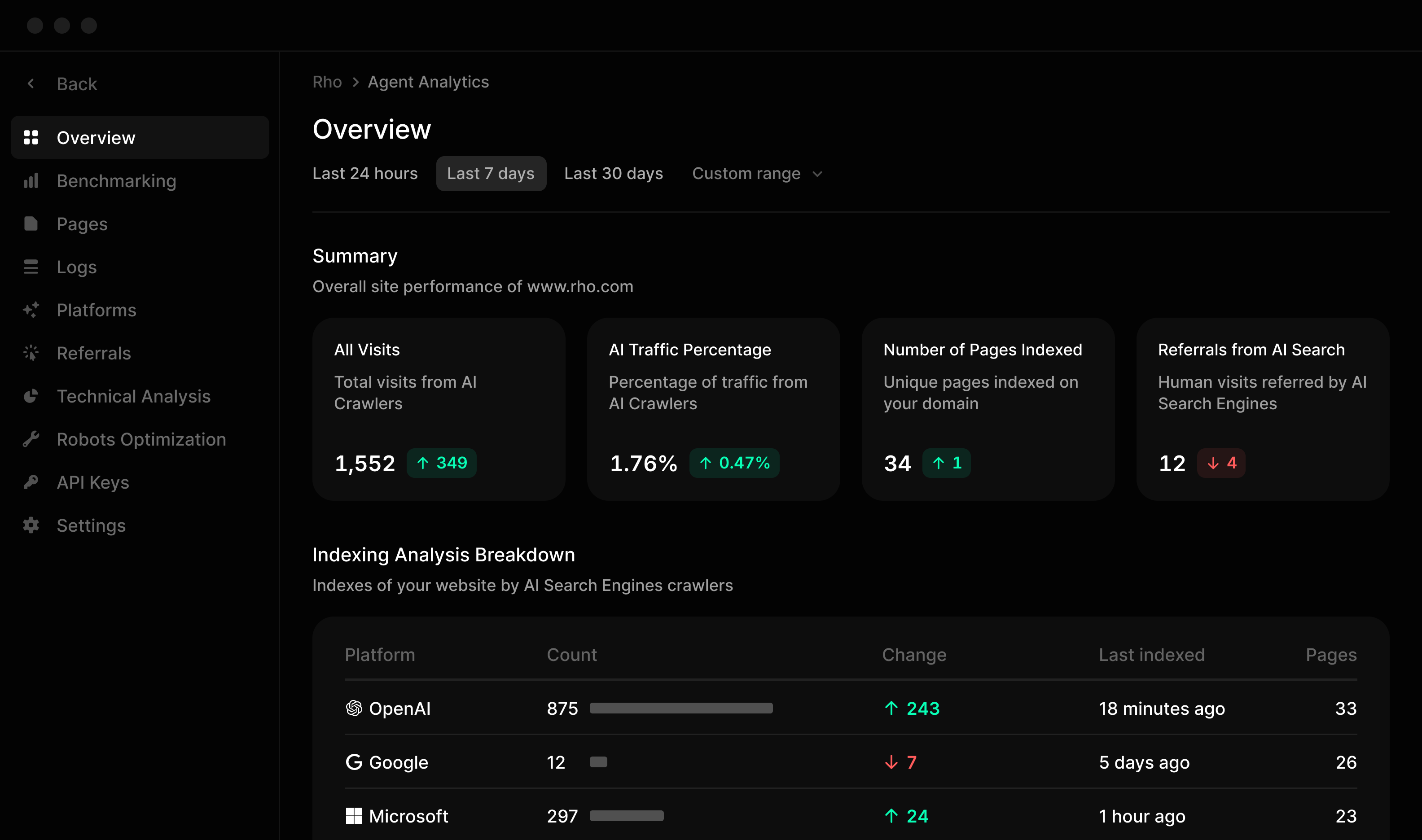
- Crawler visibility & real-time monitoring — when, how often, and which AI bots access your content, live.
- Attribution & traffic insights — how AI-driven discovery converts into actual human visitors.
- Content performance & benchmarking — which pages get referenced most, benchmarked page-by-page against 100,000+ pages in Profound’s network, refreshed daily. Asset Hierarchies roll product/feature data up to the brand.
- Submit to AI Search — push new content directly to AI crawlers for faster discovery.
It deploys through edge/CDN and platform connectors (Cloudflare, Fastly, Akamai, Vercel, Netlify, AWS, GCP, WordPress, Shopify, Adobe) via log forwarding, with the usual enterprise security posture.
Agents
Create · “Your marketing team, multiplied”
This is the entire Create side of the platform — and what turns Profound from a dashboard into a platform. Agents is a no-code, drag-and-drop workflow builder where AI agents perform marketing work: scrape a page, determine the core search query, research what’s being cited, draft AEO-optimized content, and publish — with a human approving before anything goes live.
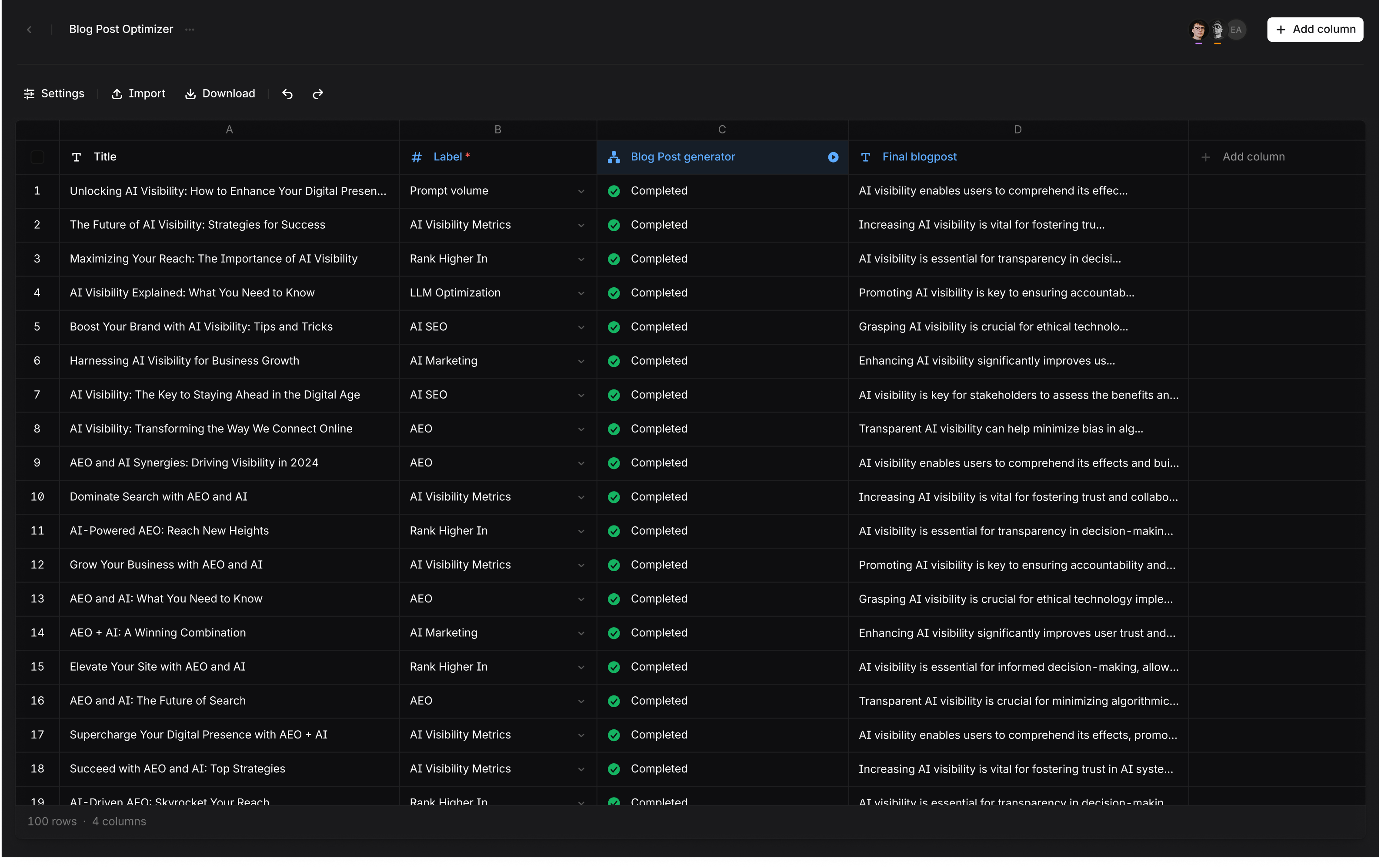
- Pre-built templates — content refresh (reclaim declining citations), AEO FAQ generation, competitive research, and net-new article creation.
- Closed-loop optimization — Agents track which content earns citations and feed those patterns into the next draft, so output compounds. Each run can query a stack of reasoning models plus Profound’s own prompt data before drafting.
- Brand kit & knowledge base — workflows pull from your tone guidelines and a single source of truth to stay on-brand at scale.
- Sheets — process hundreds of inputs in parallel, every step visible and editable; CMS integration publishes approved content directly.
Pricing here is credit-based — each agent run consumes credits, and more complex multi-step agents cost more (self-serve plans include a fixed monthly allotment; bigger volumes require enterprise). This is the piece competing most directly for budget against hiring a person or an agency.
Platform & Engine Coverage
On the right plan, Profound monitors the widest set of answer engines in the category. How many you can actually track depends on your tier — the broad list is an enterprise privilege.
ChatGPT · Claude · Gemini · Perplexity · Copilot · Grok · Meta AI · DeepSeek · Google AI Overviews · Google AI Mode · Amazon Rufus
Security & Compliance
Part of the moat that keeps Profound in enterprise deals where lighter tools can’t compete: SOC 2 Type II, HIPAA, single sign-on via SAML/OIDC, role-based access control, encryption at rest and in transit, automated daily backups, and GDPR/CCPA compliance on the panel data. In a regulated industry, this is the difference between “approved” and “not a chance.”
Ecommerce Fit
Profound can serve ecommerce, but it isn’t ecommerce-native the way a store operator might hope, and its accessibility is the opposite of DTC-friendly.
The good fit: a large retailer or brand where AI visibility is a board priority; an agency running GEO for enterprise clients; a team that needs Amazon Rufus and ChatGPT Shopping placement data, server-log crawler attribution, and compliance to clear procurement.
The weaker fit: a solo seller or small DTC store; anyone who wants to try before buying; teams needing affordable per-prompt tracking, simple Shopify-native tie-ins, or revenue attribution from AI mentions without a four-figure contract and a sales cycle.
The central decision: if your pain is “I don’t know whether AI engines mention us,” far cheaper self-serve tools answer that today. Profound earns its price only when you have a dedicated program and the budget to match.
Pricing and Value
This is where Profound gets genuinely hard to pin down — and where a DTC operator’s heart rate should settle back down.
- No free trial, no self-serve signup. Most of the sales motion is quote-based enterprise contracts behind a demo.
- Inconsistent public signals. The official pricing page now points to custom enterprise pricing, while older public references cite ~$99 Starter and ~$399 Growth tiers, and some reviews mention a “Lite” tier around $499/mo.
- Real deployments are four figures. Third-party estimates put enterprise contracts anywhere from ~$2,000 to $5,000+ per month, depending on platform count, seats, and features — numbers Profound doesn’t publish, so confirm them in a demo.
- One documented hard limit: prompt tracking is capped per tier — roughly 50/month on Starter, 100 on Growth, custom on Enterprise. Since prompts are the unit of visibility measurement, that cap defines how much of your category you can watch.
For context on why it’s priced like this: Profound raised a $96M Series C at a $1B valuation (Lightspeed-led, February 2026), bringing total funding to roughly $155M. It is built, funded, and priced to sell to the enterprise.
What’s Strong
Profound’s strengths are genuine, not marketing gloss. Its data is the deepest in the category — Prompt Volumes is a real, hard-to-copy moat, and Agent Analytics gives server-log crawler tracking that technical teams consistently praise. It captures answers from the browser rather than the API, covers the broadest set of engines (including Amazon Rufus for retail), clears enterprise compliance (SOC 2 Type II, HIPAA, SSO), and — uniquely — acts on what it finds through Agents with a human in the loop.
What Could Be Better
The weaknesses cluster around access and fit. There’s no free trial and no self-serve signup, so you can’t evaluate it without a sales process, and pricing is opaque and enterprise-only — it starts where most DTC budgets end. It’s overkill for a single brand or small store; the Shopping module is ChatGPT-only for now; there’s a real learning curve with a lot of surface area; and prompt caps on lower tiers limit how much of your category you can actually track.
What Real Users Say
Since we couldn’t test Profound ourselves, independent user reviews carry extra weight here. On G2, Profound holds roughly 4.5 out of 5 across about 960 reviews — a strong score. But note the reviewer base skews heavily toward mid-market and enterprise marketing and SEO teams, which is itself a signal about who actually uses (and can afford) the product.
The praise is remarkably consistent across reviews:
- Depth of data. Prompt-level visibility, competitor benchmarking, and especially citation and source analysis come up again and again as the reason teams choose Profound over lighter tools.
- Agent Analytics. Technical SEOs single out the server-log crawler detail, describing visibility into AI-bot behavior they couldn’t get from traditional analytics.
- Agents save real time. One enterprise reviewer reported cutting a content-briefing process from over six hours to under a minute using a custom agent.
- Support and pace. Responsive account teams (often over a shared Slack channel) and a fast feature-shipping cadence are mentioned in review after review.
The criticisms are just as consistent — and they line up almost exactly with our take:
- Price is the number-one complaint. Even happy customers repeatedly call it expensive and enterprise-grade. Several say it’s hard to justify for a single brand, and the per-domain model is hard to scale across an agency’s clients. One agency reviewer could only run it for a single month because their client couldn’t absorb the annual commitment.
- Learning curve. Lots of tabs and unfamiliar metrics; several reviewers note it takes time before the data translates into action.
- Exports and integrations. Getting data out into reporting tools like Looker Studio or Whatagraph is described as clunky.
- Granularity gaps. Limited local and regional breakdowns (for example, Canadian queries pulling US results), and visibility is tightly coupled to the specific prompts you track.
Why this matters for our verdict: the most useful takeaway is that even Profound’s enthusiasts independently confirm the exact thing this review flags — it’s a powerful, enterprise-priced platform that’s hard for small operators to justify. That’s not us guessing from the outside; it’s the recurring verdict of the paying mid-market and enterprise teams who use it daily.
Source: aggregated and paraphrased from public G2 reviews (≈960 reviews, ~4.5/5), last checked June 2026. Themes summarized in our own words, not quoted.
Who Should Use Profound?
Use Profound if you’re a large brand or a well-resourced agency running a dedicated AEO program, you need defensible data for board-level reporting, and “what are millions of people asking AI in our category” is worth four figures a month to answer accurately. It’s especially sensible for enterprise retail that needs ChatGPT Shopping and Amazon Rufus placement data, regulated industries that need compliance to clear procurement, and agencies running GEO as a practice across multiple clients.
Who Should Skip It?
Skip Profound if you’re a DTC seller, solo operator, or small store just trying to find out whether ChatGPT recommends you. You’d be buying a Fortune 500 instrument to answer a question that lighter, self-serve tools answer for a fraction of the cost — and that you can actually try before you buy. Start with an affordable tracker, learn what you need, and only consider Profound if you outgrow it and have the budget and team to use its depth.
Alternatives to Consider
- Otterly.AI — the easiest affordable, self-serve starting point for DTC sellers ($29/mo, free tier). Far less depth than Profound, but you can sign up and see your own data today.
- Peec AI — a monitoring-first AI-visibility tool if you’ll handle strategy yourself and want something lighter than an enterprise stack. For the head-to-head buying call, read Profound vs Peec AI.
- Alhena AI — a better fit if your ecommerce team wants AI visibility bundled with shopping assistance and support automation rather than a standalone AEO platform.
- A manual prompt spreadsheet — still the right first step if you have fewer than ~10 prompts and haven’t proven the workflow is worth paying for.
For the full shortlist, see our best AI visibility tools for ecommerce ranking. If you are still choosing between enterprise, self-serve, and first-paid trackers, the comparison hub is the better next stop.
Bottom Line
Profound is the category ceiling, not the category entry point. The features that make it special — Prompt Volumes and Agent Analytics — are worth understanding as concepts, because cheaper tools are racing to ship lighter versions at prices and with free trials that make sense for the rest of us. If you’re an enterprise, buy with confidence. If you’re a DTC store, learn from it, start smaller, and come back when you’ve outgrown the affordable options.
Sources Checked
We checked Profound’s public product pages, official screenshots, changelog and pricing signals, third-party demo-based reviews, G2 review themes, and public company information. Profound does not offer a public trial, so verify the current quote and contract terms directly before budgeting.
- Profound official pages: Answer Engine Insights, Prompt Volumes, Shopping, Agent Analytics, Agents, pricing, and changelog.
- Third-party hands-on reviews and comparisons, used only where claims aligned across sources.
- Aggregated public G2 review themes, summarized in our own words.
- Public funding, customer, and company information. Last checked June 2026.
Comments