Verdict
Alhena AI is strongest when the buyer wants one ecommerce AI layer across shopping, support, and AI visibility. That is the point. It is not just another prompt tracker.
For a DTC seller, the appeal is clear: one assistant can help shoppers find products, answer support questions, and feed visibility data back into how your products appear in AI answers. If your store already needs all three jobs, Alhena’s bundle is coherent.
The risk is also clear. An all-in-one platform is only a bargain when you need the whole thing. If your real problem is “are we visible in ChatGPT and Perplexity?”, Alhena may be more product than you need. A focused tracker like Otterly.AI, Peec AI, or Triple Whale AI Visibility may be easier to justify first.
My score is 7.8/10.
| Dimension | Score | Read |
|---|---|---|
| Ecommerce fit | 9.0 | The product is built around stores, catalogs, conversations, and support. |
| AI visibility depth | 7.2 | SKU-level and revenue attribution claims are interesting, but public evidence is thin. |
| Support automation | 8.0 | The support workflow looks practical for WISMO, returns, policies, and handoff. |
| Pricing clarity | 6.8 | Public pricing exists, but conversation economics need store-specific math. |
| Evidence quality | 6.9 | Strong vendor materials and positive public reviews, but limited independent depth. |
What is Alhena AI?
Alhena AI is an ecommerce AI platform with three main jobs: onsite shopping assistance, customer support automation, and AI visibility.
That combination is what makes it worth reviewing. Most AI visibility tools watch answer engines from the outside. Alhena also wants to sit inside the buying journey, answer shoppers directly, and use store data as the source of truth.
The public product stack looks like this:
| Product line | What it does | Ecommerce meaning |
|---|---|---|
| AI Shopping Assistant | Conversational search, guided discovery, product recommendations, beauty and fashion agents | Helps shoppers choose products without forcing them through filters and search bars. |
| AI Support Concierge | Automates order tracking, returns, policy questions, and helpdesk handoff | Reduces repetitive tickets while preserving context for human agents. |
| AI Visibility | Tracks how products appear in AI-generated shopping answers | Turns GEO from brand-level mentions into product-level visibility work. |
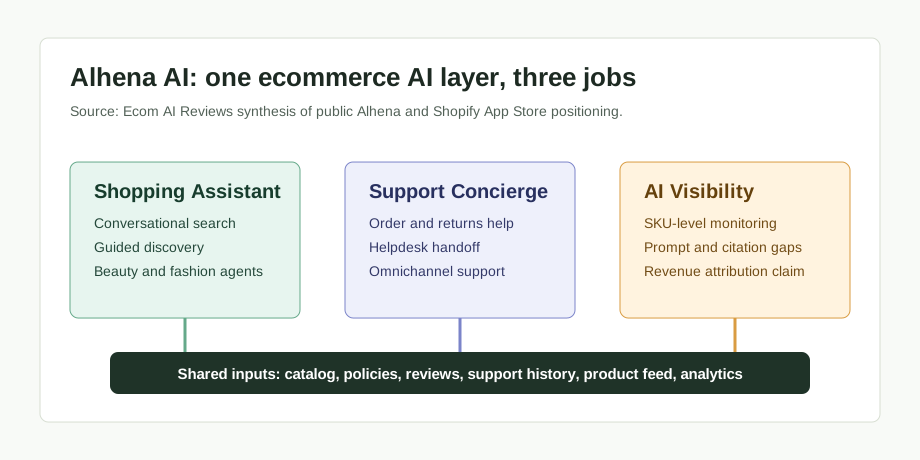
This review is researched, not based on a live Alhena workspace. The facts below come from public Alhena pages, Shopify App Store data, G2 information, and competitor research checked on July 3, 2026.
Alhena AI Shopping Assistant: Deep Dive
The shopping assistant is the cleanest part of the story. It solves a real store problem: shoppers do not always know the exact product name, filter, size, shade, or bundle they need.
Alhena positions this as conversational ecommerce rather than a generic chatbot. Public materials describe natural-language product discovery, guided recommendations, conversion nudges, smart FAQs, and vertical agents for categories such as beauty, fashion, home, travel, and sports.
For a Shopify seller, the useful jobs are:
- Replace brittle keyword search with natural-language questions.
- Ask follow-up questions when the shopper is vague.
- Recommend products from the live catalog.
- Handle category-specific needs such as shade matching, skin routines, fit analysis, outfit building, or visual discovery.
- Nudge hesitant shoppers with contextual offers, answers, or product comparisons.
That is valuable when your catalog has enough complexity to justify conversation. A one-product store does not need this. A skincare, apparel, supplement, home goods, or technical-accessory store might.
The vendor claims are aggressive. Alhena states that customers can see more than 300% conversion lift and more than 50% AOV lift depending on brand. Treat those as vendor-reported outcomes, not a guarantee. The right diligence question is not “can Alhena show a big case study?” It is “what baseline, traffic mix, assistant placement, and attribution window produced that lift?”
The likely best-fit shopping use cases are:
| Store type | Why Alhena may help |
|---|---|
| Beauty and skincare | Shade, skin type, routine, ingredient, and compatibility questions create buying friction. |
| Fashion and apparel | Fit, styling, occasion, bundle, and return-risk questions are hard for static filters. |
| Home and furniture | Size, room fit, material, and use-case questions need guided narrowing. |
| High-AOV catalog stores | A small conversion or AOV improvement can justify the software faster. |
The weaker fit is a simple catalog, low margin, or traffic that is too low to learn from conversation volume.
Alhena AI Customer Support: Deep Dive
Alhena’s support product is a practical extension of the shopping assistant. The same store facts that help a shopper choose a product can also answer post-purchase questions.
The public support pitch centers on hallucination-free support, order tracking, returns, appointment or order actions, helpdesk integrations, omnichannel coverage, and smooth human handoff with conversation history. Alhena also says brands can cut agent ticket volume by up to 70% within the first month. Again, treat that as a vendor claim until your own ticket mix proves it.
The first support target is obvious: WISMO, or “where is my order?” If 30-40% of your support queue is shipping status, delivery timing, return policy, exchange status, or basic product instructions, automation can be useful quickly.
| Support job | Why it matters | What to verify |
|---|---|---|
| Order tracking | High-volume, repetitive, time-sensitive | Can Alhena read order status accurately from your stack? |
| Returns and exchanges | Policy-heavy and emotionally sensitive | Does it know edge cases and when to escalate? |
| Product questions | Pre-purchase and post-purchase overlap | Does it cite current catalog data, not stale copy? |
| Helpdesk handoff | Keeps humans in the loop | Does Gorgias, Zendesk, Freshdesk, or your helpdesk receive full context? |
| Omnichannel support | Shoppers ask from many places | Which channels are included on your plan? |
This is where Alhena’s “hallucination-free” claim deserves scrutiny. A support bot can be grounded in your approved source of truth and still fail in ordinary ways: outdated policies, missing SKU data, weak escalation rules, API sync delays, or ambiguous customer intent.
The right buyer test is concrete. Before buying, give Alhena your ten most expensive support scenarios: late orders, partial refunds, international returns, subscription edits, damaged items, out-of-stock swaps, warranty edge cases, loyalty credit, wrong-size exchanges, and angry VIP customers. If it cannot handle those cleanly or escalate with context, the headline automation rate does not matter.
Alhena AI Visibility: Deep Dive
Alhena AI Visibility is the most interesting and least proven part of the platform from public evidence alone.
The claim is sharper than a generic brand monitor. Alhena says it measures how products appear inside AI-generated shopping answers and gives product-level actions to improve visibility and drive revenue. Public pages reference ChatGPT, Gemini, Perplexity, and AI search results; the task brief also calls out Google AI Overviews.
The ecommerce-specific promise is SKU-level tracking. That matters because brand-level visibility can hide the real problem. A store may be mentioned as a brand but lose the product recommendation. Or a hero SKU may appear while the rest of the catalog is invisible.
The useful AI visibility workflow would be:
- Pick buyer prompts that map to actual product decisions.
- Track whether Alhena’s customer products appear, not just whether the brand appears.
- Identify cited sources and missing product attributes.
- Turn gaps into product-page, FAQ, schema, review, and third-party evidence work.
- Connect visibility changes to conversation, click, or revenue signals.
That last step is the hard one. Alhena’s revenue attribution claim is ambitious because AI visibility attribution is messy. AI answers may influence discovery without a clean click. Google AI Overviews, ChatGPT, Perplexity, and Gemini can mention a brand without passing consistent referral data. A tool can still build useful directional attribution, but buyers should ask exactly how it matches prompts, citations, visits, assisted revenue, and conversions.
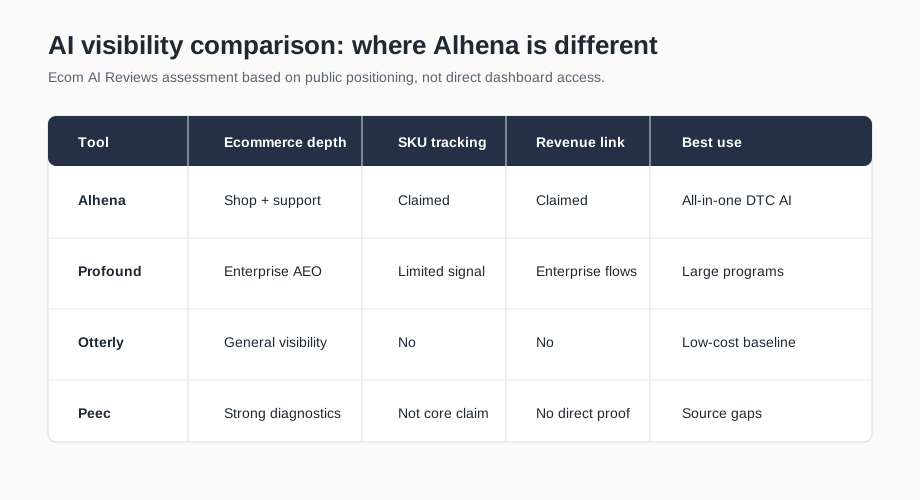
The comparison is simple:
| Need | Better first shortlist |
|---|---|
| Free Shopify-native AI visibility baseline | Triple Whale |
| Low-cost standalone monitoring | Otterly.AI |
| Source and competitor diagnostics | Peec AI |
| Enterprise AEO program | Profound |
| Shopping assistant + support + visibility bundle | Alhena AI |
Alhena can be the right choice when AI visibility is tied to onsite shopping and support. It is less obviously right when visibility is the only job.
Pricing: The Conversation Math
Alhena pricing is not just a monthly subscription question. It is a conversation-volume question.
The Shopify App Store listing checked on July 3, 2026 shows:
| Plan | Public Shopify App Store signal | Practical read |
|---|---|---|
| Free | Up to 25 conversations/month | Useful for evaluation, not meaningful production volume. |
| Pro | $239/month, up to 200 conversations, overage language shown | Starter paid tier for smaller DTC use. |
| Growth | $599/month, up to 550 conversations | Mid-volume store economics. |
| Scale | $1,199/month, up to 1,200 conversations | Larger store or heavier automation use. |
The original research brief cited $1.10 per conversation. Current public Shopify data is more nuanced: it references $1.20 per conversation if above limit, while higher tiers imply lower blended per-conversation economics. That is why buyers should model their own volume instead of relying on one shorthand number.
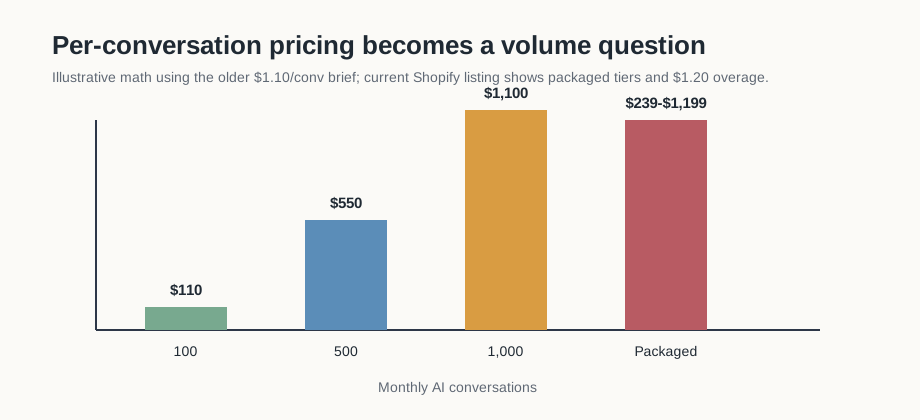
The math changes by store:
| Monthly AI conversations | At $1.10 shorthand | At $1.20 overage shorthand | Buying implication |
|---|---|---|---|
| 100 | $110 | $120 | Fine if conversion lift is visible. |
| 500 | $550 | $600 | Needs meaningful support deflection or sales lift. |
| 1,000 | $1,100 | $1,200 | Must be tied to margin, AOV, and automation savings. |
| 5,000 | $5,500 | $6,000 | Enterprise-level diligence, not impulse SaaS spend. |
For a mid-sized DTC store, the budget question is not “is $239/month cheap?” It is “how many customer conversations will Alhena handle, how many would have required human support, and how many create incremental revenue?”
If you cannot answer those three questions, start smaller.
Who Should Use Alhena AI?
Use Alhena if the bundle matches your operating problem.
The best buyer is a Shopify or DTC brand with a real catalog, real support volume, and a growing need to understand AI search. That buyer does not want three disconnected tools. They want one system that knows the catalog, answers shoppers, reduces repetitive support, and starts building product-level AI visibility intelligence.
Alhena is especially sensible for:
- Beauty brands with shade, skin, routine, and ingredient questions.
- Fashion brands with fit, style, outfit, and return-risk questions.
- Home, travel, sports, or specialty retailers where shoppers need guided narrowing.
- Stores where support and pre-purchase questions overlap.
- Teams that already planned to buy both support automation and AI visibility tracking.
- Larger DTC brands that can validate vendor claims with their own analytics.
The size threshold matters. A tiny store can be impressed by an AI concierge and still lose money on it. Alhena becomes more compelling when the store has enough traffic, enough support tickets, enough gross margin, and enough catalog complexity to benefit from automation.
Who Should Skip?
Skip Alhena if the all-in-one shape is not actually your problem.
You should compare other tools first if:
- You only need AI visibility tracking.
- You already have support automation that works.
- You want the cheapest possible GEO baseline.
- You need broad competitor source diagnostics more than onsite shopping assistance.
- Your catalog is simple enough that guided selling is unnecessary.
- Your margins cannot absorb conversation-based software costs.
- You need independently audited revenue attribution before buying.
Also be cautious if “hallucination-free” is the main reason you are excited. Grounded support is possible, but no public marketing claim removes the need for QA. A store still needs escalation rules, source-of-truth governance, policy updates, and human review of high-risk scenarios.
Alhena AI vs Competitors
Alhena competes in two directions at once: AI visibility tools and ecommerce support platforms.
| Comparison | Choose Alhena if… | Choose the alternative if… |
|---|---|---|
| Alhena vs Profound | You need ecommerce-specific shopping and support bundled with visibility. | You need an enterprise AEO platform with broader governance and analytics. |
| Alhena vs Otterly.AI | You want onsite ecommerce AI, not just monitoring. | You want a low-cost standalone visibility tracker. |
| Alhena vs Peec AI | You want product-level ecommerce operations tied to the store. | You want stronger source, citation, and competitor diagnostics as a standalone workflow. |
| Alhena vs Gorgias/Zendesk AI | You want AI shopping and visibility, not just helpdesk automation. | Your helpdesk is already the center of the customer operation. |
The most honest comparison is this: Alhena is not the best pure monitor on paper. It is the most ecommerce-embedded option in this shortlist. That makes it either more valuable or more cumbersome depending on your needs.
Evidence Notes
Evidence level: Researched.
What this review uses:
- Alhena public product pages for shopping assistant, support concierge, AI visibility, integrations, and claims.
- Shopify App Store listing checked July 3, 2026 for public rating, free tier, tier pricing, conversation limits, app categories, languages, and integrations.
- G2 public information for rating, review count, awards, and customer-name claims.
- Ecom AI Reviews competitor context from Otterly.AI, Peec AI, Triple Whale, and Profound reviews.
What this review does not verify:
- Live dashboard quality.
- Prompt setup flow.
- SKU-level tracking accuracy.
- Revenue attribution methodology.
- Helpdesk handoff reliability.
- Actual support deflection or conversion lift on a store.
Bottom Line
Alhena AI is a credible shortlist pick for DTC brands that want a single ecommerce AI platform across discovery, support, and product-level AI visibility. Its best argument is not that it beats every standalone GEO tool. Its best argument is that shopping, support, and visibility should share one product knowledge layer.
That is also the buying risk. If you do not need the bundle, do not pay bundle complexity. Start with a focused visibility tool or a free baseline, prove the workflow, then decide whether an all-in-one AI concierge belongs in the stack.
Comments