How to choose
Otterly.AI and Triple Whale AI Visibility both help ecommerce teams answer the same first question: do AI answers mention our brand, and what sources shape that answer?
They do not answer it from the same product angle.
Triple Whale starts from ecommerce analytics. AI Visibility is a free module inside a Shopify and DTC platform. Its strongest public story is a no-cost ChatGPT baseline: mentions, citations, sentiment, and source patterns for brands that already think in ecommerce terms.
Otterly.AI starts from AI search monitoring. It is a paid standalone tool with Brand Reports, prompt sets, competitor views, and broader public engine coverage. It is not Shopify-native, but it is better suited when the buyer wants a repeatable monitoring workflow across more than one AI answer surface.
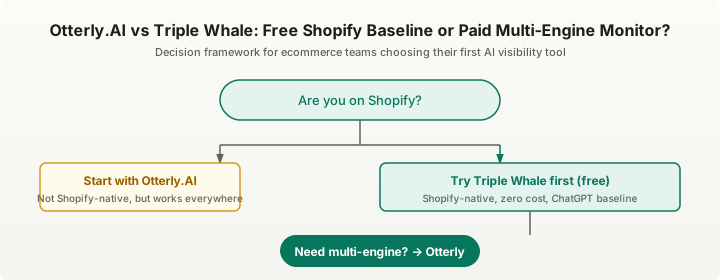
The simplest decision is this:
- Start with Triple Whale if you are a Shopify brand and the first job is free ChatGPT visibility.
- Start with Otterly.AI if you already know AI visibility matters and need recurring Brand Reports across multiple engines.
- Use a manual prompt spreadsheet first if you have fewer than 10 prompts and have not assigned work from AI visibility findings yet.
For most DTC teams, Triple Whale is the free proof-of-habit step. Otterly.AI is the paid next step when the team has enough questions, competitors, and content work to justify a dedicated monitor.
The core trade-off
The comparison is not “free tool vs better tool.” It is narrower than that.
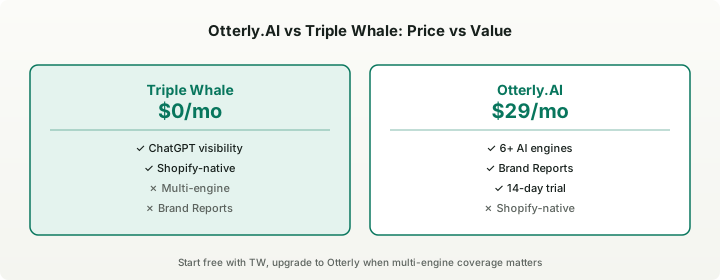
Triple Whale’s advantage is adoption. A Shopify brand can begin with a free AI Visibility module rather than creating another software budget line. That matters because many ecommerce teams are still trying to learn whether GEO belongs in the weekly workflow at all. A free ChatGPT baseline can reveal whether the brand appears, what sources are cited, and whether the findings are important enough to assign work.
Otterly.AI’s advantage is monitoring depth. It gives the team a dedicated place to organize prompts, build Brand Reports, compare brands, inspect citations, and track coverage over time. In the hands-on Otterly.AI review, the useful unit of work was the prompt set behind each Brand Report. That is exactly what a small team needs after the free baseline proves the problem is real.
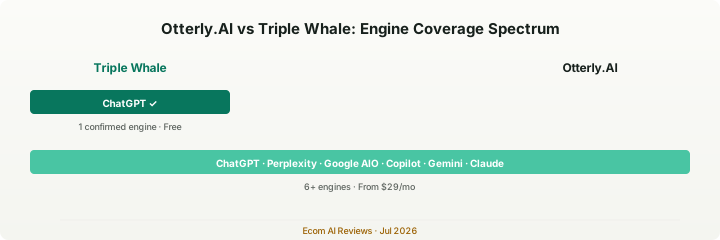
The engine difference is the buying hinge. Triple Whale’s confirmed public AI Visibility positioning centers on ChatGPT. Otterly.AI’s public positioning covers several AI-search surfaces, though plan inclusions and add-ons should be checked before purchase. If your shoppers only matter in ChatGPT right now, Triple Whale can be enough. If your category also shows up in Perplexity, Google AI Overviews, Gemini, Claude, Copilot, or AI Mode, a ChatGPT-only view is too narrow.
Where Triple Whale wins
Triple Whale wins the first-step decision for Shopify and DTC brands because the cost and context are hard to beat.
If you are a solo seller or lean ecommerce marketer, the first AI visibility workflow should not start with a complex dashboard. It should start with a simple baseline:
- Does ChatGPT mention the brand?
- Which competitors or retailers get named instead?
- Which domains or source types are cited?
- Is the sentiment accurate enough to leave alone?
- Does the finding create a real content, review, PR, product-data, or schema task?
Triple Whale is especially compelling if the team already uses, or is considering, Triple Whale for attribution and analytics. In that case, AI Visibility is not a separate procurement decision. It is a module that can sit beside ecommerce reporting.
The free tier also changes the psychology of the decision. A small Shopify brand can test the habit before buying Otterly.AI, Peec AI, Profound, or another GEO platform. If nothing changes after the team sees the baseline, staying free is the right answer.
The limitation is that Triple Whale should not be treated as a full AI visibility stack unless the live product confirms the exact coverage your team needs. Public positioning is strongest around ChatGPT. Dedicated competitor tracking, multi-engine prompts, exports, and recurring source-gap workflows are not the public center of gravity in the way they are for standalone tools.
Where Otterly.AI wins
Otterly.AI wins once AI visibility becomes a repeatable monitoring problem rather than a one-time curiosity.
The product is built around Brand Reports. In the hands-on review, that workflow was useful because it made a prompt set measurable: brand coverage, mentions, average position, competitors, top prompts, and citations. That is more operational than asking a few questions manually and saving screenshots.
Otterly.AI fits a team that wants to ask:
- Which prompts mention us, and which mention competitors?
- Which domains are cited when our category appears?
- Are we improving across the same prompt set over time?
- Which prompts should become content, comparison, review, or third-party outreach tasks?
- Are visibility gaps consistent across more than one AI engine?
That last question is where Otterly.AI separates itself from Triple Whale. A Shopify-native ChatGPT baseline is useful, but ecommerce discovery is already broader than one answer engine. A buyer may ask ChatGPT for product recommendations, see a Google AI Overview for a category question, compare options in Perplexity, and encounter citations from Reddit, YouTube, publishers, marketplaces, or software directories.
Otterly.AI is not a magic fix for that work. The main risk from the hands-on review still applies: report quality depends on prompt quality. Auto-generated prompts can help with onboarding, but they should be treated as drafts. The team still needs to clean prompts, choose competitors carefully, and turn findings into work outside the dashboard.
Buyer scenarios
For a Shopify founder with no AI visibility process, start with Triple Whale. The goal is not to buy the deepest product. The goal is to learn whether ChatGPT mentions the brand, which sources influence the answer, and whether the finding is worth acting on.
For a solo seller on a tight budget, Triple Whale also wins if the store is on Shopify. If the store is not on Shopify, use a manual prompt spreadsheet or consider Otterly.AI only after the manual checks create repeatable questions worth monitoring.
For a small marketing team that already has SEO, content, review, or PR work in motion, Otterly.AI is more attractive. Brand Reports create a cleaner monthly or weekly rhythm: pick a prompt set, watch visibility and citations, then assign specific follow-up work.
For a Shopify brand already using Triple Whale, try the AI Visibility module before buying another tool. It may answer enough of the first question for free. Add Otterly.AI later if the team needs multi-engine tracking, more competitor structure, or a monitor that stands apart from the ecommerce analytics stack.
For an agency or multi-brand operator, Otterly.AI is usually the more relevant comparison point. Triple Whale’s ecommerce-native angle is strong for a single Shopify brand, but a standalone monitor is easier to evaluate when clients, prompt sets, and reporting requirements vary.
Practical upgrade path
The clean path is not to choose a tool once and commit forever. It is to let the workflow mature.
Start with the free or manual layer:
- Pick 10 to 15 buyer prompts from your real category.
- Run the same prompts in ChatGPT, and use Triple Whale if you are on Shopify.
- Note brand mentions, competitor mentions, citations, and sentiment.
- Assign only the findings that clearly map to content, product data, reviews, schema, or third-party evidence.
Upgrade to Otterly.AI when the manual or free workflow starts to break:
- You need to track the same prompt set every week or month.
- You need to compare more than one competitor consistently.
- ChatGPT alone is no longer enough evidence.
- You need Brand Reports that separate prompt groups by product line, category, market, or funnel stage.
- The team has an owner who will act on the findings.
Do not upgrade just because a dashboard looks more complete. Upgrade when broader engine coverage or repeatable reporting changes the work your team does.
Evidence caveat
This comparison uses different evidence levels.
Ecom AI Reviews tested Otterly.AI hands-on in June 2026 with a live setup, prompt workflow, Brand Report views, competitor suggestions, and public pricing checks. The main finding was that Otterly.AI is useful as a first paid monitor, but the prompt set controls the value of every report.
Triple Whale AI Visibility is covered here from researched public evidence checked through July 2, 2026, including the Triple Whale review on this site, public pricing and positioning notes, and the public focus on ChatGPT mentions, citations, sentiment, and ecommerce source patterns. We have not verified a live Triple Whale AI Visibility workspace.
That means any Triple Whale dashboard, prompt-limit, export, alert, or competitor-workflow detail should be verified before purchase. The strategic comparison is still useful: free Shopify-native ChatGPT baseline versus paid standalone multi-engine monitoring.
Bottom line
Choose Triple Whale if you are a Shopify brand and want the lowest-cost way to begin AI visibility tracking. It is the better first step when the job is free ChatGPT visibility, source awareness, and proof that the workflow matters.
Choose Otterly.AI if your team needs a dedicated monitor, broader engine coverage, competitor views, and repeatable Brand Reports. It is the better paid next step once AI visibility has become a recurring ecommerce workflow.
The most sensible path for many DTC teams is sequential: start with Triple Whale, learn what ChatGPT says, then move to Otterly.AI when multi-engine coverage or reporting discipline becomes the constraint.
For more context, read the full Otterly.AI review, the Triple Whale AI Visibility review, the GEO checklist for ecommerce, and the best AI visibility tools for ecommerce.
Comments