Verdict
Pixis Visibility is one of the more interesting new AI visibility platforms because it is not only selling measurement. Its pitch is closer to: find visibility gaps, understand why competitors are cited, generate the content needed to close those gaps, and publish without stitching together a separate SEO and content stack.
That is a meaningful angle for ecommerce. Most DTC teams do not need another isolated score. They need to know which buyer prompts they lose, which sources AI engines cite, what their product/category pages are missing, and which content or third-party proof should be fixed next.
The caution is evidence. Pixis has a strong growth story, public pricing, and a clear execution narrative, but this review is researched rather than hands-on tested. I did not verify dashboard quality, prompt rerun behavior, citation accuracy, generated-content quality, WordPress publishing, Shopify fit, or whether its recommendations are better than a skilled SEO/content operator could produce.
My score is 7.7/10.
| Dimension | Score | Read |
|---|---|---|
| Ecommerce fit | 7.6 | Good for independent DTC sites with a content owner; not yet proven as SKU-native or revenue-native. |
| AI visibility depth | 7.8 | Covers core monitoring, competitor analysis, and cited-source questions, with plan-level engine limits to verify. |
| Execution workflow | 8.2 | The monitor-to-content loop is the main reason to care about Pixis. It needs hands-on QA before reliance. |
| Pricing value | 7.7 | $99/site/month is accessible, but Growth at $399 is the realistic budget if multi-engine tracking matters. |
| Evidence quality | 6.8 | Strong official materials and recent growth coverage, but limited independent ecommerce user evidence. |
This review is based on Pixis public materials, public comparison pages, third-party coverage, and search results checked on July 5, 2026.
What It Does
Pixis Visibility is an AI search and SEO visibility platform. Pixis describes it as a way to track how a brand appears in ChatGPT, Perplexity, Gemini, and Google, identify why competitors are cited instead, and generate ready-to-publish content in the same workflow.
For ecommerce, that maps to five practical jobs:
- Track prompt visibility across buyer questions.
- Compare your brand against real category competitors.
- Inspect whether AI engines cite your store, competitor pages, publishers, review sites, or other sources.
- Combine GEO monitoring with traditional SEO keyword intelligence.
- Turn gaps into content briefs, drafts, and publishing actions.
The last point is the real differentiator. Tools like Otterly.AI and Peec AI can help you understand where you appear and which sources matter. Pixis is trying to compress the next step: what content should exist, what should it say, and how does it get shipped?
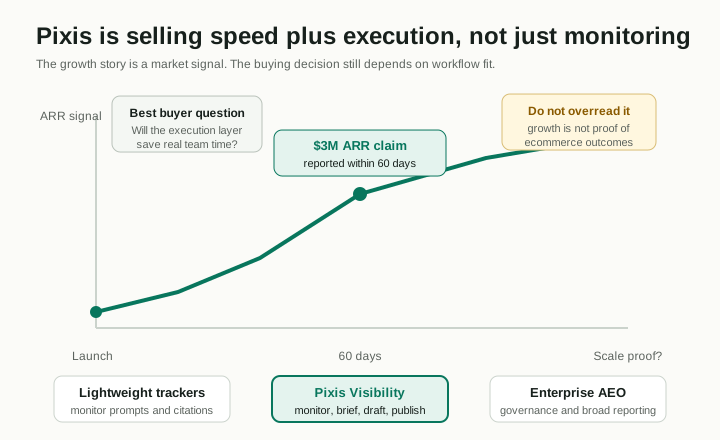
For a Shopify or DTC team, the execution loop could be useful if it turns a vague finding like “competitors are cited more often” into specific owned-content work:
| Visibility gap | Ecommerce interpretation | Pixis-style next step |
|---|---|---|
| Competitor appears for “best [category]” prompts | Their category or third-party evidence is stronger | Build or improve category, comparison, and buyer-guide content. |
| AI cites a publisher but not your store | The trusted source layer excludes you | Target inclusion, reviews, or better third-party proof. |
| Your product is mentioned with weak positioning | AI understands the brand but not the use case | Improve PDP facts, attribute coverage, reviews, and FAQs. |
| Prompt data and keyword data disagree | Traditional SEO demand and AI-answer demand are diverging | Prioritize pages that serve both search results and answer engines. |
That is the right workflow shape. The open question is how good the actual recommendations and drafts are inside a live account.
Pricing
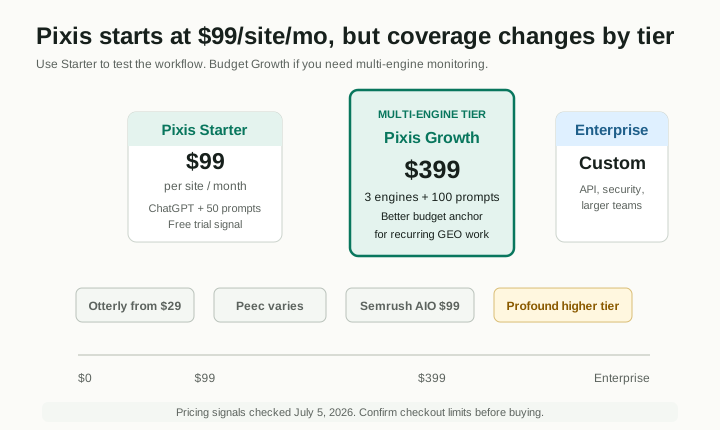
Pixis public materials checked on July 5, 2026 point to three buying levels:
| Plan | Public price signal | Public limit signal | Ecommerce read |
|---|---|---|---|
| Starter | $99/site/month | ChatGPT and 50 prompts | Reasonable first test if you want to validate one brand/category workflow. |
| Growth | $399/month | 3 engines and 100 prompts | Better budget anchor for recurring multi-engine monitoring. |
| Enterprise | Custom | Larger coverage, API, security, and success needs | For teams that already know AI visibility is a funded operating system. |
The $99 entry price is useful because it puts Pixis in the same general conversation as first paid trackers, not only enterprise AEO tools. But the buyer should not stop at the price.
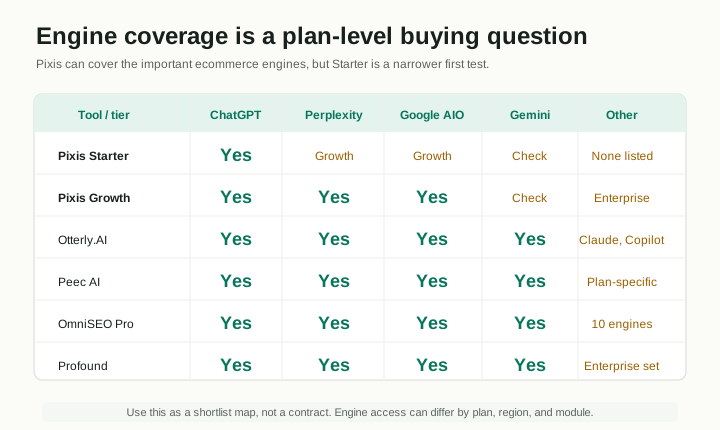
If Starter is ChatGPT-centered, it may be too narrow for teams that care about Perplexity, Google AI Overviews, Gemini, or region-specific buyer behavior. In ecommerce, one engine can make you overconfident. A brand may look healthy in ChatGPT and absent in Perplexity, or visible in AI Overviews for broad keywords and missing for comparison prompts.
Before buying, confirm:
- Which engines are included in the exact plan.
- Whether Google AI Overviews and Gemini are available on the tier you want.
- How prompt limits are counted across engines, regions, and competitors.
- Whether the free trial includes content generation and publishing features.
- Whether generated briefs and drafts can be exported, edited, approved, and rolled back.
The content-execution layer can justify more than a pure tracker if it saves hours every week. It can also create risk if low-quality drafts move too quickly into production.
Engine Coverage
Pixis materials reference ChatGPT, Perplexity, Gemini, and Google. The task brief also lists Google AIO specifically. That is the core set most ecommerce teams should care about first.
The important buyer issue is not whether Pixis supports those engines somewhere. It is which engines are included at Starter, Growth, and Enterprise levels.
For most DTC teams, I would test Pixis with a narrow prompt set before expanding:
| Prompt bucket | Example for an ecommerce brand | Why it matters |
|---|---|---|
| Category discovery | ”best mineral sunscreen for sensitive skin” | Tests whether AI engines know the brand as an option. |
| Attribute prompts | ”reef safe sunscreen that does not leave a white cast” | Matches how shoppers describe needs. |
| Comparison prompts | ”[brand] vs [competitor]“ | Reveals which third-party sources frame the decision. |
| Branded trust | ”is [brand] legit?” | Finds reputation, review, policy, and entity issues. |
| Problem solving | ”how to choose sunscreen for acne-prone skin” | Shows whether educational content is being cited. |
Start with 25 to 50 prompts, not a giant map. The goal is to learn whether Pixis can turn prompt gaps into better content priorities, not to create a dashboard no one reads.
Pros and Cons
What I like:
- The positioning is practical. Pixis connects AI visibility data with SEO keyword intelligence and content execution.
- Public pricing starts at a level smaller ecommerce teams can at least test.
- The 10-15 minute self-serve onboarding claim lowers friction compared with demo-only enterprise platforms.
- The growth story suggests strong market demand for action-oriented GEO tooling.
What I do not like:
- The public evidence is still vendor-heavy.
- Starter appears narrow if ChatGPT is the main included engine.
- I could not verify recommendation quality, citation accuracy, or publishing workflow without a live account.
- The platform is not clearly ecommerce-native in the way a product-feed, SKU, review, or revenue-attribution tool would be.
The main risk is not that Pixis cannot track prompts. The risk is that teams trust the execution layer too quickly. AI-generated briefs and drafts still need human review, category expertise, product accuracy checks, claims compliance, and internal linking discipline.
Pixis vs Otterly and Peec
Pixis belongs in the same buying conversation as Otterly.AI and Peec AI, but the reason to choose it is different.
| Decision point | Otterly.AI | Peec AI | Pixis Visibility |
|---|---|---|---|
| Best first buyer | Small team trying paid monitoring | Growing team that needs source and competitor diagnostics | Team that wants monitoring tied to content execution |
| Entry price signal | Lower public entry point | Public pricing signals vary | $99/site/month Starter |
| Core workflow | Track prompts, brand visibility, and citations | Diagnose prompts, competitors, sources, and actions | Track gaps, generate briefs/drafts, and publish |
| Ecommerce fit | Good first baseline | Stronger recurring diagnosis | Strong if content execution is the bottleneck |
| Main risk | May stay lightweight | Still requires human execution | Execution quality needs careful QA |
Use Otterly if your team is still proving the AI visibility habit. Use Peec if you already have prompts and need better source diagnostics. Use Pixis if the bottleneck is the work after diagnosis: briefing, drafting, refreshing pages, and shipping content.
Pixis also competes indirectly with SEO-suite add-ons like Semrush AI Visibility Toolkit and broader platforms like OmniSEO. Semrush is easier if your SEO team already lives there. OmniSEO is more interesting when bot analytics and broad AEO/GEO monitoring matter. Pixis is more interesting when the team wants a single path from visibility gap to content output.
Who Should Use Pixis?
Pixis Visibility is most worth testing if:
- You run an independent ecommerce site with an owner for SEO, content, or growth.
- You already know which products, categories, and competitors matter.
- You need AI visibility tracking plus content prioritization.
- You can review AI-generated briefs and drafts before publication.
- You want a faster first test than enterprise-only AEO platforms allow.
The best first project is one product category, one country, three to five real competitors, and a prompt set small enough to act on. If Pixis can show where you lose and produce useful content work from that finding, it deserves a deeper test.
Who Should Skip Pixis?
Skip or delay Pixis if:
- You only want a cheap visibility snapshot.
- You do not have a person responsible for content changes.
- You need SKU-level tracking, product-feed diagnostics, or revenue attribution.
- You cannot review generated content for accuracy, claims, brand voice, and SEO fit.
- You need independent ecommerce case studies before committing.
For many smaller sellers, the better first step is still manual: run 20 prompts across ChatGPT, Perplexity, Gemini, and Google AI surfaces; log which brands appear; inspect cited sources; and fix obvious product-page, schema, review, and comparison gaps. Buy software when that process becomes too repetitive or too important to manage in a spreadsheet.
Sources Checked
Primary and vendor sources checked on July 5, 2026:
- Pixis Visibility product page
- Pixis comparison: Evertune AI vs Pixis Visibility
- Pixis comparison: Profound vs Pixis Visibility
- Pixis blog: best AI visibility platforms in 2026
Third-party and public context checked on July 5, 2026:
Comments