Verdict
LLMrefs is the value pick in AI visibility tracking if the buyer’s question is blunt: “What is the cheapest serious tool that gives me broad coverage, enough prompt volume, competitor context, citations, exports, and team access?”
For a Shopify or DTC team, that makes LLMrefs more interesting than a generic “cheap SEO tool.” The official page positions it around keyword-based AI visibility, not manual prompt-by-prompt tracking. You add SEO keywords, LLMrefs generates fan-out prompts, checks major answer engines, and reports rankings, share of voice, citations, and competitors.
That is a useful shape for ecommerce because most teams already think in category keywords: “best running shoes for flat feet,” “non toxic cookware,” “best collagen powder,” “Shopify loyalty apps,” “Klaviyo alternatives.” LLMrefs gives those keywords an AI-search monitoring layer.
The score is 8.2/10 for ecommerce buyer fit. The price and breadth are strong. The missing piece is ecommerce-native execution: LLMrefs will not know your SKU margins, inventory, product feed, review velocity, merchandising priorities, or affiliate/publisher strategy unless your team connects those dots.
What LLMrefs Does
LLMrefs tracks AI visibility from keywords. That is the important distinction. Instead of asking a marketer to maintain a spreadsheet of prompts, the product says it can generate fan-out prompts from the keywords your SEO team already watches.
The public workflow is built around:
- Keyword AI ranking tracking.
- Brand and competitor share of voice.
- Citation and source analysis.
- GEO and AI SEO optimization clues.
- CSV export and API access.
- Country and language filters.
- Weekly reports and real-time checking toward statistically significant samples.
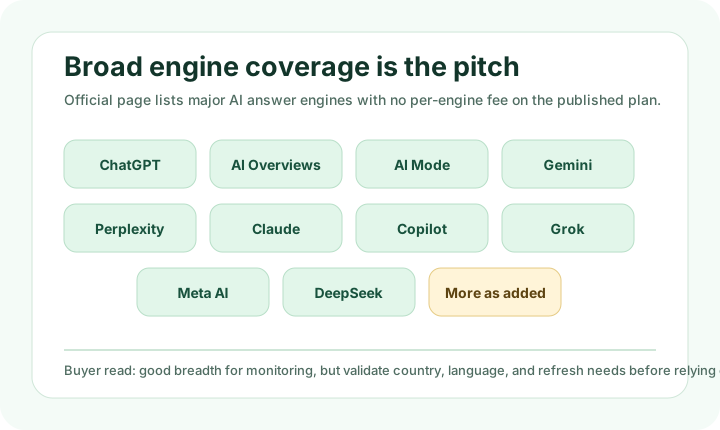
On its official page, LLMrefs lists answer-engine coverage that includes ChatGPT, ChatGPT Search, Google AI Overviews, Google AI Mode, Gemini, Perplexity, Claude, Grok, Copilot, Meta AI, and DeepSeek. The pricing block says the plan includes access to all AI search engines with no additional fees.
For ecommerce, the practical value is not “AI visibility” as a vague dashboard. It is knowing which competitors, publishers, marketplaces, Reddit threads, YouTube videos, review pages, and product pages appear when AI tools answer commercial questions in your category.
Pricing and Value
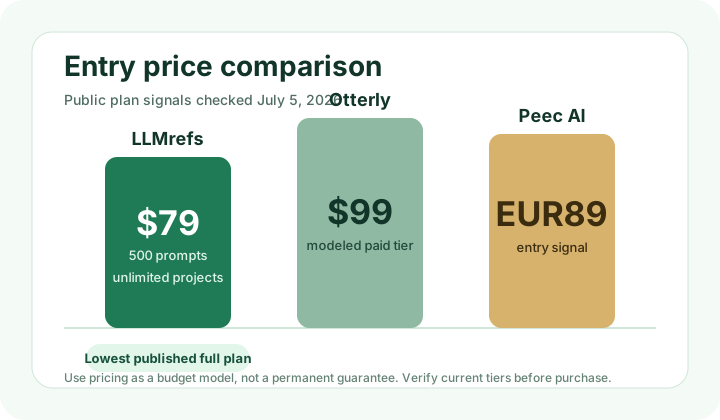
The pricing is the headline. LLMrefs publicly lists one All in One plan for marketing teams at $79/month, marked “Limited time only.” The listed plan includes:
| Plan item | Public signal | Ecommerce buyer read |
|---|---|---|
| Monthly price | $79/month | Low for a full AI visibility tracker, but verify because the site labels it limited-time pricing. |
| Prompt capacity | 500 prompts | Enough for a serious category baseline or several focused client projects. |
| Projects | Unlimited projects | Helpful for multi-brand stores, agencies, or teams tracking several product lines. |
| Team members | Unlimited team members | Strong value if SEO, content, PR, and founders all need visibility. |
| Engines | All AI search engines, no extra engine fee | Broad coverage is a major reason to test it. |
| Reports | Weekly AI visibility reports | Better for ongoing monitoring than one-off manual checks. |
| Data access | CSV export and API access | Useful if you want to blend AI visibility with SEO, analytics, BI, or client reporting. |
The cheapest-tool claim is not perfect because pricing in this category moves fast and “limited time” matters. Still, against common paid plans like Otterly at $99/month in many buyer models and Peec AI around EUR89/month, LLMrefs is the most aggressive full-plan price in this comparison.
For a single Shopify brand, 500 prompts is a lot if you organize it well. I would not spend them across every possible query. I would pick one to three money categories, define the closest competitors, and group prompts around discovery, comparison, trust, review, and post-purchase questions.
For an agency, the economics are more obvious. Unlimited projects and members make LLMrefs attractive when you can split prompt coverage across clients, export reports, and charge for interpretation. The risk is that 500 prompts can still disappear quickly if every client wants many categories, markets, and engines.
What We Like
The strongest point is simple value density. LLMrefs combines a low published price with several things that often create hidden costs elsewhere: projects, seats, engine breadth, exports, and API access.
The keyword-first workflow is also a good fit for SEO-led ecommerce teams. Many store operators do not know which prompts to track. They do know their category keywords, competitor names, and comparison queries. LLMrefs’ fan-out approach can turn that familiar input into AI visibility reporting.
Citation tracking is the feature I would watch most closely. Ecommerce AI visibility is often won outside your own site. If AI answers cite Reddit, YouTube, publishers, marketplaces, affiliates, or review sites, a store needs to know which external pages shape the answer. That can inform PR, affiliate outreach, content refreshes, and comparison-page strategy.
The CSV and API support also matter. AI visibility is still a young metric. A team that can export it, compare it with branded search, product page traffic, and revenue, and learn over time will get more from the tool than a team that only screenshots dashboards.
What We Don’t Like
LLMrefs is not ecommerce-native. It may show that your brand is missing from “best protein powder for women” or “best linen sheets for summer,” but it will not automatically know which product page has inventory, which SKU has margin, which reviews prove the claim, or which third-party publisher is worth a partnership.
It is also not the cheapest possible starting point. If your store has not done any manual AI visibility work, $79/month can still be premature. A small team can begin with a prompt spreadsheet, the site’s own search console data, and a focused manual audit before paying for any tracker.
The “limited time only” price deserves a caveat. A buyer should confirm whether $79 is stable, whether extra keywords cost more, and what happens when the account needs enterprise controls, procurement, SSO, or higher-volume reporting.
Finally, broad engine coverage can become false comfort. More engines are useful only if the prompts, countries, languages, competitors, and refresh cadence match how your buyers actually research products. Do not buy LLMrefs just because the logo row is long.
Alternatives
| Tool | Better when | Main trade-off |
|---|---|---|
| Otterly.AI | You want an easy first paid AI visibility tracker and do not need the broadest prompt economics. | Lower-friction monitoring may be enough, but larger prompt coverage can change the budget. |
| Peec AI | You want recurring competitor and source diagnostics, not just low-cost coverage. | Pricing and depth need to be modeled against your prompt and reporting needs. |
| Semrush AI Visibility Toolkit | Your SEO team already runs in Semrush and wants AI visibility beside keyword, audit, and reporting workflows. | The real cost can include Semrush subscriptions, users, domains, and prompt limits. |
| Manual prompt sheet | You are validating whether AI search matters before buying software. | Cheap, but hard to repeat, benchmark, and report across engines. |
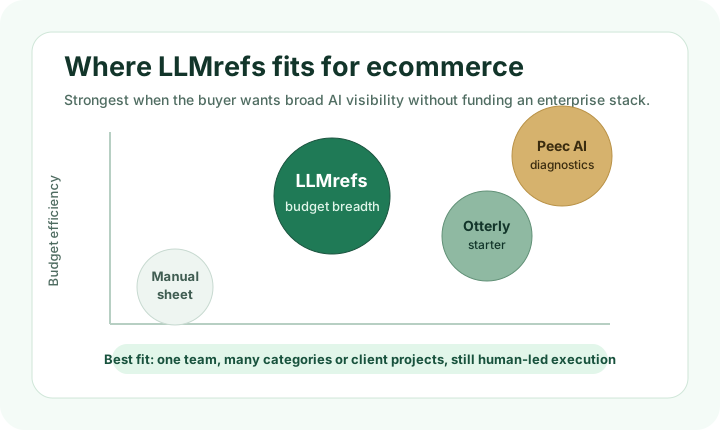
LLMrefs is strongest when your team already believes AI visibility is worth monitoring, but you do not want enterprise pricing. If you are still trying to prove the category matters, start manually. If you already have a mature SEO and PR workflow, LLMrefs can be a cost-efficient measurement layer.
Ecommerce Setup I Would Run First
For a DTC apparel brand, I would use LLMrefs like this:
| Setup item | Starting point |
|---|---|
| Keywords | 30 to 50 commercial category and comparison keywords. |
| Competitors | Three direct DTC brands, one marketplace or Amazon result, one review publisher. |
| Prompt groups | Best, alternatives, comparison, sizing, materials, reviews, shipping, returns, and trust questions. |
| Engines | Start with the engines LLMrefs supports for your target country and language. |
| Cadence | Review weekly changes, then decide which content, citation, PR, and technical fixes matter. |
The output should become a work queue:
- Owned site fixes: category pages, comparison pages, FAQs, schema, crawl access, and clearer product claims.
- Third-party proof: review sites, YouTube, Reddit, affiliates, and niche publishers that AI answers cite.
- Measurement gaps: categories, countries, competitors, or prompts that need more capacity.
That is where LLMrefs can pay for itself. It does not replace strategy. It gives a budget-sensitive team enough signal to stop guessing where AI answers are pulling ecommerce recommendations from.
Comments