If you have ever searched “best AI visibility tools” and felt like every result was written by someone selling AI visibility software, your instinct is not wrong. The AI visibility category is young, expensive, and crowded with vendors trying to define the buying criteria before ecommerce teams know what to ask for.
Independent reviews matter because AI visibility buyers are not just choosing software. They are choosing which sources to trust in a market where vendors can publish “best tools” pages, rank themselves first, and then get repeated by search engines and AI answer engines. A credible independent review separates the buyer’s job from the vendor’s sales motion: it names the evidence level, explains the limits, checks pricing, and says who should skip a tool.
This guide is written for the DTC or Shopify operator who wants to compare tools without getting pulled through five demo funnels. If you need the concept first, start with What Is AI Visibility for Ecommerce?. If you already want a ranked shortlist, use our best AI visibility tools for ecommerce hub after you read the checklist below.
01. The Problem - The “Best Tools” SERP Is a Vendor Billboard
On July 6, 2026, a fresh search for “best AI visibility tools” returned a mixed SERP: independent publishers, vendor blogs, service-provider pages, YouTube videos, and community threads all competing for the same buyer. That mix is the point. A buyer sees the phrase “best tools” and expects evaluation, but many results are written by organizations with a commercial stake in the category.
The pattern is easy to spot once you know what to look for.
| SERP pattern | Example observed on July 6, 2026 | Why it matters |
|---|---|---|
| Vendor ranks itself first | Profound’s agency-focused list places Profound at #1, then compares alternatives such as SE Visible, AIclicks, Otterly, Brandlight, AthenaHQ, and Scrunch. | It may be useful category education, but it is not independent evaluation. Profound sells an AI visibility platform. |
| Vendor defines the category around its own product | Frase’s 2026 list says Frase is the best AI visibility tool for teams that want to monitor and fix gaps in one workflow. | That framing naturally favors Frase’s product architecture. It may be fair positioning, but the incentive is visible. |
| Vendor FAQ creates buyer criteria | Scrunch’s AEO/GEO FAQ describes must-have and nice-to-have criteria for dedicated platforms, including prompt-level monitoring, citations, audits, enterprise readiness, and AI-optimized content delivery. | Useful criteria can still come from a vendor trying to shape how buyers evaluate the category. |
| Independent or broader publisher compares tools | Zapier’s “8 best AI visibility tools” article is a broader software roundup rather than a vendor page. | This is closer to independent review, but readers still need to inspect testing depth, affiliate incentives, and ecommerce fit. |

None of that means the vendor pages are useless. A vendor often knows the category well and may explain features clearly. The issue is the label. A vendor-written “best” list is marketing material, even when it contains accurate facts. Treat it as one input, not as the shortlist.
For ecommerce teams, the risk is practical. A DTC marketing manager does not have time to decode every incentive. She needs to know whether a tool helps her understand ChatGPT, Perplexity, Gemini, Google AI Overviews, and AI shopping journeys for real products - not whether a vendor has the strongest content machine.
02. Why It Matters - AI Engines Amplify the Problem
AI engines do not create buyer advice from nothing. They retrieve, summarize, and synthesize what the web already says. If the web is full of vendor-authored “best AI visibility tools” pages, AI answers can inherit the same incentive pattern.
The loop looks like this:
- A vendor publishes a “best tools” article and ranks itself highly.
- Search engines index and rank that article because it is useful, fresh, and keyword-aligned.
- AI engines retrieve or summarize web results when answering buyer questions.
- The vendor’s claim starts to look like market consensus because it appears in both search and AI answers.
- More vendors publish similar pages to defend their position.

That does not mean AI engines are “biased” in a human sense. It means their outputs reflect the source environment. When the source environment is commercially tilted, the answer can be tilted too.
This is why independent sources matter more in AI visibility than they did in classic SEO. In old search, a buyer could scan ten blue links and choose what to open. In AI search, the answer may name two or three tools before the buyer clicks anything. Third-party evidence, current pricing, dated testing notes, and source diversity become part of the buying infrastructure.
For more context on how AI discovery is changing ecommerce traffic and citations, see our AI visibility statistics for ecommerce. The short version: AI visibility is not just a dashboard metric. It is a question of which sources answer engines decide are worth repeating.
03. How to Spot Vendor-Biased “Best Tools” Content
Use this checklist before you trust any “best AI visibility tools” page.
-
The publisher sells a competing tool. Check the header, footer, pricing page, and product navigation. If the site sells AI visibility software, AI search consulting, GEO audits, or AEO services, the article has a commercial incentive.
-
The #1 pick matches the publisher’s business. This is not automatically dishonest, but it is a strong signal. A vendor may genuinely believe its product is best. Your job is to ask who else reached the same conclusion without being paid by that outcome.
-
The methodology is vague. Phrases like “we analyzed the market” or “comprehensive comparison” are weak unless the page explains what was tested, when it was checked, which pricing pages were reviewed, and how the ranking criteria were weighted.
-
Pricing is missing, stale, or hidden behind demos. AI visibility tools change pricing quickly. A useful review should at least distinguish public starting prices, custom enterprise pricing, prompt limits, engine coverage, and add-ons.
-
There is no “who should skip this” section. Every tool has a bad-fit buyer. A review that cannot explain when a tool is too expensive, too shallow, too enterprise-heavy, or too generic probably is not doing buyer work.
-
Affiliate or sponsor disclosure is buried. The FTC’s endorsement guidance says readers need clear information about paid relationships near the recommendation, not hidden behind a vague legal link. If you cannot tell who benefits when you click, slow down.
-
The article reads like a landing page. Repeated demo CTAs, product screenshots only from one vendor, or comparison rows that map perfectly to the publisher’s strongest features are signs that you are in a funnel.
For a Shopify seller, this checklist is not academic. It protects budget. A tool can cost hundreds or thousands of dollars per month, and the hidden cost is the operating time spent feeding prompts, reading dashboards, and turning findings into content, schema, review, and outreach work.
04. What Independent Review Actually Looks Like
Independent review is not the same as being negative. It is a method.
An independent AI visibility review should make the reader more informed even if the reader never clicks a vendor link. It should explain the buyer job, show what evidence was used, name limitations, and separate “this product is powerful” from “this product is right for your ecommerce team.”
| Vendor-biased pattern | Independent review pattern |
|---|---|
| Starts from the vendor’s product narrative. | Starts from the buyer’s workflow and budget. |
| Ranks the publisher’s product first or frames the category around it. | Uses consistent criteria across all tools. |
| Says “best for everyone” or uses broad superlatives. | Names who should use it and who should skip it. |
| Avoids pricing specifics or pushes demo calls. | Dates pricing checks and flags custom or opaque pricing. |
| Uses product claims as evidence. | Distinguishes hands-on testing from researched public evidence. |
| Hides limitations below conversion CTAs. | Puts limitations in the verdict, score, and FAQ. |
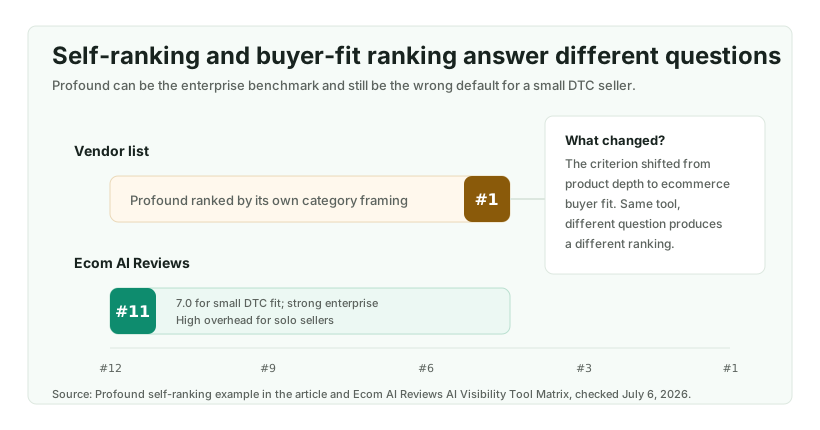
That is the standard we try to hold on Ecom AI Reviews. Our how we test page explains the difference between “Hands-on tested” and “Researched” evidence. Our affiliate disclosure explains that some links may earn commissions, but vendors do not buy rankings, inclusion, or softer verdicts.
You can see the format in individual reviews such as Scrunch and Glara. The point is not that every review is perfect or that every tool has been tested hands-on. The point is that the evidence label tells you what kind of claim you are reading. A researched review should not pretend to be a lab test. A hands-on review should show the work.
This also matters for AI engines. Clear methodology, dated claims, and consistent page structure make it easier for answer engines to understand what the review is and what it is not. That is part of why trust pages are not just brand decoration; they are machine-readable evidence about how the site produces judgments.
05. Where to Find Independent AI Visibility Tool Reviews
Start with sources that do not sell the category they are ranking.
For ecommerce teams, the most direct path is our best AI visibility tools for ecommerce ranking, then the individual reviews behind it. Use that ranking as a shortlist, not as a command. Your store model matters: a solo Shopify founder, a DTC marketing manager, an ecommerce agency, and an enterprise retail team should not all buy the same product.
Then add three other source types:
- Current vendor documentation. Use vendor pages to verify engine coverage, prompt limits, pricing, integrations, and what is actually public versus demo-only.
- Community discussion. Reddit, ecommerce forums, and SEO communities can surface failure cases vendors avoid. Treat them as leads, not proof.
- Research and policy sources. The OECD’s work on online reviews highlights risks around misleading practices, accuracy, and consumer bias. FTC endorsement guidance is a useful baseline for disclosure expectations.
The safest buying process is not “trust one independent site.” It is triangulation. If an independent review, vendor documentation, and several credible user discussions agree on a tool’s strengths and weaknesses, the signal is stronger. If only the vendor says the tool is category-leading, keep researching.
06. What This Means for Ecommerce Sellers
You do not need to become an AI visibility expert before you evaluate tools. You need to become a better information consumer.
Before you book a demo from any “best tools” article, run the six-minute audit:
- Who published the page?
- Do they sell software or services in this category?
- Who is ranked first?
- Is the testing method clear?
- Is pricing current enough to be useful?
- Does the page tell you who should skip the tool?
- Is the commercial relationship disclosed near the recommendation?
If the page passes that audit, keep it in your research pile. If it fails, use it only for vendor positioning.
For the actual work, start with the fundamentals. Learn what AI visibility is, run a manual prompt baseline, and fix the crawlability, schema, content, and third-party evidence gaps that tools will eventually measure. Our How to Do GEO for Ecommerce guide covers the execution path, and How to check whether ChatGPT recommends your Shopify store gives Shopify sellers a smaller first test.
The practical takeaway is simple: a vendor can be a useful source about its own product, but it should not be the only judge of the category. Independent reviews give ecommerce teams a second opinion before software spend becomes operating drag.
Evidence Notes
Evidence level: Researched. This article is based on a July 6, 2026 SERP check for “best AI visibility tools,” public vendor and publisher pages, Ecom AI Reviews’ own review methodology, and external guidance on endorsement and review transparency. The SERP changes quickly, so treat the named examples as a dated snapshot, not a permanent ranking claim.
External references used:
Comments