Verdict
Glara is one of the clearest examples of what an ecommerce-native AI visibility tool should look like. It does not stop at brand mentions. The public product pages describe catalog import, Shopify integration, SKU-level visibility, product detail page analysis, product-level optimization recommendations, Google Analytics and Google Search Console connections, and AI-attributed revenue per SKU.
That makes Glara more relevant to a Shopify or DTC operator than many horizontal GEO tools. A generic tracker can tell you whether ChatGPT or Gemini mentions your brand. Glara is trying to answer a sharper commercial question: which products are understood by AI assistants, which products are invisible, what needs to change on the PDP, and whether AI-referred visits turn into purchases.
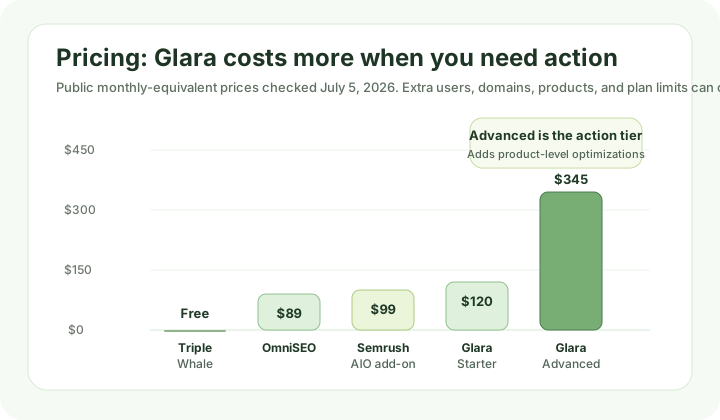
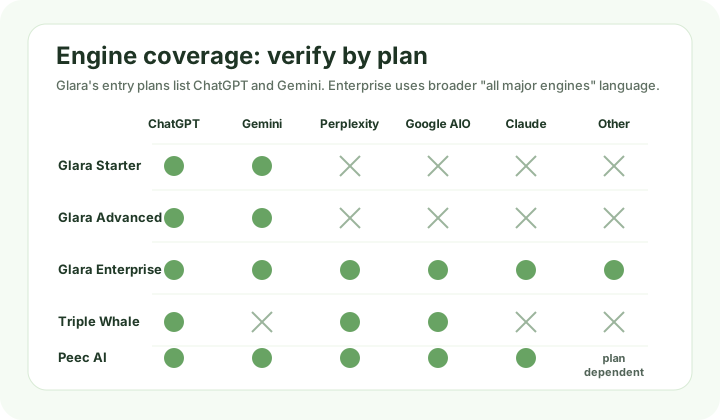
The caveat is scope and price. The pricing page checked on July 5, 2026 lists Starter at $120/month when billed annually and Advanced at $345/month when billed annually. Starter tracks visibility, but Advanced is where product-level optimizations appear. Starter and Advanced also list ChatGPT and Gemini coverage, while Enterprise is the tier that lists all major AI answer engines.
My score is 7.7/10.
| Dimension | Score | Read |
|---|---|---|
| Ecommerce fit | 9.0 | Strong Shopify, SKU, PDP, and revenue-attribution framing. |
| AI visibility depth | 7.6 | Good product-level workflow, but plan-level engine coverage needs verification. |
| Pricing value | 7.0 | Clear public pricing, though the action tier starts at $345/month annually. |
| Evidence quality | 6.8 | Strong official materials and some third-party coverage, but no hands-on workspace test here. |
| Ease of first test | 7.2 | Public pages mention a 7-day try-free motion, but value depends on connecting real store data. |
This review is researched, not hands-on tested. The facts below come from Glara’s public site, pricing page, integration page, terms, and third-party context checked on July 5, 2026.
What Glara Does
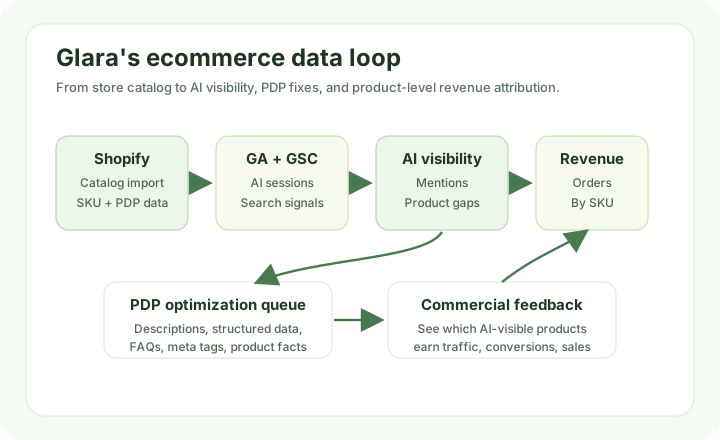
Glara is a GEO and AEO platform for ecommerce brands and retailers. Its terms describe the service as software for tracking and improving visibility in AI search engines, monitoring how AI platforms mention and recommend products, receiving optimization guidance, and measuring performance through analytics, revenue attribution, and benchmarking.
For a Shopify team, the practical workflow is:
- Import the store catalog from Shopify.
- Monitor brand mentions, product recommendations, and competitors in AI answers.
- Analyze product detail pages and catalog attributes at SKU level.
- Identify products that are visible, missing, or poorly described by AI assistants.
- Generate fixes for product descriptions, structured data, FAQs, and meta tags.
- Review and approve changes before anything goes live.
- Connect AI visibility to sessions, conversions, and sales through Shopify, GA, and GSC.
That is a better fit for ecommerce than a generic “share of voice in AI answers” dashboard. Product visibility often fails because product facts are incomplete, vague, inconsistent, or not structured in the way AI systems need. A review tracker can show the symptom. A catalog-aware tool can point to the PDP and attribute gaps that caused it.
Pricing
Glara’s pricing is public and easier to model than many AI visibility tools.
| Plan | Price checked July 5, 2026 | Public limits | Ecommerce read |
|---|---|---|---|
| Starter | $120/month annual or $150/month monthly | Shopify catalog import, GA + GSC + Shopify attribution, visibility scores, brand mentions, 5 competitors, 3 seats, ChatGPT + Gemini, no optimizations | Good for proving whether AI visibility and revenue attribution matter for a focused product set. |
| Advanced | $345/month annual or $435/month monthly | Everything in Starter, optimizations for 50 products, 8 competitors, 5 seats, Slack support, ChatGPT + Gemini | The realistic tier if you want Glara to help fix product-level visibility gaps, not only observe them. |
| Enterprise | Custom | Custom product tracking, custom optimizations, 20 competitors, unlimited seats, all major AI answer engines, dedicated account manager | Better fit for large catalogs, multi-market setups, agencies, or teams that need broader model coverage. |
The buying question is not whether Glara is expensive in isolation. It is whether the store has enough product-level signal to justify it. If a brand already sees AI-referral sessions, has a meaningful catalog, or depends on product attributes that AI assistants must understand, $345/month can be rational. If a store has a narrow catalog and almost no AI traffic, Starter may still be early.
What We Like
The best thing about Glara is that it starts from the ecommerce object model. Products, SKUs, PDPs, product facts, product attributes, categories, variants, Shopify, GA, and revenue attribution are not afterthoughts. They are the core buying reason.
That matters because AI visibility work for DTC brands usually turns into product-data work:
| AI visibility issue | Store-level action |
|---|---|
| A product is missing for high-intent prompts | Add clearer attributes, use cases, comparison language, and structured data. |
| AI mentions the brand but not the right SKU | Improve category and PDP specificity so models can match intent to products. |
| A competitor wins because its product facts are clearer | Fill gaps in materials, ingredients, dimensions, fit, compatibility, claims, and FAQs. |
| AI traffic appears in analytics but revenue is unclear | Connect Shopify, GA, and post-click behavior to see whether the channel deserves more work. |
| Visibility improves but sales do not | Check whether prompts, product fit, price, trust proof, and landing pages match buyer intent. |
That is more useful than telling a merchant to “do GEO.” Glara’s strongest promise is turning AI visibility into a product operations loop.
What We Don’t Like
The first concern is engine coverage by plan. The task brief references ChatGPT, Google AIO, Perplexity, and Gemini. Glara’s homepage references several engines, including ChatGPT, Claude, Perplexity, Gemini, and Grok. But the pricing table checked for this review lists ChatGPT and Gemini for Starter and Advanced, and reserves “all major AI answer engines” language for Enterprise. Buyers should verify exact coverage before budgeting.
The second concern is that Starter is monitoring-heavy. It includes catalog import, visibility scores, brand mentions, competitors, seats, and attribution connections, but the pricing table shows no optimizations. If the goal is to improve product content, Advanced is the more honest budget anchor.
The third concern is attribution. Connecting AI visibility to traffic and revenue is exactly what ecommerce teams need, but AI attribution is still developing. GA referral data, direct traffic leakage, dark social, AI-assisted discovery, and post-purchase survey bias can all distort the picture. Treat Glara’s attribution as a workflow to validate, not a guaranteed finance-grade source of truth.
Glara vs Triple Whale
Glara and Triple Whale overlap because both speak to Shopify and DTC brands, but they start from different jobs.
| Decision point | Glara | Triple Whale |
|---|---|---|
| Primary job | AI visibility, SKU visibility, product optimization, attribution | Broader ecommerce analytics with AI visibility as one module |
| Best buyer | DTC brand trying to improve product discoverability in AI answers | Shopify team that wants AI visibility inside a broader performance cockpit |
| Entry motion | Paid plan, public try-free/demo motion | Lower-friction free AI visibility entry point |
| Product depth | Stronger SKU/PDP optimization framing | Stronger full-store analytics context |
| Revenue context | AI-attributed revenue by product through Shopify/GA/GSC | Ecommerce analytics and attribution context across the broader business |
| Main risk | Optimization value depends on real catalog and AI traffic signal | AI visibility may be only one part of a larger platform decision |
The short version: choose Glara if the problem is “AI assistants do not understand or recommend our products.” Choose Triple Whale if the problem is “we need AI visibility alongside broader ecommerce analytics.”
Who Should Use Glara?
Use Glara if your store already has a real reason to care about product-level AI visibility.
The best-fit buyer is a Shopify or DTC brand with:
- A catalog large enough that SKU-level visibility matters.
- Product attributes that influence purchase decisions.
- Existing GA, GSC, and Shopify analytics discipline.
- Someone who can approve PDP, FAQ, metadata, and structured-data changes.
- Enough AI-referred or high-intent discovery traffic to make attribution useful.
- Budget for Advanced if optimization recommendations are the main reason to buy.
Glara is especially interesting for fashion, beauty, food, supplements, FMCG, and other categories where specific product facts drive recommendations. If a buyer asks for “vegan leather laptop bag under $200” or “gentle retinol alternative for pregnancy,” the model needs structured product facts, not just brand copy.
Who Should Skip?
Skip or delay Glara if AI visibility is still only a curiosity.
You should probably start elsewhere if:
- You need a free or very cheap first tracker.
- You only want brand-level prompt monitoring.
- You need broad multi-engine monitoring below enterprise pricing.
- Your catalog has too few products to benefit from SKU-level diagnosis.
- You cannot edit PDP copy, schema, FAQs, product attributes, or metadata.
- You do not trust your analytics setup enough to interpret attribution.
For many small stores, the better first step is still a manual prompt sheet or a low-cost tracker. Run category, comparison, and branded-trust prompts across the AI surfaces your customers use. If the results show product-level gaps and the work becomes repetitive, then Glara’s ecommerce-native workflow becomes much easier to justify.
Sources Checked
Primary sources checked on July 5, 2026:
Third-party context checked on July 5, 2026:
Comments