AI search is reshaping ecommerce discovery, but the numbers are easy to misuse. A 4,700% growth headline can be true and still describe a channel that is tiny in absolute traffic. A strong conversion benchmark can be useful and still come from a vendor with a commercial incentive. A forecast about search decline can be important without proving that Google is dead.
This page collects the numbers that matter for ecommerce teams deciding whether AI visibility deserves time, budget, or just a quiet monthly check. It is written for a DTC or Shopify operator who needs the signal without the sales pitch.
The short answer
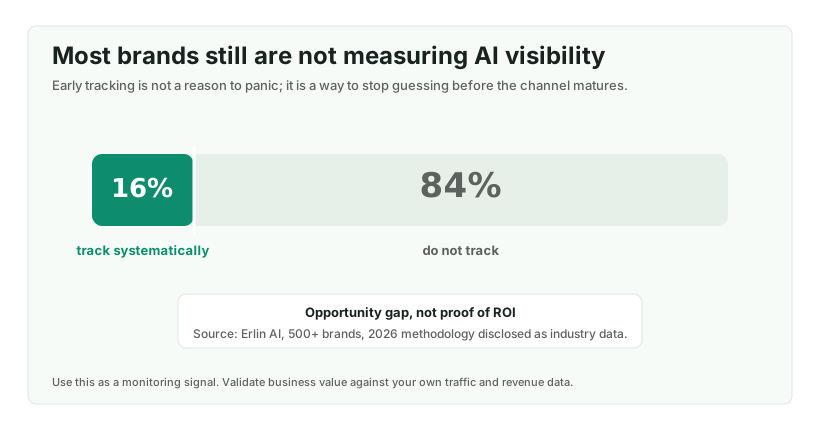
Five numbers matter most: Adobe reports 4,700% year-over-year growth in AI-driven U.S. retail visits; academic ecommerce data still places ChatGPT below 0.2% of total visits; Alhena reports 2.47% LLM referral conversion in its ecommerce sample; Gartner forecast a 25% decline in traditional search volume by 2026; and Erlin reports that only 16% of brands systematically track AI search performance.
The takeaway is measured urgency. AI search is small enough that many stores can start manually, but visible enough that a $2M DTC brand should know whether ChatGPT, Perplexity, Gemini, and Google AI Overviews mention it accurately.
PDF report
Need the statistics, charts, and source list as a self-contained report? Download as PDF ↗.
Why AI Visibility Data Matters Right Now
The search pie is being redistributed. Google still matters, classic SEO still matters, and product pages still need to be crawlable. But shoppers increasingly ask answer engines for recommendations before they click a store, marketplace, or review page. In that moment, visibility means being named in the answer, not merely ranking somewhere below it.
The strongest current signal is not one source. It is the pattern across sources. Adobe sees rapid growth in generative-AI-driven retail traffic. Kaiser and Schulze find that ChatGPT referrals are still a tiny slice of ecommerce visits. Gartner forecast that traditional search volume would fall as AI assistants absorb some search behavior. Erlin and SE Ranking point to a citation ecosystem where review platforms, third-party mentions, and source credibility matter.
For store operators, this changes the planning question. The useful question is not “Is AI search already bigger than Google?” It is “Are buyers asking AI tools questions where our products should appear, and do we have a way to measure that?” Here is what the data actually says.
The 7 Numbers Every Ecommerce Seller Should Know
How fast is AI search traffic actually growing?
The headline number is 4,700% YoY growth, but the base is still tiny. Adobe Analytics reported that generative-AI-driven visits to U.S. retail sites were up 4,700% year over year in July 2025. The independent ecommerce study from Maximilian Kaiser and Christian Schulze keeps that in proportion: ChatGPT traffic remained below 0.2% of total visits in their 973-site sample.
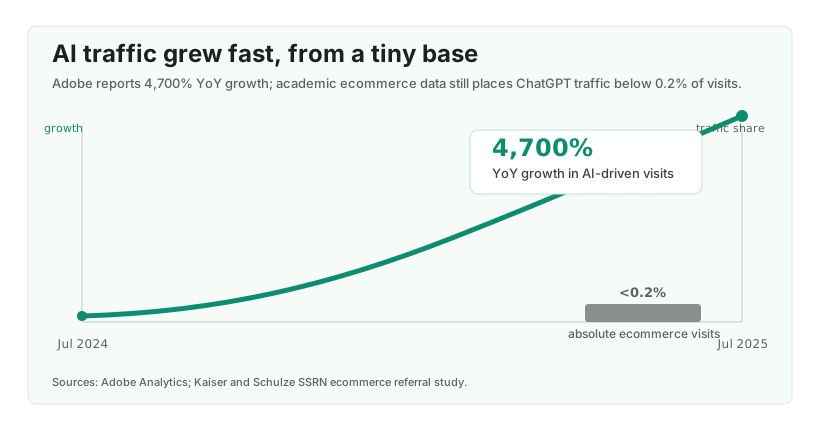
What it means for you: AI search is not replacing your organic, paid, or email channels this quarter. It is a new source of influenced demand that can compound quietly. If your store already has meaningful organic traffic, add AI referrals and AI mentions to the monthly dashboard before you buy tooling.
Where the number comes from: Adobe’s retail traffic analysis is based on large-scale Adobe Analytics data. Kaiser and Schulze analyzed 12 months of first-party ecommerce data from 973 websites, more than 50,000 ChatGPT-referred transactions, and 164 million transactions from traditional channels.
What it does not tell you: Adobe’s growth number does not say that AI referrals are a large share of all ecommerce traffic. The academic study does not cover every product category or every answer engine. Read the two together: fast growth from a low base.
Does AI referral traffic convert?
The useful benchmark is 2.47%, with a caution label. Alhena reports that LLM-referred traffic converted at 2.47% across 329 ecommerce brands, ranking fourth behind SMS, affiliate, and email in its benchmark. That is interesting because LLM referrals do not require a paid click. But independent academic evidence is more conservative: Kaiser and Schulze found ChatGPT referrals converting below affiliate and organic search in their sample.
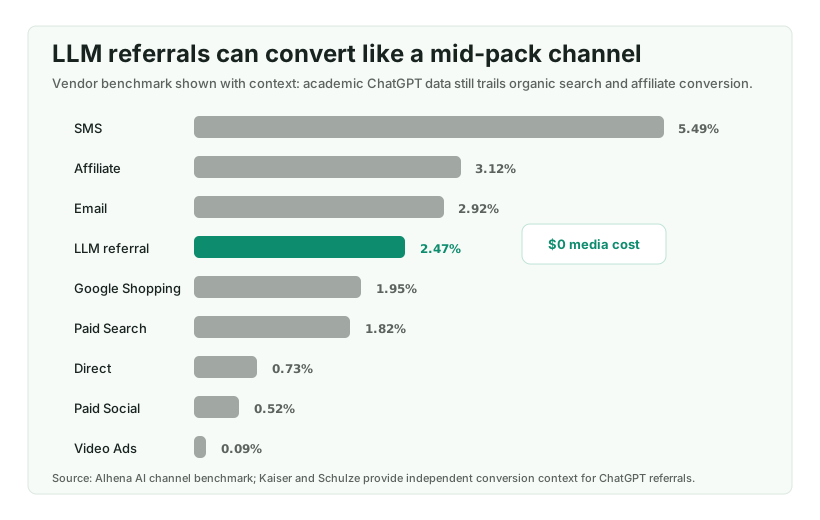
Alhena sells AI shopping software, so its numbers describe its own data environment and should not be treated as a neutral market average. Still, the benchmark is useful because it shows where AI-referred visitors may sit relative to familiar channels. Even if AI traffic converts below email, it may still be attractive if the media cost is zero and the buyer arrives with a clear use case.
What it means for you: measure conversion separately by source. Do not blend ChatGPT, Perplexity, Gemini, Google AI Overviews, and generic organic search into one bucket. Start by tagging AI referrals in analytics, then compare revenue per session and assisted conversions over several months.
What it does not tell you: conversion varies by product complexity, price point, category, and how much of the AI journey happens before the final click. A shopper can ask ChatGPT for a shortlist, Google the brand later, and convert through organic search. Referral data undercounts that influenced path.
Is traditional search declining?
The planning number is Gartner’s 25% forecast, not a settled fact. Gartner predicted that traditional search engine volume would drop 25% by 2026 as AI chatbots and virtual agents absorbed some search behavior. SE Ranking’s review-platform analysis adds a more concrete search-surface signal: Google AI Overviews cited at least one review platform in 34.5% of the AI Overviews in its review-platform dataset.
This matters because ecommerce SEO has always depended on the result page sending a click. AI Overviews, ChatGPT answers, Perplexity responses, and Gemini summaries can satisfy a research query before the shopper reaches your site. That does not kill SEO; it changes the unit of visibility from ranking alone to being cited, named, and described correctly.
What it means for you: keep investing in technical SEO, content clarity, and product schema. Those same foundations help answer engines parse your store. But add off-site trust and answer inclusion to the scorecard. If your category is review-heavy, third-party sources can become as important as your own product page.
What it does not tell you: Gartner’s number is a forecast. It does not mean your store will lose exactly 25% of search demand. Some categories will see faster AI answer adoption; others will remain mostly classic search for longer.
Which AI platforms actually send ecommerce traffic?
Current LLM referral volume is heavily concentrated in ChatGPT. Alhena’s ecommerce sample reports ChatGPT at roughly 97% of LLM-referred ecommerce sessions, with Perplexity at 1.8%, Gemini at 0.8%, and other platforms around 0.4%. Kaiser and Schulze provide an independent scale check: their academic study had more than 50,000 ChatGPT-referred transactions, compared with 164 million transactions from traditional channels.
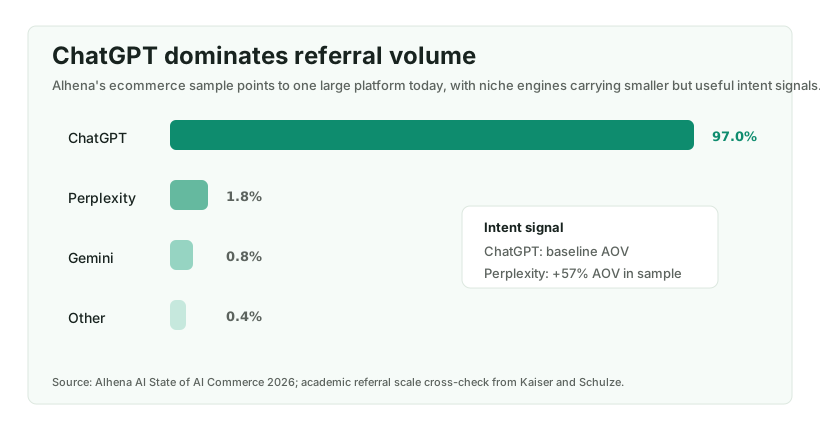
What it means for you: if you only have time for one manual test, start with ChatGPT prompts. Then add Perplexity because it exposes citations clearly, Gemini because of Google’s ecosystem, and Google AI Overviews because they affect the search result page even when referral attribution is hard.
What it does not tell you: platform share is moving quickly. Google AI Overviews can influence ecommerce discovery without showing up as a clean LLM referral. Perplexity may send fewer sessions while attracting deeper research behavior. Use platform share as a starting point, not a permanent map.
What gets cited by AI answers?
Third-party proof is a primary AI visibility asset. Erlin reports that 68% of AI citations come from third-party sources rather than brand-owned sites. Feefo’s review-focused research reports that ChatGPT and Perplexity product answers cite reviews heavily. SE Ranking found review platforms appearing in 34.5% of analyzed AI Overviews that involved review-platform citations.
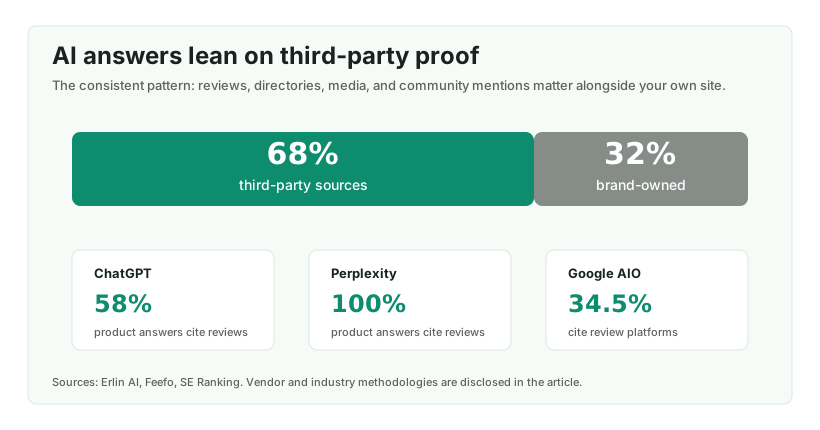
What it means for you: your own site still has to be fast, crawlable, structured, and clear. But the model is also asking, in effect, “Does anyone else trustworthy say this store is relevant?” Independent reviews, comparison pages, community discussions, marketplace listings, and accurate directory profiles all contribute to that consensus.
What it does not tell you: third-party citation share is not an instruction to spam Reddit, fake reviews, or buy thin directory links. Low-quality mentions can create reputation risk. The useful work is earning credible, specific, recent evidence that matches buyer questions.
What do ecommerce consumers say they want from AI shopping?
Consumer demand is real, but different studies measure different behaviors. Adobe reported that 38% of surveyed U.S. consumers had used generative AI for online shopping and that many shoppers use AI for product research and recommendations. Capgemini reported that 58% of consumers had replaced traditional search engines with generative AI tools for product or service recommendations. Capital One Shopping reports high interest in AI-powered shopping assistants.
This is not the same as saying AI search already drives 10% of your store’s sales. Alhena’s 10x revenue-to-reach figure is about on-site AI shopping assistant interactions in its platform data, not about off-site AI search visibility. Keep those two ideas separate: an on-site assistant can increase conversion after the shopper arrives; AI visibility determines whether the shopper finds or trusts you before arriving.
What it means for you: consumers are already comfortable asking AI tools for shopping help. Your job is to make sure the tools can read your products, understand who they fit, and find enough third-party evidence to cite you.
What it does not tell you: surveys are self-reported. People overstate some behaviors and understate others. Treat these as adoption signals, then validate against your own referral, search, and conversion data.
How mature is the AI visibility tool market?
The market is early, crowded, and useful only if you can act on the data. Ecom AI Reviews currently tracks and reviews a growing set of AI visibility and GEO tools for ecommerce, from free Shopify-native monitoring to enterprise answer-engine platforms. Public pricing in our reviewed set ranges from free and low-cost tiers to enterprise contracts above $250 per month. Erlin’s 16% tracking figure suggests most brands still do not have a systematic workflow.
What it means for you: start with the smallest workflow that answers the business question. A manual prompt library is enough for many stores. A free or budget tracker is useful when you want recurring monitoring. Enterprise platforms make sense only when someone owns prompt strategy, source diagnosis, schema fixes, review generation, content updates, and reporting.
What it does not tell you: a tool does not create AI visibility by itself. It can show where you are missing, which competitors are cited, and which sources matter. The actual work still happens in product data, structured content, reviews, third-party mentions, and measurement discipline.
What This Means for Your Store
Act now if at least three of these are true:
- Your store is above roughly $1M ARR and organic discovery already matters.
- Shoppers ask comparison-heavy or use-case-heavy questions in your category.
- Your products depend on reviews, trust, or third-party proof.
- You have someone who can turn findings into schema, content, review, or PR work.
It is safe to wait if most of these are true:
- You are under roughly $500K ARR and still fixing core acquisition, retention, or merchandising.
- You do not yet have clean product data, review collection, or analytics basics.
- You would buy a dashboard but have no one to act on the findings.
For the middle group, the pragmatic move is a monthly baseline. Create 20 to 40 buyer prompts, run them in ChatGPT, Perplexity, Gemini, and Google AI surfaces, and record whether your brand appears, whether the description is accurate, and which sources are cited. That takes less time than a vendor demo and gives you enough evidence to decide whether tooling is justified.
How We Collected This Data
We treated the data as a source map, not a single blended benchmark. Academic research gets the highest weight when it measures real ecommerce traffic and transactions. Industry research and public-company disclosures help with scale and platform trends. Vendor reports are useful, but only with disclosure that the publisher sells products in or near the category. Our own contribution is tool-market tracking: pricing, feature coverage, ecommerce fit, and how these tools map to store workflows.
The biggest limitation is inconsistency. Adobe measures retail traffic at massive scale; Kaiser and Schulze measure ecommerce transactions from a specific dataset; Alhena measures its own customer/platform environment; Erlin measures AI citation patterns from its own tracking data; consumer surveys measure stated behavior rather than observed conversion. These are not interchangeable.
Geography is another limitation. Much of the evidence is U.S. or U.S./EU heavy. Platform behavior also changes quickly: Google AI Overviews, ChatGPT Search, Perplexity, Gemini, Claude, and ecommerce-specific AI shopping assistants are all evolving. This page should be refreshed quarterly, not treated as a permanent market census.
Sources & Methodology
| Source | Type | What we used | Limitation |
|---|---|---|---|
| Adobe Analytics: generative AI-powered shopping rises | Industry / primary analytics | 4,700% YoY AI-driven retail visit growth; consumer shopping behavior signals | Growth rate is not absolute share |
| Kaiser & Schulze SSRN paper | Academic / first-party ecommerce data | 973 ecommerce sites, 50k+ ChatGPT transactions, 164M traditional transactions, low traffic share | Working-paper dataset may not represent every store type |
| Alhena AI State of AI Commerce 2026 | Vendor data | 329-brand benchmark, 2.47% LLM CVR, ChatGPT platform share, on-site AI assistant context | Alhena sells AI commerce software |
| Gartner search-volume forecast | Forecast | 25% traditional search volume decline prediction | Projection, not measured ecommerce outcome |
| SE Ranking review-platform AIO study | Industry research | Review platforms appearing in 34.5% of analyzed AI Overviews | Review-platform-focused dataset |
| Feefo AI search and reviews research | Industry / vendor-adjacent research | Review-source importance for ChatGPT and Perplexity product answers | Feefo sells review technology |
| Erlin GEO trends | Industry / vendor data | 68% third-party citation share; 16% brand tracking gap | Vendor methodology needs independent replication |
| Capgemini generative AI shopping release | Consumer survey | Consumer willingness to use generative AI in shopping | Self-reported behavior |
| Capital One Shopping research | Consumer survey / aggregator | AI shopping assistant interest | Aggregated research page changes over time |
| Ahrefs AI search conversion analysis | Vendor site data | Directional conversion quality signal for AI search visitors | Ahrefs’ own site, not ecommerce-wide |
| Ecom AI Reviews methodology | Own research | Tool count, pricing checks, ecommerce fit, review evidence labels | Our reviewed set changes as the market changes |
Access date for web sources: July 6, 2026. Any number marked as vendor data should be treated as directional until replicated by independent datasets.
Tools That Track These Metrics
The statistics above describe the opportunity. Tools help answer the operational question: does your store appear in the answers your buyers are asking, and what sources cause that result?
If you are starting from zero, begin manually with a prompt library. If the work becomes recurring, compare the trackers we have reviewed in the AI visibility tool matrix for ecommerce. That hub covers free monitoring, first paid trackers, ecommerce-native product visibility, SEO-suite add-ons, and enterprise answer-engine platforms.
Related background: start with What Is AI Visibility for Ecommerce? for the concept, then use How to Do GEO for Ecommerce for the implementation checklist.
FAQ
The FAQ below is also included in structured data so search engines and AI systems can parse the core answers cleanly.
Comments